







Where does Java coffee come from, Bolivia or Indonesia?
Java is a variety as well as an island name. The Bolivian Java offered by Front Street Coffee comes from the Waliki Estate in Caranavi, a six-hectare farm above 1,660 meters. The cold climate lengthens the growing cycle, so sugars accumulate and the brewed cup shows pronounced sweetness with soft citrus acidity and berry notes.
Bolivia is a low-volume origin: local coffee is largely grown by smallholders and mostly supplies the domestic market, which keeps these green coffee bean lots scarce abroad. Lower-altitude Bolivian coffee tends toward a balanced mouthfeel, chocolate sweetness and mild acidity. Light roasting highlights the high-altitude profile, and the article compares it with Indonesian West Java beans.
Although Bolivia is a low-volume, niche coffee-producing country, it produces specialty coffee beans with unique flavors. The Bolivian Java coffee launched by Front Street Coffee comes from the Waliki Estate in the Caranavi production region. The estate covers only six hectares and sits at an altitude of over 1,660 meters. The cold climate extends the growing cycle, which is conducive to sugar accumulation, bringing pronounced sweetness and soft citrus acidity. This article will introduce the varietal characteristics, processing methods, transportation difficulties, and cupping and pour-over performance of Bolivian coffee, and compare it with Indonesian West Java coffee beans, helping readers gain a comprehensive understanding of the unique charm of this niche origin.
For more specialty coffee knowledge, please follow the WeChat public account: Front Street Coffee (FrontStreet Coffee)
Front Street has acquired coffee beans from quite a few countries. We have a good stock of representative beans from major coffee nations such as Brazil, Colombia, and Indonesia. But today Front Street wants to talk about a relatively obscure origin—Bolivian coffee beans.
In the domestic market, Bolivian coffee beans are not common, which is related to their low production. Bolivia's coffee production scale is small and cannot be compared with major exporting countries like Brazil and Vietnam. Local coffee is basically grown by smallholders and mainly supplies the domestic market.
However, a Bolivian Java coffee launched by Front Street Coffee (FrontStreet Coffee) comes from the Waliki Estate. This estate is very small, only six hectares, located in Caranavi, the core production region of Bolivian coffee, at an altitude above 1,660 meters. The climate in this area is relatively cold, so the coffee's growing cycle is extended. A longer growing cycle is beneficial for the accumulation of substances in the coffee, and the sugar content in the fruit gradually increases over time, making the sweetness more prominent after brewing.
Coffee produced in Bolivia's high-altitude areas, in addition to sweetness, also carries soft citrus acidity and berry notes. Coffee from relatively lower altitudes tends toward a balanced mouthfeel, chocolate-like sweetness, and mild acidity.
After Front Street received this Bolivian coffee bean, it used a light roast to highlight its distinctive flavors. Customers of Front Street Coffee (FrontStreet Coffee) often ask about the difference between light-roasted and dark-roasted beans. In fact, the flavor differences among different light-roasted beans are also significant. Generally speaking, light-roasted coffee has more prominent acidity, while medium-dark or dark-roasted coffee has more obvious bitterness. But coffee flavor cannot be judged by roast level alone; the processing method also affects flavor—for example, washed beans have a cleaner mouthfeel, while natural beans have more prominent aroma and sweetness. Front Street Coffee (FrontStreet Coffee) suggests that friends new to coffee can start with washed beans, then try natural beans, and finally gradually transition to estate-level beans.
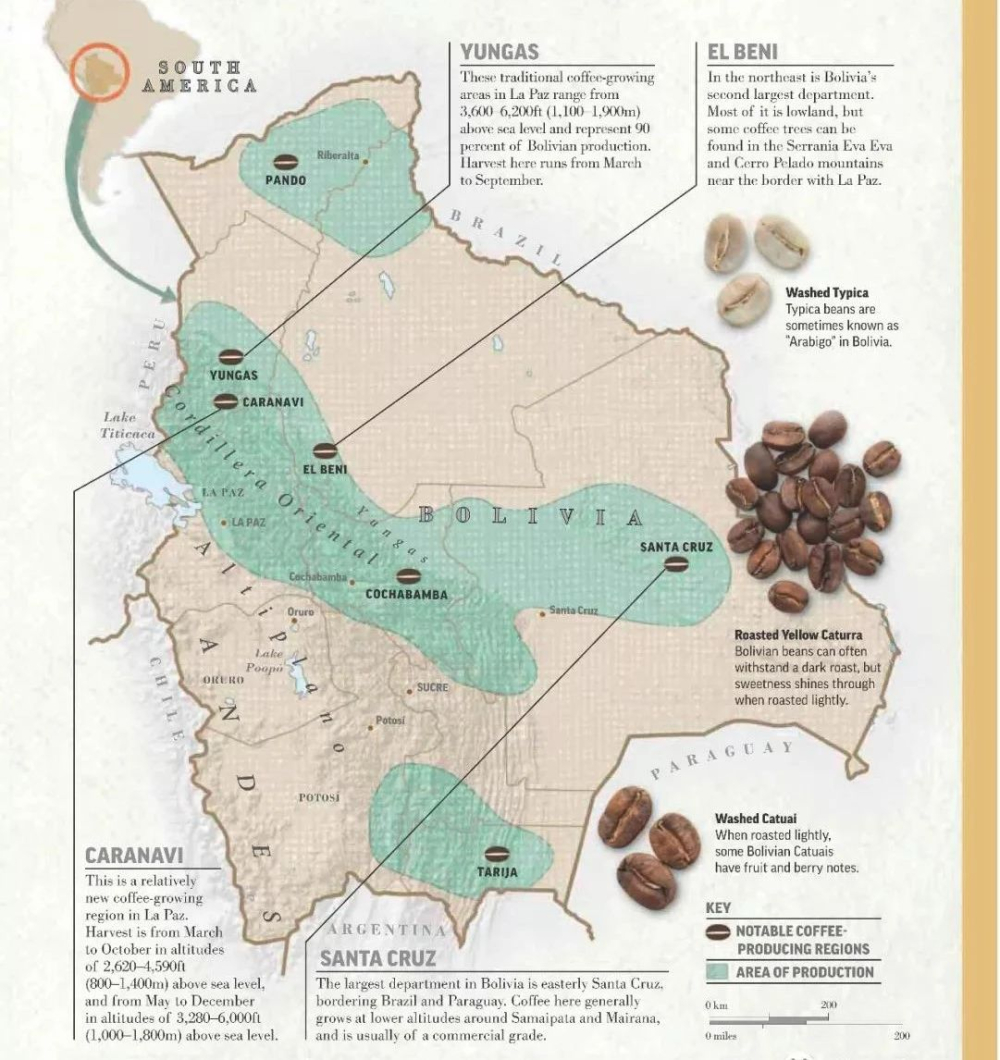
Of course, besides being affected by altitude and terrain, coffee flavor is also closely related to variety. Variety is the gene of the coffee tree; at the moment it is planted, it has largely already determined the general flavor direction of the bean. The varieties grown in Bolivia are mainly Typica, with a small amount of Caturra, but the most special one is Java. This Bolivian coffee bean launched by Front Street is exactly the Java variety. Friends who often read the Front Street public account should know that Front Street Coffee (FrontStreet Coffee) previously introduced a coffee bean from West Java, Indonesia, but that Indonesian one is not the same as Bolivian Java, so don't confuse them.
The Indonesian bean previously introduced by Front Street Coffee (FrontStreet Coffee) comes from the Amani Estate, uses a honey processing method, has obvious sweetness, and flavors close to mango, red wine, and jackfruit. Because the flavor reminds people of a traditional Indonesian snack called Amani, it was named after that snack.
Moreover, its variety is not Bolivian Java either. This Indonesian coffee tree is planted on the island of West Java, and the variety is S-795. It should also be noted that the Java variety of the Bolivian coffee bean launched by Front Street is not grown on the Indonesian island of West Java. Don't confuse the two beans just because the names are similar.

According to Front Street's understanding, Java actually originated in Ethiopia and is called long bean locally in Bolivia because the bean shape is relatively long; its formal name is Java (JAVA). Don't underestimate the Java variety. It has strong resistance to leaf rust, is suitable for smallholder cultivation, and its flavor is also very prominent, not inferior to Geisha.
Bolivia's economic level is relatively backward. Compared with Ethiopia, Ethiopia actually counts as having relatively good economic conditions, let alone compared with major coffee countries such as Brazil and Colombia. This causes Bolivian coffee beans to face transportation difficulties. Bolivia's main production region is the Yungas area, where local infrastructure is very weak and large washing stations are lacking. In addition, transportation in Yungas is extremely inconvenient and is known as the "Death Road." Such road conditions can easily cause coffee cherries to ferment and rot during transport, producing a pungent smell. Front Street believes this situation is very unfavorable for Bolivia's coffee exports.
Bolivian farmers mainly use the washed method to process green beans: put screened coffee cherries into a depulper to initially remove the skin and pulp; place the green beans with residual pulp and mucilage into water and ferment for about 24 hours; after fermentation is complete, put the beans with parchment into a flowing water channel to wash off the pulp and mucilage; after washing, dry them in the sun or with a dryer to reduce the moisture content to about 12%, and finally remove the parchment and store them in the warehouse.
However, other production regions in Bolivia occasionally also use natural processing. Front Street believes that these regions using natural processing may have considered the local cold climate, so many farmers use machine drying instead of sun drying. This processing method is called cocoa natural processing. Front Street believes many people probably have never heard of using a cocoa dryer to process coffee beans. This practice was first used by Pedro of the Rodriguez family, using a cocoa dryer to slowly and continuously dry coffee beans at low temperature, thereby reducing the impact of weather.
The cocoa natural processing procedure is roughly as follows: pick the most mature coffee cherries at optimal ripeness. After selection and weighing, carefully wash the fruit and lay it on African raised beds to dry, turning it once every hour. After one week, place the coffee fruit into a cocoa dryer. Then store the processed green coffee beans in the warehouse.
Front Street has cupped naturally processed Bolivian coffee beans. The barista at Front Street Coffee (FrontStreet Coffee) used a 200ml standard cupping bowl, with a grind size of 70%-75% passing a No. 20 standard sieve, 11.3g of coffee, and a water temperature of 94°C. First grind and smell the dry aroma. The dry aroma of the naturally processed Bolivian coffee beans gives off a hazelnut aroma. Then pour water to fill the bowl and confirm the wet aroma. After 4 minutes, break the crust and skim, then evaluate the flavor. The wet aroma gives off the fermented wine aroma of ripe fruit. Front Street's overall cupping flavor for this Bolivian coffee bean is: at the start, the sweet fragrance of cream and hazelnut; after cooling, more of a sweet-and-sour profile of citrus and tropical fruit, with a bit of fermented wine aroma.
Afterward, Front Street used pour-over to verify the flavor of this Bolivian coffee, because pour-over is relatively simple and can perfectly display the flavor of the origin. Front Street Coffee (FrontStreet Coffee) used a V60 dripper to brew this coffee bean. The V60 conical dripper has a larger hole, and together with its unique spiral curved ribs, it allows air to escape more easily, thereby improving extraction quality. The mouthfeel may not be thick enough, but its high concentration brings sweetness, acidity, and distinct aroma, which is one of its major features. Front Street's brewing parameters are: water temperature 90-91°C, grind size BG#6m (caster sugar size), coffee-to-water ratio 1:15, and 15 grams of coffee.
Front Street's pour-over method uses the simplest three-stage pour. In the first stage, use 30g of water to fully wet the coffee bed into a "hamburger" shape and bloom for 30s; then proceed to the second stage. At 54s on the timer, pour water until it reaches 125g, then stop and wait for the water level to drop to 2/3 of the coffee bed before pouring the third stage (this stage is to extract the sweet-and-sour flavor substances in the coffee grounds); in the third stage, at 1'40" on the timer, pour water until it reaches 225g, with a total extraction time of 2'10". After extraction is complete, gently swirl, and wait for the coffee liquid to be fully uniform before tasting.
The brewing flavor of Bolivian coffee: slight fermentation, grape, slight nuttiness, floral fragrance, medium acidity, juicy mouthfeel.
The above content is compiled by CoffeeHunters, a coffee news website.


