








When Was Coffee Introduced to Europe and How Did Espresso Rise?
Coffee reached Europe around 1580, landing on the Apennine Peninsula through the port of Venice. It first circulated among nobility and, because of its Middle Eastern and Turkish roots, was nicknamed the devil's drink. Pope Clement VIII later gave it approval and the title the drink of God. Europe's first coffee house opened in Rome in 1645, after which coffee spread quickly through Italy.
The coffee machine followed after the Industrial Revolution. In 1884, Angelo Moriondo filed a patent in Turin for a steam-powered coffee-making device, but steam alone made temperature hard to control, so the coffee often came out burnt and bitter. Repeated improvements led to modern extraction. To taste a shot well, stir it, take several sips, and pair it with ice water to appreciate the layers behind the bitterness.
How did espresso evolve from a "devil's drink" into Italy's national beverage? This article traces the complete story of espresso, from its introduction to Italy in the 16th century, to the invention of the steam coffee machine, and the establishment of the modern extraction system, while taking a deep dive into the cultural roots of Italians' preference for dark roasts and heavy body. At the same time, Front Street Coffee will share three practical tips for tasting espresso—stir it, take a few more sips, and pair it with ice water—to help you better appreciate the rich layers and lingering finish hidden behind the bitterness.

For more specialty coffee knowledge, please follow our WeChat official account: Front Street Coffee (FrontStreet Coffee)
The Italian tradition of drinking coffee can be traced back to the late 16th century. Around 1580, coffee beans from Africa and the Middle East landed on the Apennine Peninsula via the port of Venice; at the time, this beverage circulated only among the nobility and upper classes. Because coffee had Middle Eastern and Turkish origins, it was regarded as a "Muslim drink," and many Christian Italians gave it the nickname "the devil's drink."
By the early 17th century, things took a turn. Pope Clement VIII developed a keen interest in this black liquid and held a baptism for it, officially bringing coffee into the category of drinks acceptable for Christians and bestowing upon it the title "the drink of God." In 1645, Europe's first coffee house opened in Rome, and it was also Italy's earliest establishment dedicated to selling coffee. From then on, coffee spread rapidly throughout Italy.
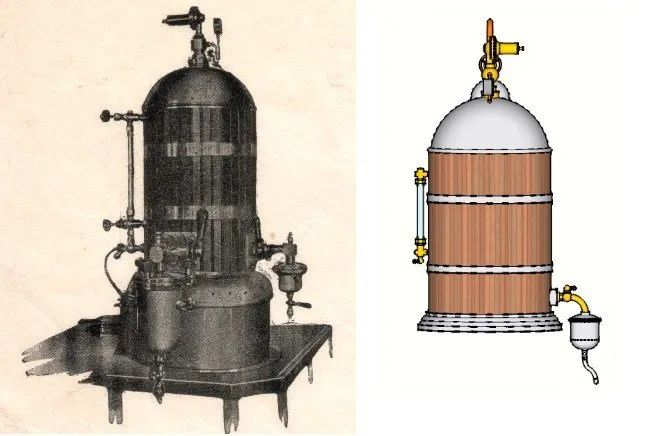
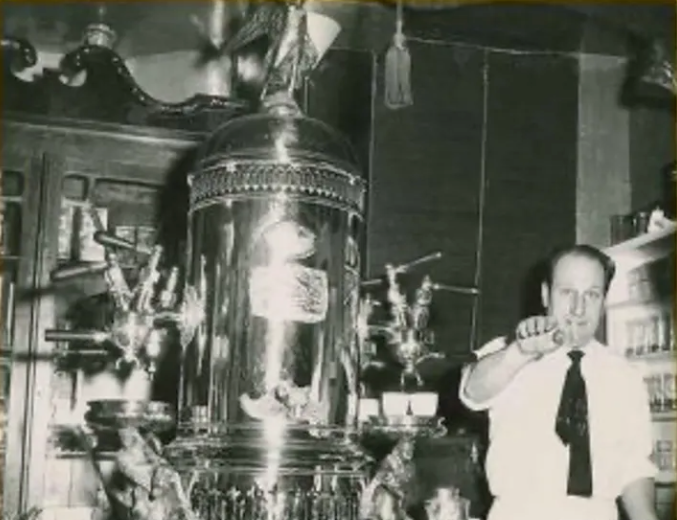
The Italian contribution to coffee was not only a matter of flavor, but also of equipment invention. In the early days, people brewed coffee using old-fashioned Turkish pots, and after brewing they still had to filter it. After the Industrial Revolution arrived, the pace of society accelerated across the board, and Italians were no exception. In 1884, Angelo Moriondo successfully filed a patent in Turin for a steam-powered coffee-making device. But this machine relied entirely on steam, making the temperature very difficult to control precisely, and the extracted coffee was often burnt, bitter, and hard to swallow, so it was later improved repeatedly by many people.
(Angelo Moriondo's Espresso Machine)
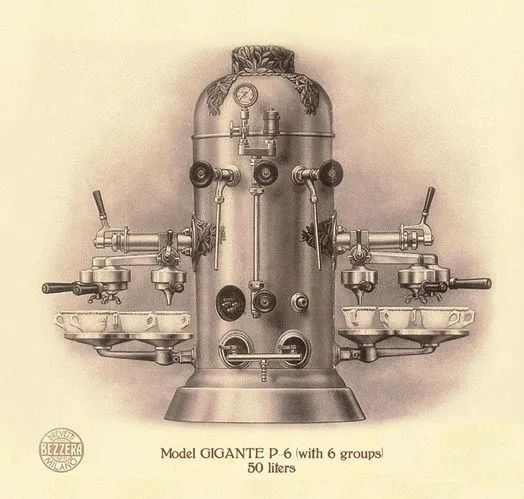
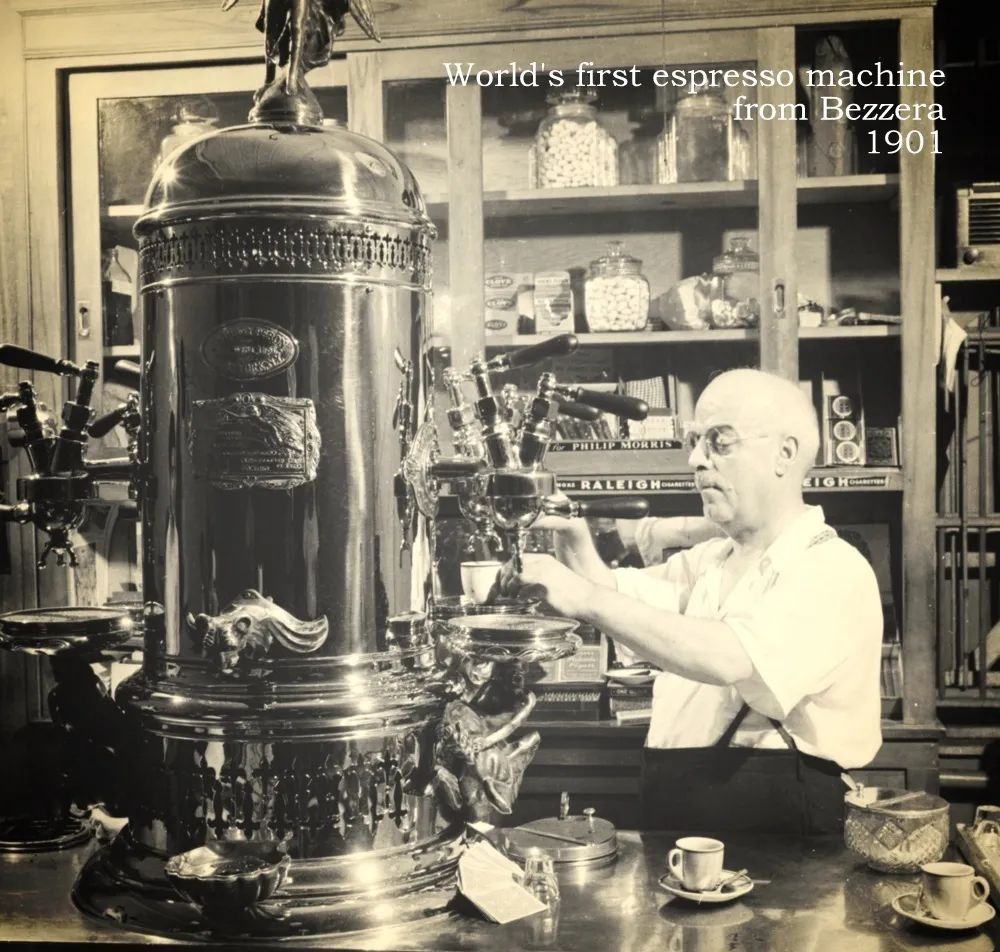
In the early 19th century, Milanese manufacturer Luigi Bezzara improved on the patent and introduced the prototype of the world's first steam-pressure coffee machine. This device featured a detachable handle and a separable group head, and could extract coffee under high pressure in a short time.
(Luigi Bezzera's Espresso Machine)
As the new machines came out and were put into use, more and more Italians became obsessed with this quickly extracted coffee. The word "espresso" was first included in an Italian dictionary around 1920, defined as: concentrated coffee made using a pressure machine or filter.
For people tasting this "quick coffee" for the first time back then, the flavor was not appealing. But when they learned that it was a method of quickly obtaining coffee by means of steam pressure, Italians seemed to be set ablaze with enthusiasm, constantly thinking about how to upgrade and modify this steam-powered coffee machine to make the output taste better.
For example, around 1938, Milanese engineer Achille Gaggia added a lever to the coffee machine, which could sharply raise the water pressure from 1.5 bar to 9 bar. This not only produced a layer of dark brown "crema" on the surface of the coffee, but also made the volume of the solution quantifiable, making coffee quality more consistent.
It is precisely thanks to people's continuous refinement and promotion of these machines that coffee-making methods underwent earth-shaking changes. High speed and convenience became the new standard of service in every coffee shop, and that small cup of espresso gradually evolved into the foundational core of the modern coffee system.
About Italians' heavy taste
As espresso developed into its final form, coffee culture kept pace. Compared with many countries, Italian coffee shops emphasize an efficient, fast-paced atmosphere, which happens to fit perfectly with the small cup of espresso, making it convenient for people coming and going to enjoy it quickly, chat a few words with acquaintances, and then leave. Taking advantage of a brief moment of leisure to go to a coffee shop and order an espresso can be said to be one of Italians' most deeply rooted habits.
Walking into a coffee shop, they will directly tell the barista they want a single espresso; the vast majority are dominated by the bitterness of dark roasting, and robusta is generally added to make the crema richer. Some people add a little yellow sugar and stir before tasting, then down it in one gulp, which is extremely satisfying. A cup of espresso in Italy usually costs only 1 euro, about 7 yuan, making it a very affordable drink.
You should know that in the eyes of most Italians, only espresso is "real" coffee. Compared with lighter-roasted specialty coffees that emphasize single origin, they are more accustomed to rich, full-bodied, heavy, even bitter flavors. It is said that in Italians' belief, coffee "aids digestion" and has nothing to do with staying awake, so after every meal, if there is no cup of espresso, they feel as if something is missing.
It is not hard to see that the reason Italians are so fanatical about espresso is that they stay true to their own cultural roots. As Front Street mentioned above, Italy invented the espresso machine, and this not only made the production of coffee drinks faster, but forever changed the global coffee industry. Therefore, for the Italian people, espresso is an important part of national identity, and it also makes Italy stand out in the world.
Next, Front Street will share with you how to taste the deliciousness of espresso. It is not just about drinking; when tasting espresso, there are many techniques that can help us better experience its deliciousness.
A detailed explanation of the correct way to drink espresso
Tip one: stir
Actually, for many friends, the bitterness they taste from espresso does not all come from the coffee liquid; more of it comes from the crema. Because espresso machines use pressure extraction, espresso carries a layer of golden foam filled with carbon dioxide—Crema, which is what we call coffee crema.
Since the density of crema is far lower than that of the coffee liquid, within just a few seconds after extraction is completed, it all floats to the surface of the coffee liquid. If you do not take a big sip, there is a good chance you will not get much coffee liquid. And it happens that many friends, when tasting it for the first time, tend to tentatively take just a small sip, so they often only get the crema, are stimulated by its bitterness, and then give up on tasting espresso.
If you do not want this to happen, then we just need to take the small spoon that comes with the cup and use it to stir the espresso properly, so that the crema and the coffee liquid can reintegrate. Even if you only take a small sip, you can still drink more of the coffee liquid. And the effect of stirring is not only to let us better taste the coffee itself, but also to let the fine particles attached to the crema blend with the coffee, making the coffee's mouthfeel richer and smoother. Tip two: take a few more sips Just like drinking cola, when drinking espresso, the flavor felt on the first sip is often the strongest. This is because the taste buds are not yet prepared, so when facing a sudden flavor, the sensation they get is often relatively strong and stimulating.
When we taste the second sip, we will find that the bitterness has dropped a lot. As the sense of taste gradually adapts, the perception of bitterness also weakens step by step; at this point we can begin to gradually accept the taste of espresso and start exploring the diverse layers hidden behind it. But note that the interval between sips should not be too long. If there are several minutes between one sip and the next, then forget about it decreasing—the bitterness will instead increase as the coffee temperature drops. Not only that, the crema and flavor will also dissipate, and the experience will be greatly reduced. So espresso generally needs to be finished quickly in a few sips within a short time to prevent the deliciousness from fading. Tip three: pair it with ice water Generally, when coffee shops serve espresso, they include a glass of ice water, but the purpose of the ice water is not to make an americano. Its main function is to rinse the mouth. Before tasting the espresso, we can first take a sip of ice water, which helps us better perceive the deliciousness of the espresso.
Combine them. First First, we take a sip of ice water/room-temperature water.
Then, stir the espresso with a spoon.
Finally, finish the espresso in several sips or one gulp. Note that after swallowing the coffee, we can briefly close our mouths and exhale to feel the aroma and aftertaste of the espresso continuously emanating and lingering in the mouth (this is the soul experience of espresso). After that, continue with the next tasting~
After drinking it this way two or three times, there is a fairly high chance you will become addicted to espresso; otherwise, usually after the first time, you would not try it a second time. But you should know that the above methods can only help everyone better appreciate the flavors hidden behind the bitterness, rather than remove the bitterness, so friends who really cannot handle bitterness had best not try it rashly! Or reduce the bitterness by adding sugar, which is also a very classic Italian way of drinking it~
The above content is compiled by CoffeeHunters, a coffee news website.


