







How Do Jamaican Coffee Bean Grades Separate Blue Mountain From Prime?
Jamaican coffee beans are sorted by growing region and bean quality, which is why Blue Mountain, High Mountain and Prime coffee sit at different levels and prices. Authentic Blue Mountain comes from the Blue Mountain range in eastern Jamaica, where volcanic ash soil, sea air, mist and shade trees create the conditions behind its reputation. A cup can now be found for around 60 yuan, with beans at 158 yuan per 100-gram pack.
To stabilize quality, the Jamaican Coffee Industry Board was established in 1952 and given official oversight of grading and export. Coffee bean grades depend on elevation, bean size and defects, and Blue Mountain No. 1 is the top lot within that system. Local farms also plant coffee alongside bananas and avocados. Brewing Blue Mountain No. 1 with a medium roast and moderate water temperature keeps its balanced acidity and sweetness intact.
Blue Mountain coffee was once hailed as one of the finest coffees in the world, with prices often reaching several hundred yuan per cup, putting it out of reach for ordinary people. Nowadays, enjoying an authentic Blue Mountain coffee is much more convenient. At Front Street Coffee, a cup of rich, aromatic Blue Mountain can be enjoyed for just 60 yuan, and a 100-gram pack of coffee beans costs 158 yuan. How exactly are Jamaican coffee beans classified? What are the differences between Blue Mountain, High Mountain, and Prime coffee? How are authentic Blue Mountain beans graded, how can you tell real from fake, and how should they be brewed to taste best? This article will guide you through the complete classification system of Jamaican coffee beans and the full brewing method for Blue Mountain No. 1.
Before Geisha coffee took the world by storm, Blue Mountain coffee had long held the throne as the world's top coffee. Back then, ordering a cup of authentic Blue Mountain at a café cost at least several hundred yuan, which was hard for ordinary consumers to afford. Times have changed, and today tasting real Blue Mountain is no longer difficult. At Front Street Coffee, you can enjoy a cup of rich, delicious Blue Mountain for 60 yuan, or buy the beans at 158 yuan per 100-gram pack.
The Growing Environment of Authentic Blue Mountain Coffee
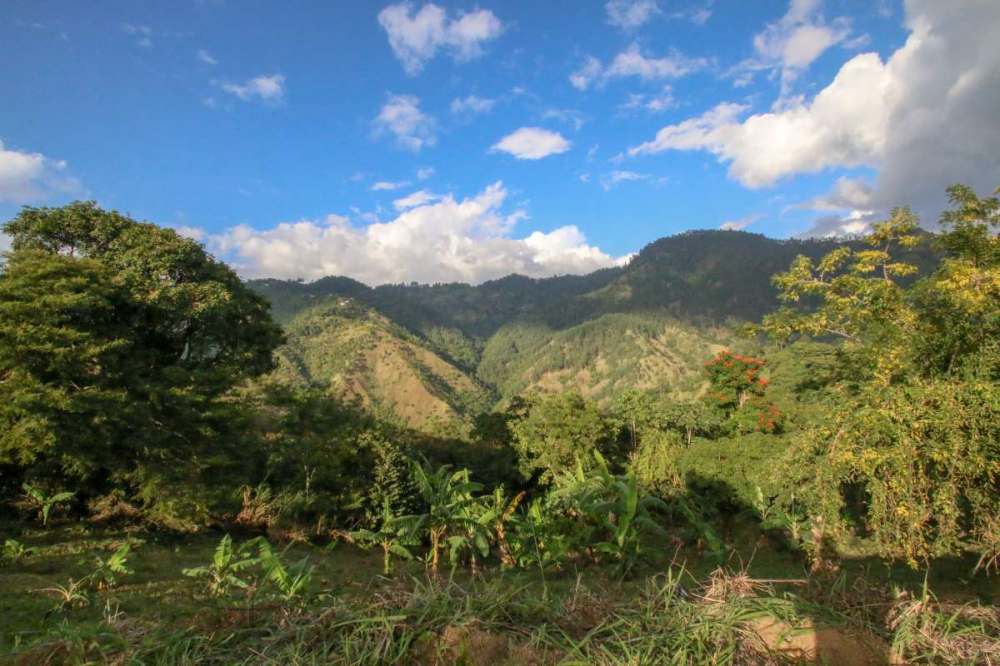
Blue Mountain coffee comes from the island of Jamaica in the Caribbean. The Blue Mountain range in the east is surrounded by sea, and under the sunlight the mountains take on a blue glow, which is how they got the name "Blue Mountain." This area is far from the noise of the city, and its highest peak rises over two thousand meters, making it a well-known local tourist destination. The volcanic ash soil is fertile, with abundant sunlight and rainfall, providing ample nutrients for crops. Locals are also accustomed to planting coffee alongside bananas and avocados. Coffee is more delicate and demanding than other crops—it needs a warm, humid environment without frost and rich nutrients, as well as proper shade. The Blue Mountain peaks are shrouded in mist and clouds year-round, enveloping the coffee plantations and creating exceptionally favorable natural conditions for coffee growth.
To stabilize the overall quality of Jamaican coffee, the government established the Jamaican Coffee Industry Board (CIB) in 1952, granting it official authority to strictly regulate the country's coffee. In 1953, the CIB designated an area of about 6,000 hectares in the Blue Mountain range, accounting for only 15% of total Blue Mountain production, and stipulated that only coffee from this area could be called "Jamaican Blue Mountain Coffee," while products from other areas would be called "Jamaican High Mountain Coffee" and "Jamaican Prime Coffee." Because Blue Mountain coffee has such an outstanding reputation, its price is much higher than the other two categories.
Blue Mountain coffee cultivation areas are distributed across four production regions at elevations of 910 to 1,700 meters (above 1,700 meters is protected forest), including St. Andrew, St. Mary, St. Thomas, and Portland. The CIB cups the coffee produced in these areas, which displays rich aromas of chocolate and nuts, a rounded mouthfeel with virtually no perceptible bitterness, and a perfect integration of various flavors.
It is worth noting that in the 1960s, Jamaica was hit by hurricanes that devastated multiple industries, and the coffee sector was no exception. At that time, the Japanese company UCC extended a helping hand to Jamaica and introduced ecological cultivation methods to the Blue Mountain region. In 1972, Jamaica signed a 30-year contract coordination with Japan, promising Japan priority purchasing rights for Blue Mountain coffee in return for the assistance from Japanese companies. During this period, 90% of Blue Mountain coffee was supplied to Japan, with only a small 10% quota allocated to Europe, America, Asia, and other countries. This also explains why Blue Mountain coffee was so expensive during that era.
How Are Authentic Blue Mountain Coffee Beans Graded?
The CIB was the first organization to use scientific and objective methods to assess coffee quality grades, taking into account green bean size, color, uniformity, defect rate, moisture content, and cupping performance for grading.
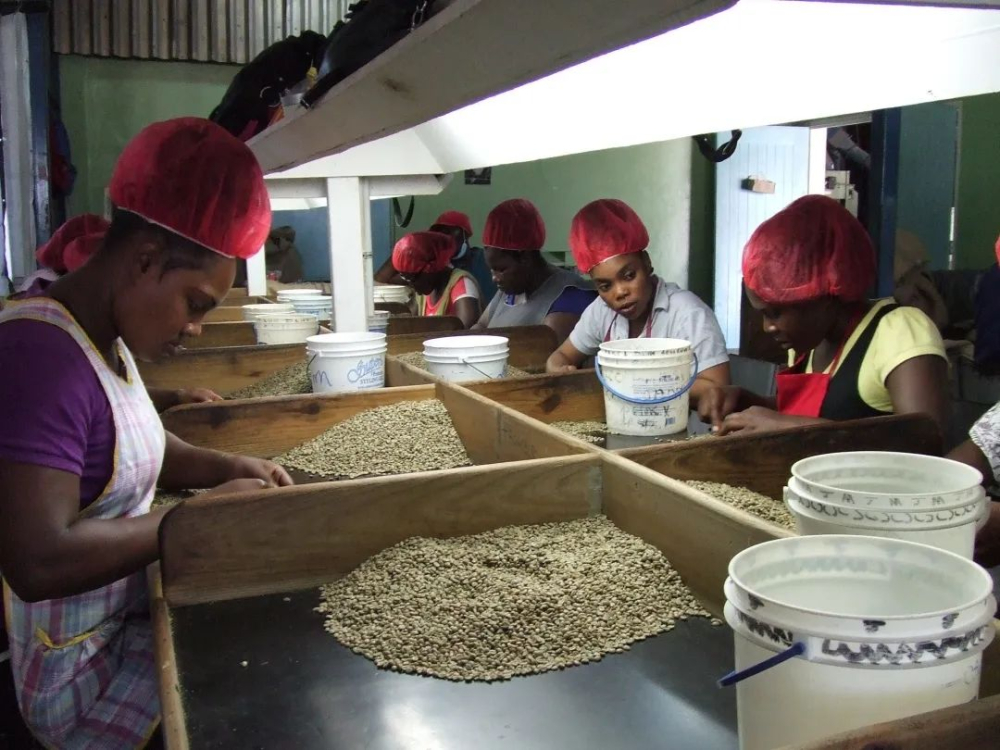
Before export, Blue Mountain coffee beans are packaged and sent for inspection, then graded according to size specifications and defect rate after processing, classified as Blue Mountain No. 1, Blue Mountain No. 2, Blue Mountain No. 3, and Blue Mountain Peaberry. Bean size is measured using screens with different hole sizes; beans that cannot pass through the holes meet the corresponding specification standard. Top-grade Blue Mountain No. 1 green beans must reach a specification of 17 screen or above, have a defect rate below 3%, and a moisture content of about 13%. When cupped, they display a rich coffee aroma, a smooth and balanced mouthfeel, low acidity, and a lasting sweet aftertaste.
To ensure Blue Mountain coffee beans maintain good quality before roasting and to prevent moisture intrusion during transport, Jamaicans insist on using handcrafted wooden barrels to hold Blue Mountain green beans, and the barrel has thus become one of the important symbols of Jamaican Blue Mountain coffee. According to Front Street, this is an imitation of the Bonifieur barrels produced on the island of Guadeloupe last century. These barrels were originally used to hold flour shipped from England to Jamaica, and usually bear a trademark and the manufacturer's name. The Coffee Industry Board issues certificates for all pure Jamaican coffee and stamps an approval seal at the exporter's premises.
Front Street's roasting philosophy is to present coffee's most classic flavor profile—such as the bright lemony acidity of Yirgacheffe, the rich, toasty depth of Indonesian Mandheling, and for Blue Mountain, naturally, to highlight the classic Blue Mountain flavor. Front Street uses a medium-dark roast to maximize the coffee's chocolate and nut aromas while preserving soft acidity and sweetness, bringing the overall taste into balance.
How to Identify Real vs. Fake Blue Mountain?
Precisely because high-quality Blue Mountain coffee is extremely scarce and production cannot meet market demand, some merchants exploit this by labeling low-quality blended coffee beans with the word "Blue Mountain" to mislead consumers. To identify authentic Jamaican Blue Mountain coffee, Front Street has summarized the following points for your reference.
As Front Street mentioned earlier, authentic Blue Mountain coffee comes from specific high-elevation areas, and the labor costs are very high, so the price will not be too low. If the "Blue Mountain beans" you buy cost only a few dozen yuan, there is a strong chance they are fake.
In terms of aroma, Blue Mountain coffee has a rich, dense, and long-lasting chocolate and roasted hazelnut aroma that ordinary dark-roast blends find hard to match. In terms of taste, real Blue Mountain coffee balances acidity, sweetness, bitterness, and aroma, with no single flavor standing out, and its body and sweetness are just right.
If you cannot distinguish it by the above two points, ask the merchant to show Blue Mountain-related certificates and the wooden barrels used for packaging Blue Mountain green beans—Jamaica Blue Mountain is the only production region that uses wooden barrels to hold green beans. Front Street's Blue Mountain No. 1 coffee also comes with a quality certificate issued by the Jamaica Coffee Board, an authorized sales certificate issued by the Blue Mountain coffee producer, and a certificate of origin for Jamaican Blue Mountain coffee. The documentation and handcrafted barrels are all on display at Front Street's store. This Blue Mountain No. 1 from Front Street is produced by Clifton Mount Estate and uses the traditional washed processing method, which is also the most common green bean processing method for Blue Mountain.
How to Brew Authentic Blue Mountain No. 1 Coffee for the Best Taste?
Some friends, after purchasing high-grade Blue Mountain No. 1 coffee beans, don't know how to extract the classic Blue Mountain flavor. Here, Front Street demonstrates a Blue Mountain pour-over procedure based on the store's standard preparation.
For brewing the delicately flavored Blue Mountain No. 1 coffee, Front Street believes freshness is very important. Since roasted coffee beans have an optimal tasting window, once the peak aroma has passed, the flavor becomes very difficult to extract. The beans shipped by Front Street are all freshly roasted within 5 days, precisely so everyone can enjoy the fullest tasting window.
Front Street typically uses a KONO dripper to extract medium-dark roasted coffee beans. The upper part of the KONO dripper is a smooth curved surface that helps the filter paper fit better. Compared with the V60 dripper, its extraction method is mainly immersion-style, which increases the overall concentration of the coffee and enhances its body. Besides KONO, common slow-flow devices such as the Kalita trapezoidal dripper, cake flat-bottom dripper, and flannel are also suitable.
Additionally, considering that medium-dark roasted coffee has undergone a certain degree of roasting, the internal structure of the beans is fluffier than light-roasted coffee, so it absorbs water better. To avoid over-extraction, Front Street chooses a grind size with 75% passing through a No. 20 standard sieve, along with a water temperature of 88°C, paired with Front Street's usual three-stage pouring.
Pour-over parameters: 88°C water temperature, coarse sugar grind size (75% passing through No. 20 standard sieve), 15 grams of coffee beans, 1:15 coffee-to-water ratio, three-stage extraction.
In the first stage, gently pour 30 grams of water for blooming, with a blooming time of 30 seconds. In the second stage, pour until the water amount reaches about 125 grams, circling outward evenly and steadily. Then wait for the coffee liquid to drop; when it has dropped by half, pour the final stage of water up to 225 grams. After all the coffee has dripped through, the total extraction time is generally about 2 minutes.
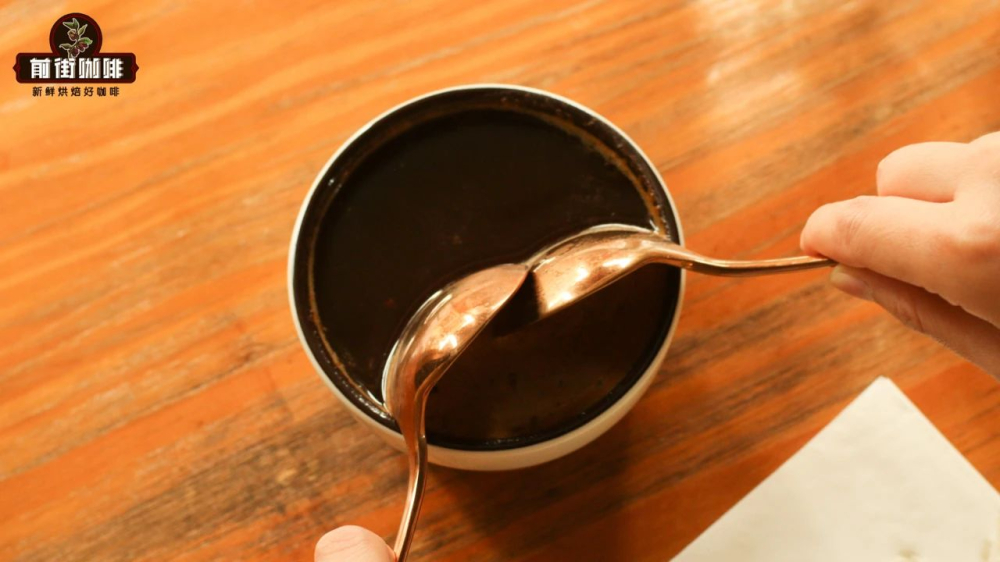
Blue Mountain No. 1 Coffee Flavor: At high temperatures, Blue Mountain No. 1 coffee greets the palate with a dark chocolate aroma, very full-bodied, with a noticeable almond sweetness in the aftertaste. As the temperature drops, roasted hazelnut and creamy sweetness emerge, silky and smooth, accompanied by a hint of soft acidity and caramel sweetness, with the aroma lingering in the mouth.
The above content is compiled by CoffeeHunters, a coffee news website.


