







Why Are Some Coffee Beans Oily and How Does Roast Color Explain It?
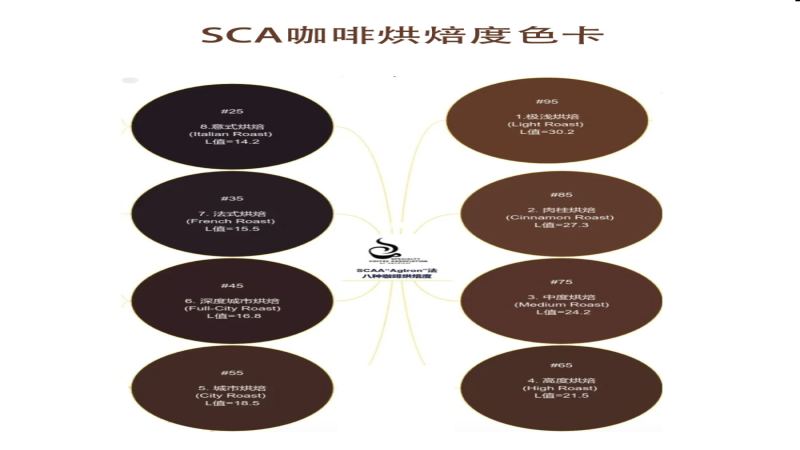
The SCA color card divides roast levels into eight grades, from extremely light to extremely dark, each tied to a bean surface color, weight loss ratio and flavor tendency. Light roasts such as L1 and L2 drop near the end of first crack at 11 to 13 percent weight loss, showing bright acidity with floral and fruity notes but undeveloped sweetness and possible grassy flavors.
Darker roasts push color toward brown and beyond, and this is often why are some coffee beans oily: longer roasting drives oils to the bean surface. Medium-light levels L3 and L4 drop near the end of first crack at about 14 to 16 percent weight loss, keeping citrus and berry acidity while caramel sweetness develops. M0 and M1 are medium roasts with first crack finished and 17 to 19 percent weight loss.
Coffee roasting is the core step that determines the direction of flavor. The SCA (Specialty Coffee Association) color card subdivides roast levels into eight grades, from extremely light to extremely dark, each with corresponding color values and sensory characteristics. This article focuses on this standard color card, explaining one by one each roast level's bean surface color, weight loss ratio, flavor tendency, and suitable applications, while also organizing the causes and identification methods of common green bean defects. The article also includes Front Street Coffee's reference standards to help roasting enthusiasts match color card readings with actual operations, choose the right roasting curve, and make the cup they want.
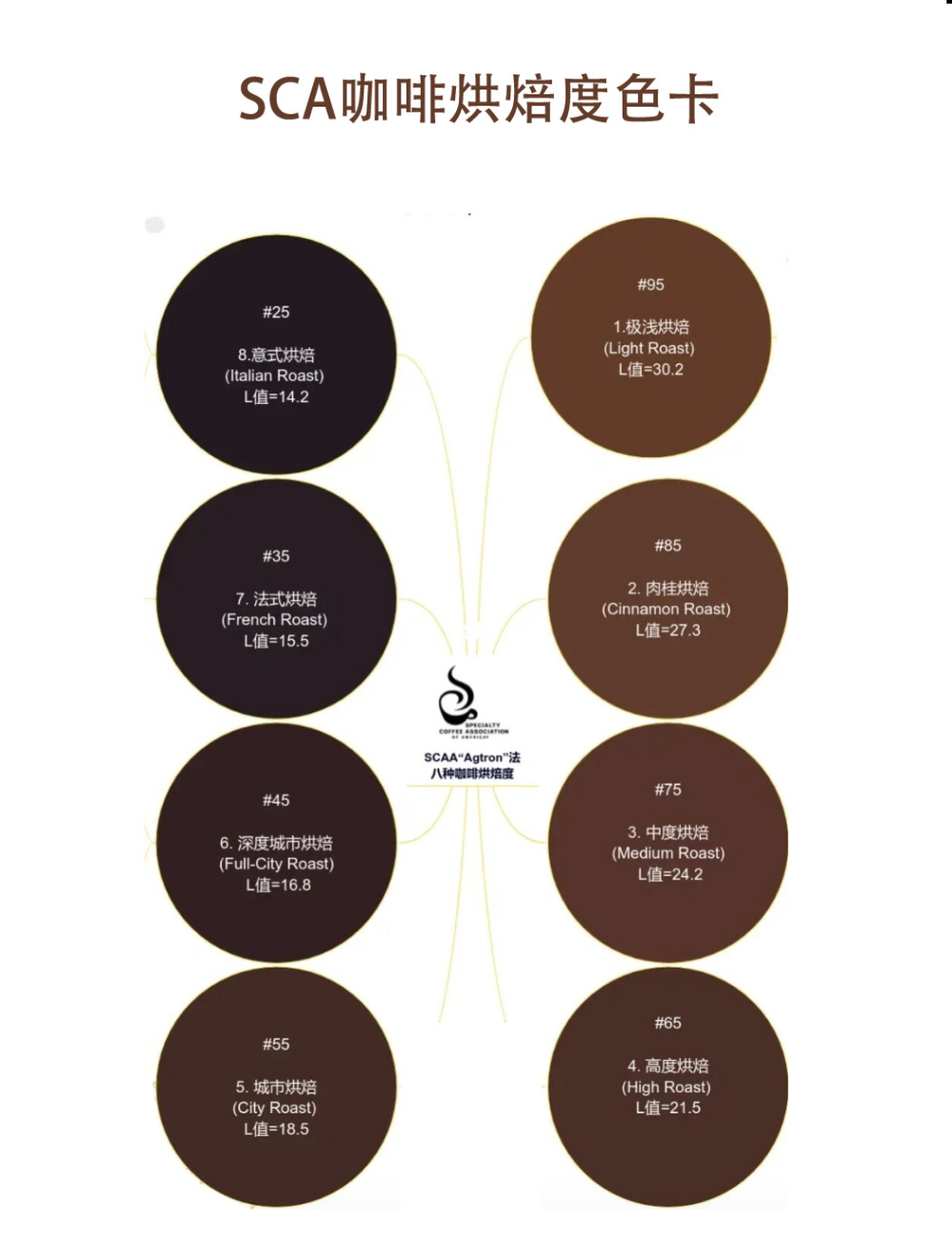
In practice, the SCA color card divides roast levels into eight grades. If that level of detail isn't needed, it can also be compressed into fewer tiers for use. The chart below shows the simplified corresponding relationships.
Let's start with the lightest end. The bean surface colors corresponding to L1 and L2 range from cinnamon to light brown. The beans are dropped just as first crack ends or before it fully ends, with a weight loss rate typically between 11% and 13%. This type of roast has very bright acidity, with prominent floral and fruity notes, but sweetness has not yet fully developed, and it easily brings out grassy, green, and grain-like flavors. In pour-over, if the water temperature is too low, the acidity will seem sharp. It is recommended to extract with higher water temperature and grind finer to enhance sweetness.
L3 and L4 fall into the medium-light roast range. The color value is close to light brown, and the beans are dropped around the end of first crack, with a weight loss rate of about 14% to 16%. The acidity is still active, but bright acidity such as citrus and berry starts to turn in a rounder direction. The sweetness brought by caramelization gradually emerges. This is a commonly used roasting range for many specialty beans to express terroir. Front Street Coffee's Yirgacheffe, Sidamo, and other natural-process beans mostly fall in this range, retaining floral and fruity aromas and fermented sweetness relatively completely.
M0 and M1 correspond to medium roast. The color reaches brown, first crack has completely ended, and second crack has not yet begun, with a weight loss rate of roughly 17% to 19%. At this point, the balance between acidity and sweetness is at its best. Nutty, cocoa, and caramel flavors begin to dominate. It is suitable as an espresso base and also suitable for everyday pour-over. Front Street Coffee's Golden Mandheling, Colombia Huila, and other beans perform steadily at this roast level, with a full body and lingering sweetness.
Going darker, M2 and D1 belong to medium-dark roast. The bean surface appears dark brown, and the beans are dropped when second crack is heard sporadically, with a weight loss rate of about 20% to 22%. Acidity is greatly reduced, bitterness and smoky notes rise, and oils begin to appear on the surface. It is suitable for blend beans or for people who prefer intense flavors. D2, D3, and D4 are dark roast to extremely dark roast. The color approaches dark brown or even becomes oily and shiny, and the weight loss rate can exceed 23%. The flavor is mainly bitter, smoky, and charred, with acidity almost indistinguishable. It is often used as the flavor framework in espresso blends or pursued by lovers of heavy flavors.
It is worth noting that color card readings are only a reference. The same color value may produce very different flavor directions when roasting different bean varieties and different processing methods, so it is still necessary to judge in combination with cupping.
Next, let's organize some common types of green bean defects. These defects can often be identified visually before roasting, but their off-flavors are only fully exposed during cupping.
• Appearance characteristics: dried berries.
• Cupping sensory characteristics: fermented flavor, musty flavor, chemical irritant flavor.
• Cause: incomplete removal of berry pulp, or harvesting dried berries.
Fungus-infected beans
• Appearance characteristics: green beans show yellow, yellowish-brown, or reddish-brown spots, and the spots may have a powdery appearance.
• Cupping sensory characteristics: diverse: fermented flavor, muddiness, musty flavor, earthy flavor, chemical irritant flavor, and other off-flavors, either single or mixed.
• Cause: fungal spore invasion and infection during harvesting, post-processing, and storage, with humid and warm conditions allowing spores to grow, develop, and infect.
Foreign matter
• Appearance characteristics: non-coffee impurities, including twigs, stones, copper plates, etc.
• Cupping sensory characteristics: produces various off-flavors.
• Cause: poor processing
Looking at these defective beans together with the SCA roast color card makes things clearer: if a bean itself carries fermented or musty flavors, no matter which color value it is roasted to, the off-flavors will not disappear; they will only be partially masked by varying degrees of caramelization or charring. So the color card solves the question of "how dark to roast," while "whether it can be roasted" must return to the quality of the green bean itself. Front Street Coffee conducts a round of hand sorting at the bean selection stage, removing obvious defects before moving on to roasting curve design. The purpose is to make the readings on the color card truly reflect clean regional flavor, rather than making repairs on top of defects.
The above content is compiled by CoffeeHunters, a coffee news website.


