







How do you make americano at home?
To make americano, pull a shot of espresso and add water, keeping the ratio of espresso to water roughly one to two or one to three for a balanced cup. Add the water to the espresso for the standard version, or pour the espresso into the water to make a long black, which keeps more crema on top.
The drink dates to after World War II, when U.S. soldiers stationed in Southern Europe diluted espresso with warm water. For iced americano, chill the water and pour it over ice before adding the shot. Whether you keep or skim the layer of crema changes the flavor, since the crema carries oils and a slightly bitter edge.
Americano is the most basic and also the most skill-testing drink on a café menu. Its composition appears to be only espresso and water, yet behind it lies a whole range of topics including its origin story, preparation styles, and extraction techniques. This article will start with the definition and history of Americano, sort out the differences between the Americano and Long Black methods, discuss the controversy over making a weak coffee by running the machine for a long time, and provide specific ratio plans for hot Americano and iced Americano. At the same time, we will also talk about an often overlooked detail—that layer of coffee crema floating on the surface, and exactly what flavor differences removing it or keeping it will bring. Front Street Coffee's hands-on comparison may give you some reference.
What exactly does Americano refer to?
"Americano" (written in Italian as Caffe Americano), by its traditional definition, is black coffee made with a drip brewer. The drip extraction process often lasts four to five minutes, so the resulting coffee flavor comes across as relatively plain.
This kind of coffee has a low barrier to entry, and its main appeal is being effortless, fast, and unrestricted. Compared with espresso, Americano leans toward a lighter, more refreshing mouthfeel and makes it easier for people to taste the original flavor of the coffee beans. However, the Americano sold in cafés today has already deviated from the traditional definition of earlier years. The current method uses espresso as the base, then adds a large amount of water to make a standard beverage that appears on almost every shop's menu.
Since the components of Americano are only espresso and water, the currently popular preparation methods fall into two categories: one is adding water to the espresso, and the other is pouring the espresso into the water. The former is usually called Americano, while the latter is mostly called long black.
How did Americano come about?
Americano appeared after the end of World War II. At that time, after the U.S. military ended its campaign in Europe, a large number of soldiers were stationed in Southern Europe. They were not used to drinking espresso, so they diluted it with warm boiled water. Only when it was diluted to that concentration did they find it drinkable—which shows that espresso was not something everyone loved from the start. Because the people who drank it this way were mainly American GIs, people named it Americano.
In that era, most American households were accustomed to using the filter method to make coffee with a lighter taste. This habit has continued to this day, and the drip brewer commonly found in American homes is therefore also called an American coffee maker. As for the widespread popularity of the practice of diluting espresso with water, Starbucks' continuous global expansion played a significant role in driving it forward.
So, is it correct to let an espresso machine run water for a long time and directly make a cup of coffee with a lighter taste? There are two schools of opinion on this issue. Supporters of traditional espresso hold a negative view, arguing that doing so causes the coffee grounds to be over-extracted, especially in the latter half of extraction, when off-flavors and excessive caffeine are also pulled out together. They strongly disapprove of this operation.
But in today's coffee market, cafés in Australia do exactly this, and it is quite common. Their counterargument is: if this counts as over-extraction, then aren't the extraction times for a French press and a siphon even longer? If so, what problem is there with this method?
For now, let's not compare which of the two methods is superior in taste, because as soon as taste is mentioned, disagreements are inevitable. But one thing needs to be known: weakly flavored coffee obtained through long extraction will have a higher caffeine content than the finished product obtained by diluting a standard espresso with water. Even so, there are still two paths in terms of production order—extract the espresso first and then dilute it with water, or prepare the water first and then pour in the espresso.
How do you make Americano?
Among all kinds of espresso drinks, Americano is probably the simplest one, because it consists of only two parts, espresso and water, while iced Americano adds ice cubes on top of that. But never let your guard down just because it is simple—the more basic the step, the more it can reveal one's technical level. Americano is often the cup of espresso that tests a barista's espresso extraction skill.
Compared with milk-containing coffees such as latte, Americano has no milk interfering with the flavor, so it is the best way to directly experience the characteristics of the coffee beans themselves. Many baristas order Americano when visiting other shops, first because it is quick and convenient, and second because it can be used to judge the other party's quality level.
Back to the main point. As mentioned earlier, Americano only needs two things, water and espresso, and in practice you just pour the espresso into the water. For the espresso part, the extraction parameters should be adjusted according to the characteristics of the beans, and different beans correspond to different plans.
If you prefer a rich mouthfeel, you can try Front Street Classic Espresso Blend. This recipe is composed of beans from three origins: Brazil, Indonesia, and Vietnam. The extracted espresso is rich and aromatic, and the crema is abundant and very fine and dense. Considering the portafilter capacity, the plan used by Front Street is: extract 40 grams of coffee liquid from 20 grams of coffee beans, with the extraction time controlled between 25 and 30 seconds.
When making a hot Americano, first preheat the cup with hot water, then pour hot water into the cup, and finally pour in the extracted espresso. The coffee-to-water ratio for Americano usually falls in the range of 1:6 to 1:8. After repeated testing, Front Street Coffee chose 1:6, that is, 40 grams of coffee liquid paired with 240 grams of hot water.
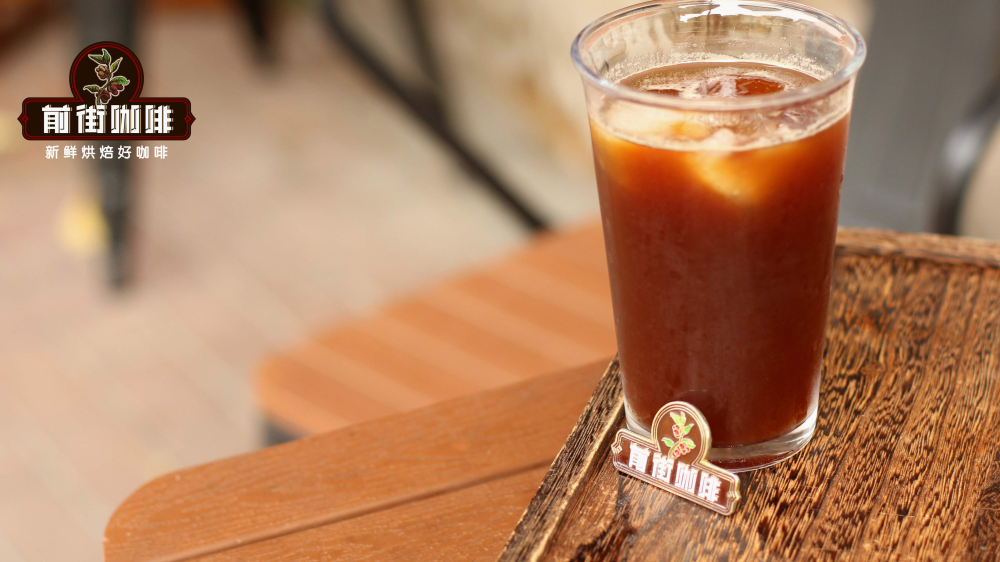
The logic for iced Americano is the same, except that ice cubes are used instead to pre-cool the cup, then water is added, and finally the espresso is poured in. Since ice cubes will also be added, Front Street Coffee's iced Americano uses a 1:7 ratio—40 grams of coffee liquid corresponding to 280 grams of ice-water mixture, of which 180 grams is ice and 100 grams is water.
Does Americano taste better if the crema is removed?
When making a hot Americano, you will notice a layer of foam floating on the surface of the coffee liquid. That is what everyone calls coffee crema. This layer of crema comes from the process of making espresso. We know that espresso consists of three parts: the heart, the body, and the crema. The principle behind crema formation is: under the high-pressure environment of the espresso machine, carbon dioxide is forced into the liquid; after extraction ends and the pressure returns to normal, the carbon dioxide in the liquid begins to escape into the air and is wrapped by the fats in the coffee along the way, and crema is thus formed.
What happens if you remove the crema? Front Street Coffee conducted a comparative test, making two cups of Americano with the shop's Warm Sun Blend coffee beans, one of which had the crema removed as a control. The result was: the cup with the crema removed tasted cleaner and had a smoother mouthfeel; the cup that kept the crema seemed a bit thicker. Both cups had a distinct dark chocolate note and a faint whisky oak barrel aroma, and both had relatively soft acidity, so the difference was actually not that big. If you pursue a clean flavor, removing the crema is recommended; if you need to serve cups continuously, keeping the crema will be more convenient.
The above content is compiled by CoffeeHunters, a coffee news website.


