







How Does the Coffee Industry in Singapore Fit Luckin's Overseas Plan?
Luckin Coffee is planning to enter Malaysia, negotiating with a local listed company and drafting a five-year store expansion plan. The chain already runs more than 20,000 stores in China but only 38 directly operated outlets overseas, all in Singapore. Malaysian netizens have welcomed the news, hoping for low promotional prices, while also expecting sharper competition in the local coffee market.
Rumors point to Berjaya Group, the operator of Starbucks in Malaysia, as the partner, though other sources say talks involve a different company and no official announcement has been made. The push follows a saturated domestic tea beverage market and a first-quarter turn from profit to loss at Luckin, making Southeast Asia central to its strategy after building a presence in the coffee industry in Singapore.
Luckin Coffee plans to enter Malaysia, in talks with a local listed company for cooperation, and has formulated a five-year expansion blueprint. Currently, Luckin has over 20,000 stores in China, with only 38 directly operated stores overseas in Singapore. Malaysian netizens have reacted enthusiastically to the brand's entry, looking forward to discounted pricing, but also concerned about intensified market competition. Rumors point to Berjaya Group, the operator of Starbucks, as the partner, but other sources say the contact is with someone else, and the final decision awaits official announcement. This overseas expansion comes as the domestic tea beverage market is saturated and price wars are intense, with Luckin turning from profit to loss in the first quarter, making Southeast Asia key to breaking the deadlock.
According to foreign media reports, Luckin Coffee (referred to as "Luckin") is planning to enter the Malaysian market, intending to partner with a local listed company to open stores in Malaysia, and has already drafted a five-year store expansion plan. As of now, Luckin has over 20,000 stores in its home market of China, and previously only expanded overseas to Singapore, where it has 38 directly operated stores.
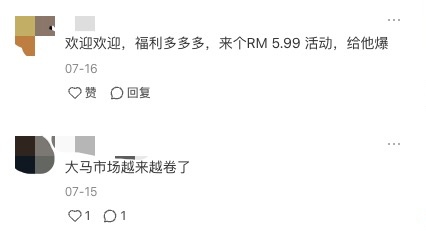
In response to the news of Luckin's upcoming entry into Malaysia, there has been widespread praise online, with local netizens leaving comments on social media expressing hope that Luckin will bring generous benefits. Some suggested launching a promotion at 5.99 yuan, because if priced at 9.9 yuan, it would lack competitiveness compared to Cotti, unless converted to 6.9 yuan based on the exchange rate.
Some netizens believe that Luckin's entry into Malaysia will enrich local consumers' coffee options, but also intensify competition in the Malaysian coffee market, leading to increased industry involution, and ultimately possibly no one making money. Other analysts point out: initially, well-located stores might be profitable, as large companies have capital for advertising and product price advantages, but as the number of stores increases, later-opened ones are likely to incur losses.
According to Malaysian media reports, in the first half of this year, Luckin has been in discussions with Berjaya Group (BJ FOOD), the franchised operator of Starbucks in Malaysia, to explore forming a joint venture to enter Malaysia. It is understood that the founder of Berjaya Group, Vincent Tan, holds the Starbucks coffee franchise in Malaysia and is also the entrepreneur who brought McDonald's to Malaysia.
However, earlier market rumors suggested that Luckin's coffee partner in Malaysia is not Berjaya Group, but another entrepreneur who owns a listed company. Who will Luckin ultimately partner with? It still awaits official announcement.
Looking back at Luckin's overseas expansion history, it dates back to 2019 when the company was still led by founder Lu Zhengyao, and the team planned to launch overseas in the second half of 2020, but it was shelved due to multiple factors such as the pandemic and financial fraud. After Luckin changed management, the new team discussed overseas expansion multiple times but was cautious, researching markets in Southeast Asia, Japan and South Korea, and the United States, ultimately setting Singapore as the first overseas destination.
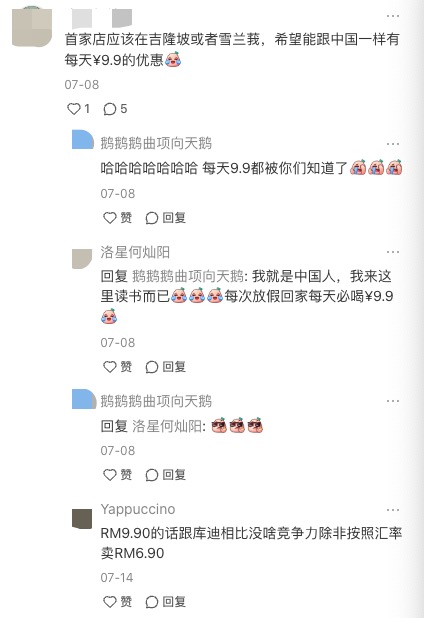
Image of Luckin's Guoco Tower store in Singapore
In recent years, Chinese tea beverage brands have been rushing to expand overseas, and in 2023, the pace of overseas expansion for domestic tea brands accelerated significantly: in August, Heytea opened its first stores in core commercial districts in multiple overseas countries including the UK, Australia, and Canada; in October, ChaPanda opened its first overseas store in Seoul, South Korea; by the end of the year, Mixue Ice Cream & Tea had over 4,000 overseas stores; Chagee had over 100 overseas stores.
Compared to Europe and America, nearby Southeast Asia is often the preferred destination for Chinese tea brands expanding overseas. In 2018, Mixue Ice Cream & Tea opened its first overseas store in Hanoi, Vietnam; in 2019, Chagee made Malaysia its first overseas stop; by the end of 2023, Nayuki Tea re-entered the Southeast Asian market and opened stores in Thailand. In August 2024, Yihetang officially announced the opening of its first store in Jakarta, Indonesia.
The primary reason for Chinese tea brands racing to expand overseas is the slowing industry growth. Currently, it is very common to see several tea brand stores clustered on one street, with numerous homogeneous products and excessive user choices. Although tea companies are pulling out all the stops in new product development, operations, and even price wars, their revenue situations remain grim.
Taking Luckin as an example, media statistics show that in the first half of 2024 alone, Luckin Coffee launched 52 new products (22 in the first quarter, 30 in the second quarter), including Chu Orange Latte, Little White Pear Latte, Full Extract Series, Huangshan Maofeng Latte and other Chinese tea-coffee series, Lemon C Americano, Oat Latte, Light Coffee Lemon Tea, etc. Among them, Little White Pear Latte sold over 7.24 million cups in its first week, and Light Coffee Lemon Tea sold over 5.08 million cups in its first week.
However, Luckin's 20,000 stores and numerous new products did not drive profit recovery. Amid the fierce price war in the tea beverage industry, in the first quarter of 2024, Luckin Coffee's revenue was 6.278 billion yuan, a year-on-year increase of 41.5%; compared to a net profit of 564 million yuan in the same period last year, it reported a net loss of 71.42 million yuan. It is understood that Luckin's significant profit decline is mainly due to the brand's ongoing 9.9 yuan coffee promotion, which lowered the average transaction price of products.
The current factors in the domestic tea beverage market, such as store saturation, slowing growth, and consumption downgrade price wars, have prompted Luckin and other tea brands to turn their attention to the Southeast Asian market, and the destination for this overseas expansion is Malaysia.
Regarding the rumor that Luckin's upcoming partner in Malaysia is actually the Starbucks operator, onlookers are watching with great interest, closely following the imminent coffee war between the world coffee giant and the Chinese coffee giant in the Southeast Asian battlefield of Malaysia. Fans of these two giants in China often clash and belittle each other on social media, but in the eyes of international capital, they are ultimately the same, further confirming the ancient economic wisdom that capital knows no borders.
The above content is compiled by CoffeeHunters, a coffee news website.


