








How does temperature change sourness and sweetness in pour-over coffee?
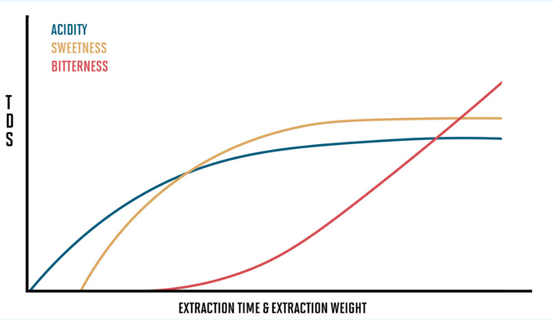
Pour-over coffee tastes different as it cools because the three main tastes shift in intensity. At 50-75°C, heat masks bitterness and dulls sweetness. Between 35-50°C, acidity and sweetness are perceived most keenly and the flavor layers read most clearly. Below 35°C, bitterness rises and sweetness falls.
Bitterness sits highest in human taste sensitivity, so warm liquid briefly hides it before it climbs as the cup cools. Sweetness peaks near body temperature, around 37°C, when the return sweetness is easiest to catch. Light roasts carry more acidity, which itself stays fairly steady as the coffee changes.
When tasting specialty coffee, temperature is one of the most intuitive clues for interpreting flavor. The three tastes in coffee—acidity, sweetness, and bitterness—show distinctly different levels of intensity as temperature changes: high temperatures suppress bitterness and dull sweetness; the mid-temperature range offers the keenest perception of acidity and sweetness, with the richest layering of flavors; low temperatures tend to expose negative flavors, with bitterness rising and sweetness falling. Starting from sensory principles, this article systematically sorts out the key tasting points across three stages—high temperature (50–75°C), mid temperature (35–50°C), and low temperature (<35°C)—and uses two beans, Front Street Coffee Wander Estate Geisha and Front Street Coffee Queen Estate, as examples to fully document their flavor trajectories from hot to cold, helping coffee lovers read a cup of pour-over coffee more comprehensively.

Drinking specialty coffee is similar to tasting wine—both have a set of evaluative logic that can be broken down. There are many angles from which to judge the quality of a cup of coffee, and temperature difference is one of the easiest to start with.
When introducing a certain bean, many baristas often say things like "at the high-temperature stage it presents…, at the mid-temperature stage it turns to…, and at the low-temperature stage it…". The reason for describing it this way is that human taste can perceive five basic tastes—sour, sweet, bitter, salty, and umami—while coffee mainly involves the three categories of acidity, sweetness, and bitterness, and their respective intensities differ at different temperatures.
Bitterness: In the ranking of human sensitivity to tastes, bitterness has always been at the top. High temperatures temporarily suppress the taste buds' perception of bitterness, because the burning sensation when scalding liquid contacts the oral cavity masks part of the bitterness. But as the temperature drops, bitterness gradually rises. Therefore, freshly brewed dark-roast coffee often has the weakest bitterness, and once it cools completely, it becomes hard to swallow.
Sweetness: When the temperature is above 50°C or below 35°C, people's perception of sweetness is relatively dull. Only when it is close to normal human body temperature do the taste buds reach peak sensitivity to sweetness, and it is also easiest to catch the returning sweetness at this time.
Acidity: The lighter the roast, the higher the acidity value of the coffee usually is. Acidity itself does not show obvious fluctuations with changes in the temperature of the coffee liquid, but below 35°C sweetness is no longer active, and some light-roast coffees become especially sharply acidic after cooling.
It is precisely because our perception of acidity, sweetness, and bitterness differs significantly at different temperatures that when Front Street Coffee cups a bean, in order to understand its "ins and outs," it makes an overall judgment in three stages: high temperature, mid temperature, and low temperature.
High temperature (50–75°C)
Freshly brewed coffee usually falls between 65 and 75°C. This temperature is too hot to drink in large mouthfuls; on the one hand it easily burns, and on the other hand high temperature suppresses the tongue's perception of taste, so apart from the aroma brought by roasting, not many other characteristics can be tasted. In fact, some studies point out that different coffees of the same roast level may taste very similar when drunk at higher temperatures.
However, at the high-temperature stage the coffee's aroma is at its richest and fullest, because a large amount of escaping steam accelerates the release of volatile substances, thereby enhancing the olfactory experience.
So it is best to first smell the freshly brewed hot coffee, then wait until the temperature drops to about 60–65°C before taking small sips or slurps. By drinking only a small amount of coffee and drawing in air, the liquid cools rapidly, allowing you to better and more comprehensively feel the coffee's flavor performance.
Mid temperature (35–50°C)
When the temperature is below 55°C, you will clearly feel that both the flavor and aroma of the coffee have changed. The olfactory aroma will weaken somewhat, mainly because part of it has already volatilized during the high-temperature stage, and also because there is less steam after the coffee cools. At this point the coffee has already become palatable, and it happens to be in a temperature range where acidity and sweetness are more sensitive, so more complex and delicate characteristics can be perceived.
So when tasting in the mid-temperature range, we can drink the coffee in large mouthfuls to feel its texture, acidity, sweetness, body, and finish, or hold it in the mouth for 1–2 seconds to feel its weight with the tongue, then swallow and quietly wait for the aftertaste.

Low temperature (<35°C)
When the coffee drops to about 35°C or even room temperature, some negative flavors easily begin to appear, such as grassy notes and woody notes. Therefore, only after tasting the low-temperature range during cupping can you be considered to have the most comprehensive evaluation of a coffee bean. More importantly, compared with the temperature range above 35°C, the cooled coffee has already lost a large part of its aroma, and the taste buds become more sensitive to bitterness while actually becoming less sensitive to sweetness, so the whole cup either "turns bitter" or "turns sour."
Now that we understand the patterns of how temperature changes coffee flavor, let us enter the tasting stage. To make a comparison, Front Street Coffee selected one light-roast bean—Front Street Coffee Wander Estate Geisha—and one dark-roast bean—Front Street Coffee Queen Estate—brewed them normally with the corresponding parameters, and then recorded their flavor performance in three stages from hot to cold.
High-temperature range:
On the nose, Front Street Coffee Wander Estate Geisha gives off delicate sweet aromas of jasmine, lemongrass, and honey; small sips reveal orange-like acidity, low bitterness, and a smooth mouthfeel; Front Street Coffee Queen Estate's aroma is distinctly roasted peanuts and baked bread, with a good sense of balance on the palate.

Mid-temperature range:
The aroma of Front Street Coffee Wander Estate turns into light floral notes and yellow lemon; drunk in large mouthfuls, the sweetness is extremely high, with brown sugar, sweet orange, and yellow peach flavors especially prominent, along with a matcha finish; Front Street Coffee Queen Estate's aroma is still mainly roasted nuts, with chocolate and maple syrup flavors on the palate, a full body, moderate bitterness, and a lasting sweet aftertaste.
Low-temperature range:
Apart from a clear weakening in aroma, the richness of flavor in both pots of coffee also drops substantially. The flavor of Front Street Coffee Wander Estate Geisha remains only at the sweet-sour level of yellow lemon and brown sugar, with a slight tea-like quality; Front Street Coffee Queen Estate offers a clear almond note, higher bitterness, and a hint of smokiness in the finish.
The above content is compiled by CoffeeHunters, a coffee news website.


