








How Is Australian White Coffee Made and Why Is It So Hard?
A flat white, or Australian white coffee, is a milk coffee with no fixed definition: less milk, a thin layer of foam, and a strong coffee flavor. The drink is widely seen as a test of barista skill because small errors in foam thickness or milk ratio turn it into a latte or cappuccino.
Production centers on milk foam thickness, controlled by how long the steam wand takes in air and by the final steaming temperature. A cappuccino needs roughly four to five seconds of air intake and a thick dome, while a flat white calls for a thinner, finer foam, so the coffee production steps leave almost no margin for error.
A flat white is a milk coffee that has no clear definition yet greatly tests a barista's skill. It emphasizes less milk, thin milk foam, and a strong coffee flavor; any slight deviation in any step can easily turn it into a latte or cappuccino. Starting with milk foam thickness control, this article breaks down in detail the air intake time, steaming temperature, integration technique, and latte art difficulties of a flat white, and, combined with the extraction parameters of Front Street Coffee's specialty espresso blend, explains how to make a flat white with rich crema and a mellow mouthfeel.

In barista circles, there is often an unspoken understanding: to judge a café's standard of output, ordering a flat white can reveal the clue. If the flat white is made beautifully, other drinks are likely not bad either. When asked why, they will say: this is the style among milk coffees that most easily exposes problems.
The Most Controversial Espresso Coffee
From its origin to its preparation method, the flat white has never had a unified standard. As to whether it was born in Australia or New Zealand, the two countries still argue endlessly to this day. But for drinkers, it is enough to know that it is a milk coffee from the Southern Hemisphere.
As for its definition, the flat white is likewise vague, so every café has its own "secret recipe." But no matter how it is adjusted, it usually revolves around three cores: less milk, a thin layer of milk foam, and prominent coffee flavor. During preparation, the barista will deliberately reduce the proportion of milk and control the thickness of the milk foam so that the aroma of the coffee beans is more distinct. Therefore, compared with a latte, a flat white has a smaller cup size, a stronger coffee flavor, and a fuller mouthfeel, and can be understood as an "upgraded version of a latte."
Milk Foam Thickness Is Hard to Control
Like lattes and cappuccinos, the milk foam of a flat white is also required to be smooth and fine, but with one additional condition—thin.
Anyone who has steamed milk knows that the thickness of the milk foam depends on the length of time the steam wand takes in air. Cappuccino milk foam is the thickest and needs at least a dome rising 1.5 centimeters above the rim of the cup, so the air intake time is the longest, about 4 to 5 seconds; lattes emphasize a balanced mouthfeel, with milk foam thickness controlled between 0.5 and 1 centimeter, and an air intake time of about 2 to 4 seconds;
while the milk foam of a flat white pursues lightness and thinness, and the air intake time must never be too long, otherwise it easily becomes a latte, and then one cannot feel more coffee crema on the first sip. In order to let customers drink a flat white that is as smooth as cream yet not too watery, Front Street Coffee keeps the milk foam thickness uniformly controlled at 0.3 centimeters when producing it.
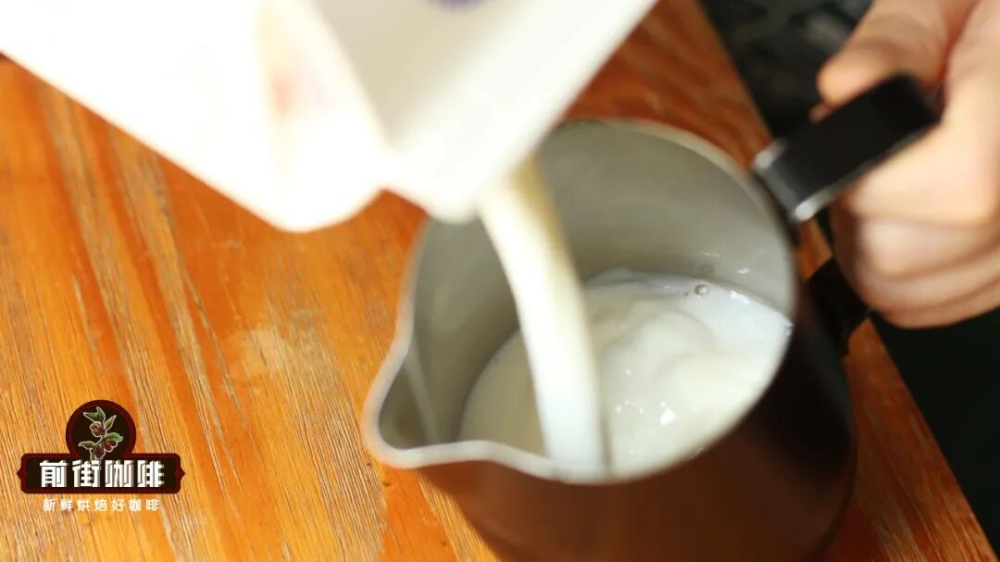
In this case, usually only 1 to 2 seconds of air intake is needed. After hearing two "squeak~ squeak" sounds, sink the steam wand into the milk, then quickly create a vortex and steam the milk until it is dense, until the temperature reaches 50 to 55°C. Because the amount of air intake is small, a relatively sharp sound will be heard during the steaming process. When you swirl the milk pitcher, if the surface of the bubbles appears reflective, it means this milk foam is already up to standard.

When the Milk Foam Is Too Thin, the Difficulty of Latte Art Rises Accordingly
There is a saying inside Front Street Coffee: an editor who cannot do latte art is not a good barista. Even if you cannot make every cup exquisite and beautiful, you must still ensure the pattern is upright and the design is clear before serving. And a flat white is precisely the coffee with the highest failure rate in latte art.
As mentioned earlier, a flat white has the thinnest milk foam, in order to let people better feel the mouthfeel after the coffee and milk are integrated. But at the operational level, the thinner the milk foam, the weaker the supporting force of the upper layer, and during integration the milk liquid more easily sinks to the bottom, while the foam drifts around with the flow of the liquid, ultimately causing the latte art pattern to become distorted.
For this reason, the flat whites made by many baristas usually do not carry complex patterns and are mostly based on simple designs. Only competition contestants or advanced enthusiasts will show off their skills in latte art.
Even Integration of Milk and Coffee
A good dish requires both quality ingredients and a reasonable pairing. Likewise, an excellent flat white first requires good beans and milk that matches them, and second is the degree of integration between the two.
Because a flat white does not have too much milk to conceal it, the coffee flavor is more prominent, so we can immediately feel the quality and characteristics of the beans. Attentive coffee shops will also choose milk according to the style of their own espresso beans, and then through repeated adjustment arrive at the best ratio.
For example, when using Front Street Coffee's specialty espresso blend to make a flat white, we will take only the first and middle segments of a double Ristretto as the base (parameters: 20 grams of coffee powder extracted to 30 grams of coffee liquid, extraction time 22 to 25 seconds), then pair it with 160 milliliters of Bright Dairy fresh milk.
When the espresso and hot milk are both ready, the next step is to integrate the two evenly. Front Street Coffee's method is: first gently pour the hot milk into the coffee, then raise the milk pitcher, maintain a small stream, and use the gravity of the milk liquid to stir evenly in circles on the surface of the crema; then lower the milk pitcher and push out white lines with force. All the steps are done in one continuous motion, and a flat white is then complete.
The flat white made in this way has a smooth surface and a clean pattern, indicating a high degree of integration. Even at the last sip, the latte art is still clearly visible, the drinking temperature is moderate, and you can taste the roasted hazelnut, dark chocolate, and toasted bread flavors brought by Front Street Coffee's specialty blend beans. The rich aroma of the crema is accompanied by a slight sweetness from the milk, mellow but not too bitter, with a rich overall layering.
For more specialty coffee knowledge, please follow: Front Street Coffee (Frontsteet Coffee)
The above content is compiled by CoffeeHunters, a coffee news website.


