








Is iced coffee fattening when brewed as iced pour-over?
Iced pour-over coffee is not fattening on its own. Black iced pour-over contains only coffee and water, roughly two calories per cup, so the drink itself adds no meaningful calories. What raises the count is what goes in the glass: milk, cream, sugar and flavored syrups. Brewed black and unsweetened, it fits a normal diet without weight gain.
The four techniques behind good iced pour-over are the coffee-to-water-to-ice ratio, grind size, pouring method and ice choice. Replace one third of the hot water with ice: 15g of grounds at 1:15 becomes 150g hot water plus 75g ice, so the coffee cools fast, keeps its aroma, and is not diluted into a weak, watery cup.
On a scorching summer day, a glass of iced pour-over coffee brings a refreshing treat. But many people end up with iced pour-over that tastes weak and lacks aroma. How exactly can you make a cup of iced pour-over with full-bodied flavor? This article compiles four key techniques—from the coffee-to-water-to-ice ratio, grind size adjustment, pouring technique, to ice selection—to help you avoid common pitfalls. Front Street Coffee, drawing on everyday brewing experience, offers specific parameter recommendations and a universal formula, so whether you're a beginner or an advanced enthusiast, you'll find practical reference solutions and make iced pour-over more than just hot pour-over with ice added.

The Major Heat solar term has passed, and in the scorching weather, a glass of iced coffee is undoubtedly a great choice for cooling off and quenching thirst. If you like making coffee at home simply and conveniently, and want to taste different flavors, Front Street suggests you try iced pour-over. Coincidentally, Front Street has recently received many questions about iced pour-over, so today we'll walk you through four tips to make iced coffee taste better.
1. Replace one-third of the hot water with ice cubes
Many people think iced pour-over means first brewing a pot of hot coffee, then pouring it directly over ice. Coffee made this way tastes as bland as plain water, with all its flavor lost. In fact, the key to a delicious iced pour-over is "high-temperature concentrated extraction + rapid ice cooling to lock in aroma." The whole process is divided into two steps: first extract a concentrated, full-flavored hot coffee → let the hot coffee drip onto the ice, locking in the aroma, cooling rapidly, and at the same time achieving an appropriate dilution effect.
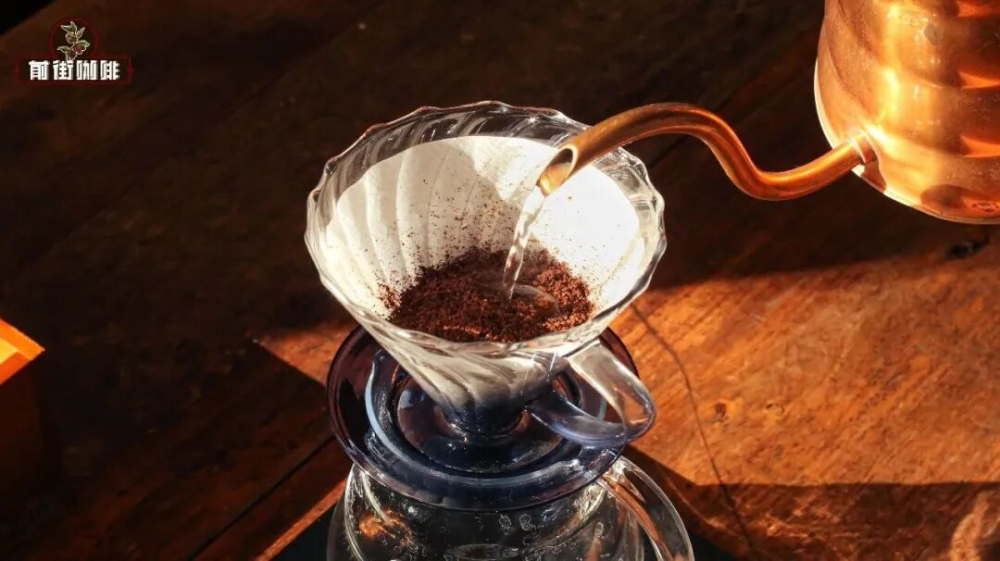
To cool the coffee liquid just right without over-diluting it, Front Street adjusts its parameters based on hot pour-over: replace one-third of the hot water with ice cubes. For example, Front Street's commonly used 15g of coffee grounds with a 1:15 coffee-to-water ratio would normally require pouring 225g of hot water; when making iced pour-over, this becomes one-third ice (75g) plus two-thirds hot water (150g). Similarly, if using 20g of coffee grounds with the same 1:15 ratio, the total hot pour-over water is 300g, and the iced pour-over is adjusted to 100g ice and 200g hot water.
If you don't want to bother with conversions, Front Street has a universal formula you can simply memorize: coffee grounds + 10 times hot water + 5 times ice. Still using 15g of coffee grounds as an example, that means pouring 150g of hot water and 75g of ice. This formula works for most coffee beans and is the recommended approach for beginners trying iced pour-over for the first time.
2. Grind finer
The reason hot pour-over tastes full-bodied is that there's plenty of hot water washing through the coffee grounds, allowing flavor compounds to be fully released. But iced pour-over uses one-third less water, which is equivalent to missing the tail-end compounds, making the coffee prone to tasting thin. So to compensate for the extraction rate, Front Street grinds slightly finer, increasing the contact area between hot water and coffee particles so soluble compounds are released faster.
The adjustment doesn't need to be large. Front Street recommends grinding 0.5–1 notch finer than your hot pour-over setting. For example, for hot pour-over, Front Street uses EK43s-10 for light-to-medium roast coffees like Front Street Fruit Punch, Front Street Panama Geisha, and Front Street Sidra; for iced pour-over, grind finer to 9.5.
For medium-to-dark roast beans like Front Street PWN Golden Mandheling, Front Street Queen's Estate, and Front Street Blue Mountain No. 1, we also uniformly grind 0.5 notch finer for iced pour-over, i.e., using the EK43s-10 grind setting. If you're using a hand grinder, you can simply adjust 1 notch finer.
3. Pour water in small amounts, multiple times
For the same reason as grind size, the pouring technique is also an adjustment to compensate for the extraction time being under two minutes due to the reduced water volume.
For iced pour-over with 15g of coffee grounds, you only need to pour 150g of water. If you pour as usual, the time will be greatly shortened, so you need to change your technique. To keep the total time between 1 minute 45 seconds and 2 minutes, Front Street coordinates by reducing the flow rate and appropriately increasing the number of pours—a total of four hot water pours of "30g-40g-40g-40g." If you find that hard to control, use three hot water pours of "30g-65g-55g."
4. Keep the coffee ice-cold
Many readers have also told Front Street that they bought coffee beans they like, followed this method at home, but the iced pour-over always lacks aroma and tastes thin—in short, it's just not satisfying. Assuming you've ruled out other factors, the problem may lie with the ice cubes.
For everyday iced coffee, Front Street likes to use large, hard ice cubes. The larger the ice cube, the slower it melts, and the less the coffee gets diluted, making the flavor more concentrated. Many people freeze ice cubes at home that are smaller in size and lower in hardness; once they meet hot water, they melt quickly, giving the coffee a "watery" taste.

If you have the means, Front Street suggests freezing more ice cubes regularly and storing them in a clean container. When brewing coffee, you can use the ice-passing method to cool it down—that is, pour the brewed hot coffee liquid over a large amount of ice cubes, rinsing repeatedly several times until it has completely cooled.
The above content is compiled by CoffeeHunters, a coffee news website.


