







How do coffee bean grades differ from country to country?
Coffee bean grades such as AA, G1, SHB and PB are not one universal scale. Each producing country sets its own green coffee bean standards, and the letters mark that country's top tier rather than a shared global ranking. The criteria usually combine defect count, bean size, growing altitude and cup quality, so a G1 Ethiopian bean and an SHB Central American bean are judged on different terms.
No single worldwide coffee grading system exists because growing conditions and farming patterns vary by origin. Ethiopia and Kenya lean on defect rate and screen size, Central American countries often grade by altitude, and Brazil uses its own category names. That is why the same letters can signal different things depending on where the coffee was grown and how it was sorted.
When buying coffee beans, have you ever been confused by combinations of letters like AA, G1, SHB, and PB? They may seem to follow no pattern, but in fact each represents the green bean grading standards of different producing countries. Why do coffee beans need to be graded? Why is there no unified global standard? This article will take you deep into the origins of green coffee bean grading, and how producing regions such as Ethiopia, Kenya, the countries of Central America, Jamaica, and Brazil classify grades based on defect rate, bean size, growing altitude, and cup quality. At the same time, we will also discuss the practical significance of these grades in the roasted coffee market, and recommend several Front Street coffees corresponding to these grades, to help you more clearly understand the cup of coffee in your hands.
A friend asked Front Street Coffee: "Why are some coffee beans labeled AA, some marked G1, and others marked SHB? These letters seem to follow no pattern at all. How should I judge which grade is higher and which is lower?"
Why do coffee beans need to be graded?
When you walk into a fruit shop, you often see the same kind of fruit placed on two shelves. The product name is the same, but the price differs quite a bit. Looking more closely, the higher-priced fruit is plump and appealing, while the lower-priced one is smaller and less attractive in appearance. Agricultural products can hardly be made completely uniform like manufactured goods, and uneven quality is the norm. Therefore, grading standards need to be established to regulate the quality of coffee beans and also to provide a price reference for green bean buyers.
As those friends asked earlier, AA, G1, and SHB are all grades of green coffee beans, but they come from the standards of different coffee-producing countries.
Why is there no unified green bean standard?
Some people may wonder: why can't the world adopt a unified grading standard for coffee beans? This is because each producing country's geographical environment and cultivation patterns are different, so when each country establishes green bean grades, it starts from its own national conditions and adopts standards suited to local conditions, roughly revolving around defect rate, green bean size, growing altitude, and cup quality.
The most representative country that uses defect rate as the main basis for grading is Ethiopia.
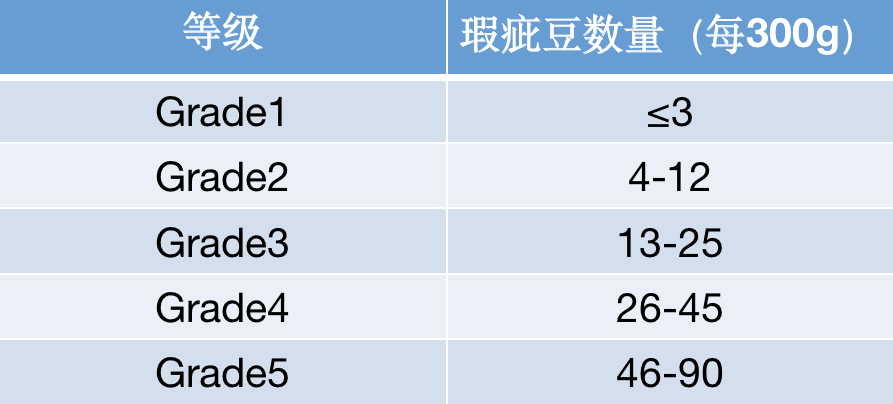
Ethiopia's grading is based on the number of defective beans contained in every 300 grams of green beans. For example, G1 requires no more than 3 defective beans per 300 grams of green beans, while G2 allows 4 to 12 defective beans... Front Street Guodingding Coffee, Front Street Huakui Coffee, Front Street Red Cherry Coffee, and many other Ethiopian beans are all G1 grade.
This is because Ethiopia's coffee cultivation model is relatively primitive, mainly based on smallholder farming, and in the early years rough processing methods led to extremely uneven coffee bean quality. Therefore, grading is based on the number of defects. Batches with fewer defects are higher in grade and naturally sell at a higher price.
Ethiopia has a large number of wild coffee varieties, which are usually collectively referred to locally as heirloom varieties. Among these complex and numerous varieties, some coffee beans are larger and some are smaller, and some varieties, although small in bean size, have good flavor performance, so classifying by green bean volume is not realistic. Ethiopia's terrain is mainly highlands, with high and relatively flat altitude, so grading by altitude is also unsuitable.
The most representative country that uses coffee bean size as a grading standard is Kenya. Although Kenya has many coffee grades, what consumers can actually encounter is usually only AA, AB, and PB. Since the varieties commonly grown in Kenya are SL28 and SL34, theoretically the larger the coffee bean, the better the quality. It is recommended to start by trying Front Street Kenya Little Tomato Coffee.

The PB grade is rather special. PB is the abbreviation of Peaberry, meaning "round bean," referring to a coffee fruit that contains only one seed. Although its screen size is around 14-15 mesh, because of its special shape, after being picked out separately it can be sold at the price of AA (otherwise it would be classified as C grade).
The producing countries that use altitude as the standard for classifying coffee bean grades are mostly concentrated in Central America. Here mountains rise steeply, and the altitude range is large. Moreover, the higher the growing altitude of Arabica coffee beans, the harder the texture and the better the flavor. At the same time, the altitude at which coffee can be grown is not exactly the same in each producing country, so these countries formulate different grading standards according to their own national conditions.
For example, Costa Rica, Guatemala, and Panama all describe grades by hardness, and their highest grade is SHB, but each country has different altitude thresholds for SHB: Costa Rica defines coffee beans grown above 1,200 meters as SHB, Guatemala defines those above 1,350 meters as SHB, and Panama uses above 1,400 meters as SHB.
There are also some producing countries that use multiple factors as the basis for grading. For example, Jamaica's coffee grading system uses both green bean size and altitude. According to different altitudes, it is divided into Blue Mountain Coffee, High Mountain Coffee, and Jamaica Select Coffee; according to green bean size, it is divided into NO.1, NO.2, NO.3... Front Street Blue Mountain Coffee is the highest grade, Jamaica Blue Mountain NO.1.
Brazil's green coffee bean standard is graded according to the number of defects, green bean size, and flavor evaluation. For example, the bag of Brazilian green coffee beans sold by Front Street says "NY2 SC-17/18 Good cup." We recommend buying Front Street Brazil Cerrado Coffee and Front Street Queen Farm Coffee. The NY2 at the front indicates the defect quantity grade. Brazil's highest grade is NY2, and there is no NY1 grade.
SC-17/18 indicates that the green bean size of this bag of coffee beans is 17-18 mesh. "Good cup" refers to the cup quality of the coffee. According to cup quality grading, it can be divided into "Fine cup, Good cup, Fair cup, Poor cup, Bad cup."
Therefore, the items on which each country's coffee bean grading standards are based are not quite the same. In other words, there is no unified standard for judging whether beans are good or bad, nor can green bean grades be used for cross-country comparison. Moreover, these grading standards target the green bean state and are more of a reference for green bean buyers when purchasing coffee beans.
In the roasted coffee market, the influence of these grades is even smaller, because they are almost all the highest grades such as AA, G1, and SHB. At most, only the first two grades of a grading standard will be seen, while the later ones are almost impossible to find. As for what the roasted coffee market considers good beans and poor beans, the price gap at origin is not as large as people imagine.
The above content is compiled by CoffeeHunters, a coffee news website.


