








What Do Different Coffee Particles in the Bed Tell You?
The coffee bed left after brewing reflects grind size, pouring technique, and circling speed. An ideal bed forms an even cone shape with neat walls and loose, honeycomb-like coffee particles. A muddy, flat, uneven, or cratered bed points to an extraction problem that can be corrected with a grind or pour adjustment.
About 70 percent of a cup's flavor depends on bean quality, while the remaining 30 percent relates to water quality and key brewing parameters. That is why fresh, well-roasted beans taste decent under most methods. The article analyzes six typical bed shapes one by one, giving adjustment directions to improve pour-over stability and flavor.
The joy of pour-over coffee lies in its controllability, but beginners often find it hard to judge whether the brew is done properly. Besides tasting the flavor, the coffee bed left after brewing is also a mirror that reflects many details such as grind size, pouring technique, and circling speed. An ideal coffee bed should be an even cone shape, with neat walls and loose, honeycomb-like particles. If the bed appears muddy, like sea salt, uneven, flat-bottomed, or with a断层, it suggests that extraction may have gone wrong. This article combines Front Street Coffee's brewing suggestions to analyze the causes and solutions for six typical coffee bed shapes one by one, helping coffee lovers find adjustment directions from the bed and gradually improve pour-over stability and flavor performance.

Many coffee enthusiasts habitually take a photo of the coffee bed after brewing and send it to Front Street Coffee asking, "Will coffee brewed this way taste good?" In fact, 70% of a cup of coffee's flavor depends on the quality of the coffee beans themselves, while the remaining 30% is related to water quality and several key parameters. That is also why people often say: as long as the beans are good enough and fresh enough, it will taste decent no matter how you brew it.
That certainly makes sense. For experienced people, brewing a satisfying cup of coffee is not difficult; but for beginners teaching themselves pour-over, if they want to quickly judge whether the brew was successful and keep improving on that basis, they need a reference indicator. Front Street Coffee believes that this indicator is first the taste, and second the state of the coffee bed after brewing.
What is a coffee bed? Is it actually useful to observe the coffee bed of pour-over coffee?
Much of the fascination of pour-over coffee comes from its controllability—by adjusting parameters and changing the water flow, the brewer creates dynamic extraction between hot water and coffee grounds, and the coffee bed is exactly the state left after all the hot water has been poured and has drained through.
An ideal coffee bed should have even, neat walls, form a cone shape according to the dripper, be rounded overall, and have coffee particles as fluffy as a honeycomb. If you can consistently achieve this state, it means your pouring technique is already up to standard. Although the coffee bed is not directly related to taste, it can reveal many details in the brewing process, such as coffee grind size, water flow rate, circling speed, bean freshness, and more.
If the coffee you brew is always less than satisfactory and you cannot find the direction for the moment, and the coffee bed is also far from the "ideal state," Front Street Coffee suggests looking for clues in it and checking the causes one by one. Here we need to first reach a consensus: Front Street Coffee's brewing advice for beginners is a coffee-to-water ratio of 1:15, a grind size with a 70-80% passing rate on a No. 20 standard sieve (granulated sugar coarseness), water temperature of 90-93°C for medium-light roasts and 86-89°C for medium-dark roasts, and a total brewing time controlled between 1 minute 50 seconds and 2 minutes 10 seconds.

① Muddy bed
As the name suggests, "mud" means the coffee bed appears muddy, looks wet after brewing, and is mixed with scattered foam. The reason is obvious—the coffee was ground too fine. In such cases, the brewing time usually exceeds expectations, ultimately making the coffee bitter. If you are troubled by this, you can look through Front Street Coffee's sharing on grind size: why the biggest "pitfall" in pour-over is the grind setting.
② Sea salt bed
The "sea salt bed" and the "muddy bed" are the two most common situations beginners encounter when first getting into coffee, because they have no concept of grind size at all and only know that coffee beans need to be ground into powder, with coarseness left entirely to feeling.
This type of coffee bed is exactly the opposite of the first: the particles distributed at the bottom of the dripper are as coarse as sea salt, far beyond the grind size needed for pour-over, and the brewing time will also be shortened, making the coffee prone to under-extraction and lacking aroma. This is either because the grinder setting was adjusted too coarse, or because the grinding equipment itself is not up to standard (such as using a blender to grind powder), and it needs to be adjusted according to time.
③ Uneven bed
Many beginners can actually make the coffee bed form a sufficiently deep pit, but the flaw is that the coffee wall will be partially sunken and partially raised. This is because the water stream is not poured vertically, causing the flow to lean forward; especially the direction the gooseneck kettle faces receives more force, so it sinks, while the positions not hit by the stream bulge up. If the coffee you brew always lacks clarity in flavor and tastes rather dull, and the coffee bed is uneven, then pay attention to adjusting your pouring technique so that the hot water lands more evenly.
④ Flat-bottomed bed
A flat-bottomed bed mainly appears as a level coffee bed, with almost no coffee grounds clinging to the upper part of the dripper. This situation usually happens because when pouring, you are used to pouring onto the edge of the dripper, washing all the originally piled coffee grounds down. This not only makes it easy for the hot water floating on top to escape along the edge, but the coffee grounds compacted at the bottom center will also be under-extracted, and the taste is often lacking.
If this shape often appears after you finish brewing coffee, it is best to adjust your circling technique during the later pouring stages, keeping the water flow landing point concentrated within the circle, and making sure it does not exceed the height of the previous brewing stage, so that the hot water is always "wrapped" by the coffee grounds.
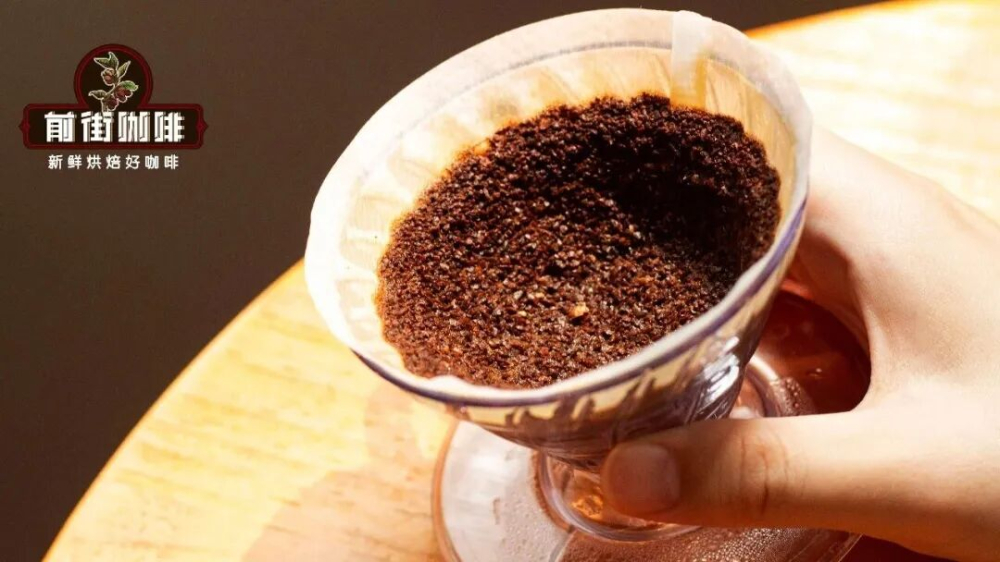
⑤断层 bed
There are usually two forms of断层. The first is common among more cautious friends: they are used to circling in a small circle with a small water flow, constantly striking the center in a straight line, while the coffee grounds on the outside not washed by the water flow cling to the edge of the filter paper, forming a thick wall. This leads to an imbalanced performance with a high extraction rate in the center and a low extraction rate around the sides, and the taste ends with "the bitter parts bitter, the sour parts sour."
If you want to bring out the flavor of the coffee while also keeping it safe and stable, Front Street Coffee suggests that after blooming ends, continuously expand the circling range from the center outward. As the water level rises, use the water stream to rinse the entire coffee layer, trying to extract the coffee grounds evenly. As the liquid level rises, fewer and fewer coffee grounds will be able to cling to the filter paper. When the liquid level reaches 3/4 of the dripper, divide the pour into stages; when the coffee bed is almost exposed, pour in circles along a radius at 1/2 of the liquid surface, and be careful not to exceed the water level of the previous stage.
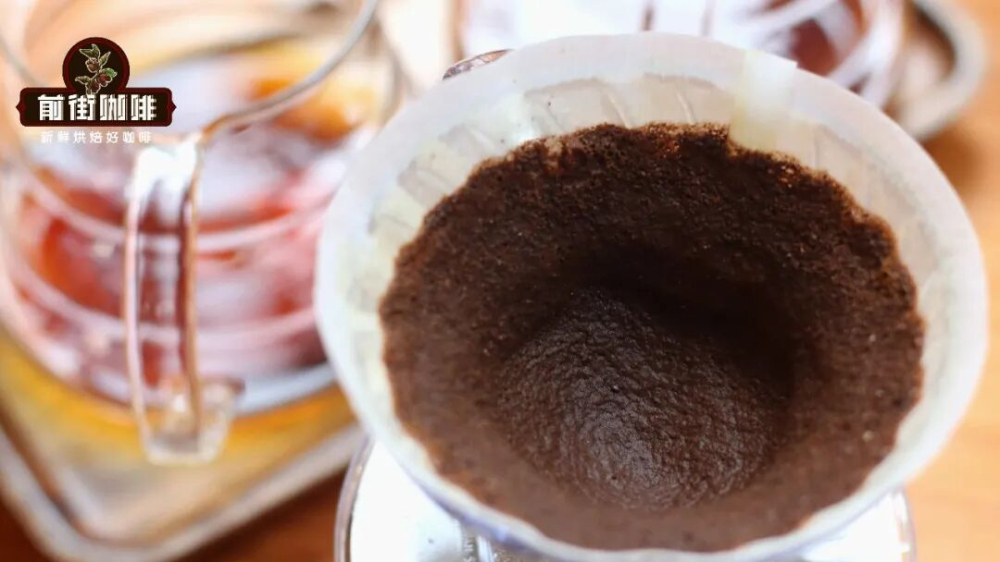
⑥ Coffee wall断层 bed
This kind of断层 appears as a split in the coffee wall: although the coffee grounds in the dripper have built up to a certain height, the connection between the coffee wall and the bottom is clearly broken into two sections. This situation usually happens because when circling the outer ring, the water flow is larger and the impact force becomes stronger, directly hitting the coffee wall, and the place that is broken through "makes way" for the hot water, leading to insufficient extraction. For specific solutions, you can refer to this Front Street Coffee article, "Why does the coffee bed split into two sections after brewing?"
The above content is compiled by CoffeeHunters, a coffee news website.


