







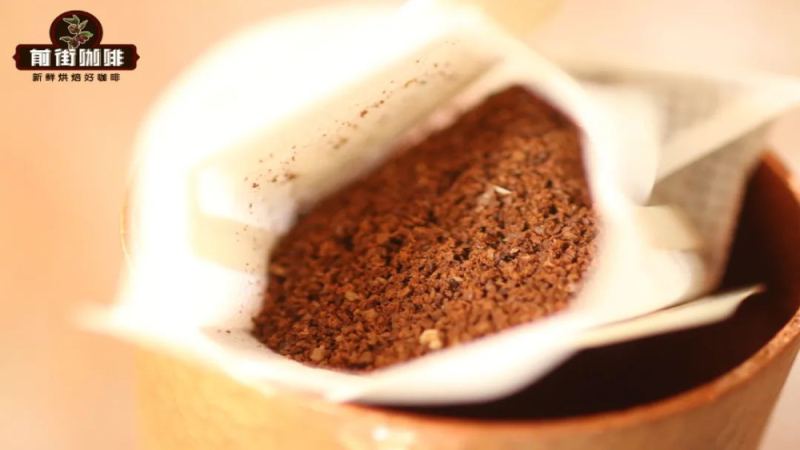
Which beans suit classic coffee drinkers using drip bags?
Drip bag coffee is black coffee made simple: pre-ground beans sealed in a filter bag, extracted with hot water into a cup you can drink straight or with milk. Yamanaka Sangyo Co., Ltd. of Japan developed the format in 1990, drawing on stringed tea bags, and a patent registered in 2002 helped it spread worldwide. Front Street drip bags hold 10g each and yield about 130 to 150 ml.
Because the bag controls grind and dose, the choice of bean matters more than technique. Single-origin options such as PWN Golden Mandheling, Brazil Cerrado Red Fruit, and Yunnan Small Bean each bring a different profile, from earthy and full to fruity and bright, so office, home, and outdoor brewing can be matched to preference.
As a convenient representative of the black coffee family, drip bag coffee allows you to enjoy a cup of freshly ground-quality coffee anytime, anywhere with just a pot of hot water and a cup. It was first invented in 1990 by Yamanaka Sangyo Co., Ltd. of Japan, with a design inspired by stringed tea bags, and after being patented in 2002, it quickly became popular worldwide. Front Street Coffee's drip bags are made to a 10g per bag specification, yielding about 130 to 150 ml of coffee liquid, just right for single-person consumption. This article will systematically introduce the origin, advantages, and disadvantages of drip bag coffee, and based on different taste preferences, share several single-origin coffee beans from Front Street's bean list that are suitable for making drip bags, including PWN Golden Mandheling, Brazil Cerrado Red Fruit, and Yunnan Small Bean, helping coffee lovers easily achieve coffee freedom in the office, at home, or outdoors.
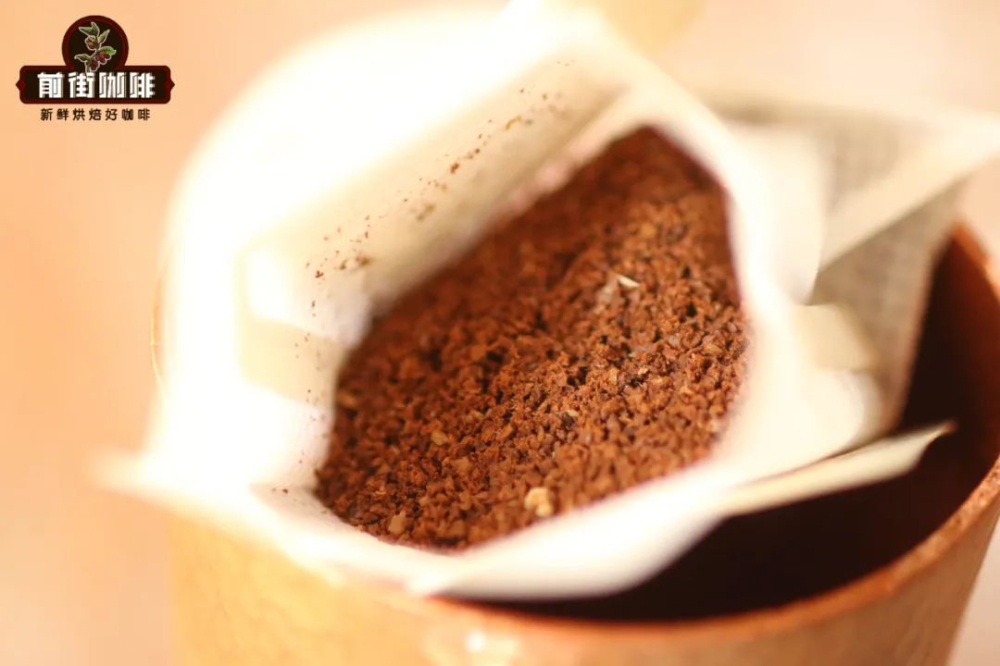
For more specialty coffee knowledge, please follow the WeChat public account: Front Street Coffee (FrontStreet Coffee)
First, let's be clear: drip bag coffee falls within the category of black coffee. Its method is to pre-grind coffee beans into powder, seal them in a filter bag, and then extract the flavor components with hot water, ultimately obtaining a cup of black coffee that can be drunk directly or with milk added for flavoring. The drip bags produced by Front Street are uniformly made to a standard of 10g per bag, capable of extracting about 130 to 150 ml of coffee liquid, just enough for one person to enjoy.
Who invented drip bag coffee?
In 1990, Yamanaka Sangyo Co., Ltd. of Japan was the first to develop drip-style coffee. The product was inspired by stringed tea bags, and the inventor wanted to mimic the effect of pour-over drip coffee, so the coffee powder was pre-ground and placed into non-woven filter bags, with paper tabs on both sides of the filter bag allowing the coffee bag to hang securely right above the cup. Because those two paper tabs rest on either side of the cup rim like little ears, people habitually called it "drip bag coffee."
By 2002, a Japanese company officially registered the drip bag coffee packet as a patent and brought it to market for sale. This simple and convenient design quickly took a mainstream position, and the Chinese market was no exception.
The threshold for brewing drip bag coffee packets is very low—just a pot of hot water and a cup is enough, and after brewing you simply throw away the filter bag along with the coffee grounds, saving many troublesome steps. With the advancement of the specialty coffee wave, the variety of coffee beans available has become increasingly rich, and they can all be made into drip bags. Taking Front Street's bean list as an example, dozens of single-origin coffees on it can all be made into drip bags, allowing people to achieve coffee freedom in various settings such as the office, park, or home.
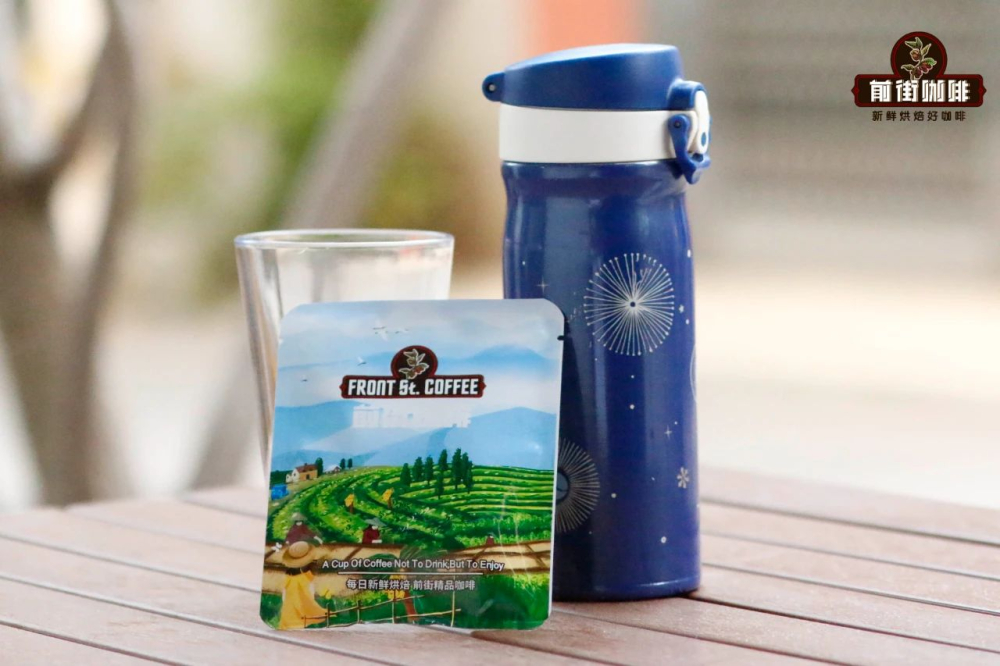
The advantages and disadvantages of drip bag coffee
Whether in the office, at home, or outdoors, as long as you have hot water and a cup on hand, you can easily get a cup of rich, aromatic coffee, with all cumbersome steps omitted. As the specialty coffee industry continues to grow, there are many varieties of coffee beans, all of which can be used to make drip bags, offering considerable choice.
Compared with pour-over extraction, drip bags do not require complex equipment, and the pouring technique, timing, and ratio do not need to be controlled as precisely as with pour-over—just ensure the water temperature is high enough and the coffee-to-water ratio is appropriate. However, precisely because the operation is more "casual," the flavor layers of drip bag coffee are usually not as rich and varied as pour-over coffee; moreover, since drip bags are pre-ground and pre-bagged, the aroma is naturally not as full as freshly ground coffee. If stored too long, beyond several months, it may even develop a woody taste. Therefore, Front Street recommends drinking drip bags within one month of receiving them.
Many office workers ask Front Street to recommend coffee beans suitable for making drip bags. More than fifty single-origin coffee beans from different producing regions on Front Street's bean list can all be made into drip bag coffee packets, and everyone can choose according to their own taste preferences:
Front Street PWN Golden Mandheling Drip Bag Coffee Beans
Mandheling coffee has continued to gain attention over the past two years. In the past, Front Street Coffee (FrontStreet Coffee)'s Mandheling sales were mostly concentrated in the Shanghai area; Shanghai and Taiwan have quite similar taste preferences, both favoring a rich and full-bodied style. Previously, Front Street Coffee (FrontStreet Coffee) also encountered a Shanghai customer who repeatedly emphasized that the Mandheling should be roasted even darker than our regular dark roast. Nowadays, more and more people are beginning to recognize Mandheling's unique flavor, and the number of customers ordering Mandheling in Front Street Coffee (FrontStreet Coffee)'s stores is also increasing day by day, many of them Guangzhou locals.
This Front Street PWN Golden Mandheling is different from ordinary Mandheling. It comes from the local Indonesian green bean trader PWN, the very company that first partnered with Japan on Golden Mandheling and registered Golden Mandheling as a trademark. The most prominent feature of Front Street PWN Golden Mandheling is that it lacks the off-flavors of ordinary Mandheling. After three rounds of strict manual sorting, the bean size is uniform and consistent, and the color during roasting is also more even, so the taste presents a clean, full-bodied feel, with a flavor resembling Guangdong herbal tea. It is no wonder Guangzhou locals can accept this flavor. Front Street Coffee (FrontStreet Coffee) has specially launched Front Street PWN Golden Mandheling drip bags this time precisely because it has noticed that people's acceptance is continuously increasing.
Front Street Brazil Cerrado Red Fruit Drip Bag Coffee Beans
Brazilian coffee beans were first introduced from French Guiana (located in northern South America) in 1720. At that time, Brazil was a Portuguese colony, while most other South American countries were Spanish colonies, so most South American countries speak Spanish, while Brazil speaks Portuguese.
A Portuguese military officer stationed in Brazil, in order to introduce Guiana's coffee beans into Brazil (at the time, the outflow of coffee to other countries was strictly prohibited), managed to win the heart of the governor's wife of Guiana and successfully brought coffee seeds into Brazil. After that, coffee quickly adapted to the environment in Brazil, spreading from the north all the way to São Paulo state in the southeast. By 1845, Brazilian coffee beans accounted for 45% of the world's total coffee beans. Today, Brazil is the world's largest coffee exporting country.
Front Street Coffee (FrontStreet Coffee) not only includes Brazil in its drip bag series but also features Brazilian coffee in its Front Street daily bean series. This shows that Brazil, as a coffee-producing country, occupies an indispensable position in classic coffee flavors. Front Street daily beans can be called the "face" of regional coffee beans, because their basic regional flavor is highly recognizable and they are also a low-price, high-value choice.
Front Street Yunnan Small Bean Drip Bag Coffee Beans
Yunnan coffee mainly cultivates two varieties: Typica and Catimor. Because the coffee beans are relatively small, it is also called "small bean coffee." The local area mainly plants the Catimor variety, a hybrid created by the Portuguese by crossing Timor and Caturra, with the aim of improving disease resistance and yield. Catimor does not have pure Arabica lineage, because Timor belongs to the Robusta variety; although crossed with Caturra, it did not inherit Arabica genes, so its flavor is relatively flat with a more prominent bitterness.
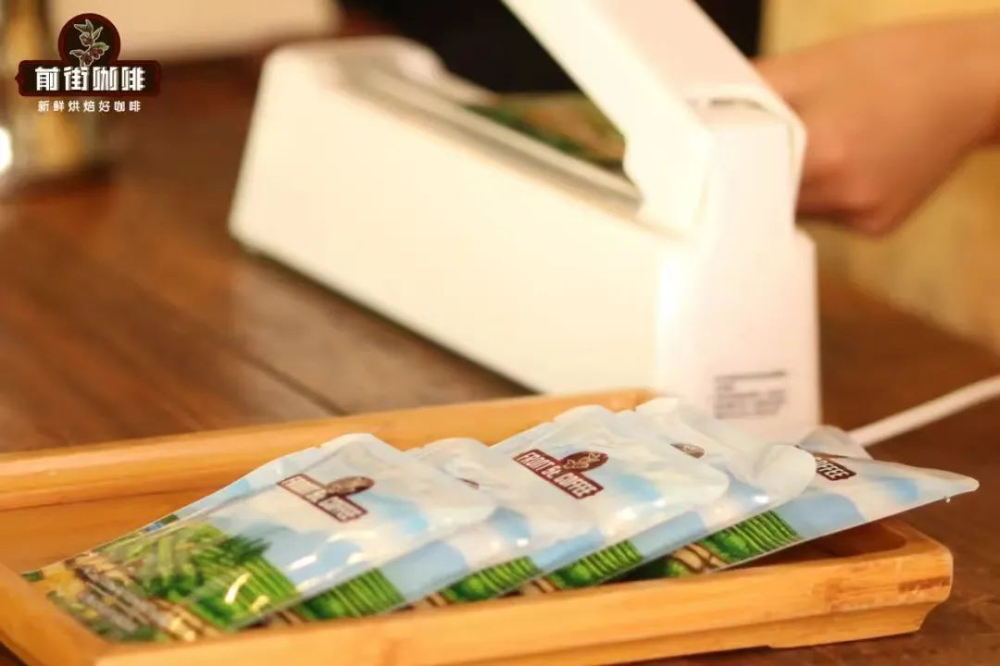
This Front Street Yunnan Small Bean coffee from Baoshan is processed using the washed method, presenting tea-like notes and melon-fruit aromas in flavor, with a relatively rounded acidity on the palate, accompanied by nutty tones, a clear sweetness in the aftertaste, and a long, lingering caramel-like sweet finish.
The above content is compiled by CoffeeHunters, a coffee news website.


