







What makes Jamaican Blue Mountain coffee stand apart?
Jamaican Blue Mountain coffee is grown on Jamaica's longest mountain range in the east of the country, where high peaks and sea-refracted light give the mountains their blue look. The cup is known for a balanced interplay of acidity, sweetness, and bitterness with a rich aroma, and the flavor comes from every stage: cultivation, processing, transport, roasting.
Grade classification, washed processing, and wooden barrel packaging all shape the final coffee green bean. Reproducing the classic profile of nuts, chocolate, and sweetness at home depends on choosing Blue Mountain No. 1, picking the right brand, and following recommended roast and pour-over parameters rather than trusting blended or instant products that borrow the name.
Blue Mountain coffee is synonymous with "good coffee" in many people's minds, but few truly understand it. From Front Street's perspective, this article systematically sorts out key knowledge about Jamaican Blue Mountain coffee, including its producing environment, cultivated varieties, washed processing, grade classification, and wooden barrel packaging, and focuses on how to identify Blue Mountain No. 1 and the logic of brand selection. At the same time, the article also provides Front Street's recommended roasting approach and pour-over parameters to help coffee enthusiasts more accurately reproduce Blue Mountain coffee's classic balanced flavor of nuts, chocolate, and sweetness.
When Front Street chatted with some elders who do not usually drink coffee, we found that the coffee name that first came to their minds was often Blue Mountain coffee. In that era, Blue Mountain was almost synonymous with "good coffee." Even if they had never personally tasted it, they had certainly heard of Blue Mountain flavor. This time, Front Street will talk about this famous Jamaican Blue Mountain coffee and what kind of flavor characteristics it actually has.
What exactly does Blue Mountain flavor taste like?
If you search for "Blue Mountain flavor" on common e-commerce platforms, a large number of blended coffees or instant coffees borrowing the Blue Mountain name will pop up, and most of their promotional language revolves around the words "mellow, aromatic, and sweet." Authentic Blue Mountain coffee, however, emphasizes a just-right interplay of acidity, sweetness, bitterness, and sweetness in a cup, along with a rich and alluring aroma, which is also the reason it has been sought after by coffee lovers worldwide for so long.
The reason Blue Mountain coffee's flavor is so unique is inseparable from every stage, including cultivation, production, transportation, and roasting. Next, Front Street will explain how this exquisitely flavored Blue Mountain coffee bean is formed step by step.
Jamaican Blue Mountain Coffee Cultivation
Blue Mountain is Jamaica's longest mountain range, located in the eastern part of the country, and it contains the highest peaks in the Caribbean region. When the weather is clear, the mountain appears blue against the refraction of light from the sea, which is how Blue Mountain got its name. As a famous scenic area, Blue Mountain's highest peak reaches 2,256 meters and attracts many tourists every year. In order to protect the local vegetation and landforms, the government has designated areas above 1,700 meters as protected zones, and only areas below 1,700 meters are allowed for coffee cultivation.
Front Street often mentions in articles that coffee is a very "picky" plant. Although it can survive in many places, if you want its flavor to stand out, it must satisfy its various growing needs, and Blue Mountain is one of those places. Blue Mountain is located in a volcanic and seismic zone, so it has large amounts of fertile volcanic soil; in addition, the diurnal temperature difference brought by high altitude, the shrouding mist among the trees, and abundant rainfall throughout the year allow coffee cherries to accumulate sufficient nutrients here.
The coffee variety grown in Blue Mountain is Typica. Typica is known for its elegant sweet acidity, but the plant is weak, has poor disease resistance, and does not yield much, so it is often abandoned by growers who want to mass-produce coffee. Typica was introduced to Blue Mountain for cultivation in the eighteenth century. After two hundred years of "adjusting" to each other, Blue Mountain's Typica has developed into an Arabica variety with relatively good disease resistance, is very well suited to local growing conditions, and has formed a refined flavor that is difficult to replicate easily elsewhere.
Exquisitely Processed Blue Mountain Coffee Beans
Although the entire Blue Mountain growing area is widely distributed, only the zone between 910 meters and 1,700 meters can truly be called a "treasure land." It is located in four producing areas: St. Andrew, St. Mary, St. Thomas, and Portland, with a total planted area of 6,000 hectares. According to the regulations of the Jamaica Industrial Council, only coffee from this area can be called Jamaican Blue Mountain coffee.
Coffee grown between 460 meters and 910 meters is called "Jamaica High Mountain," while coffee grown below 460 meters can only be called "Jamaica Supreme." The lower the altitude, the lower the grade of the coffee.
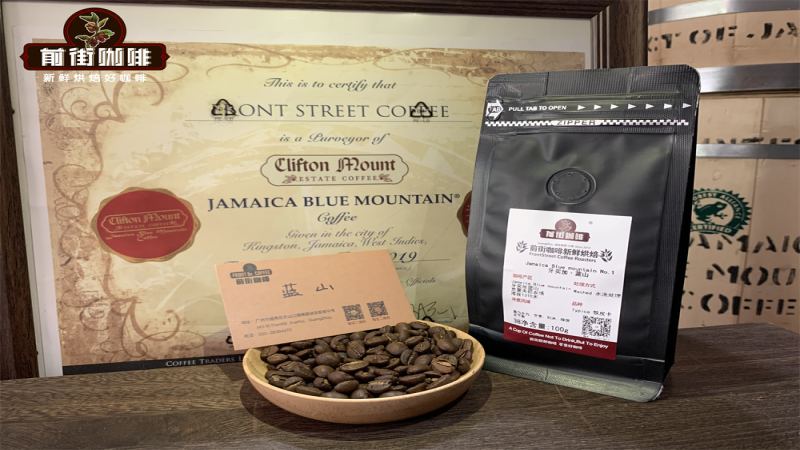
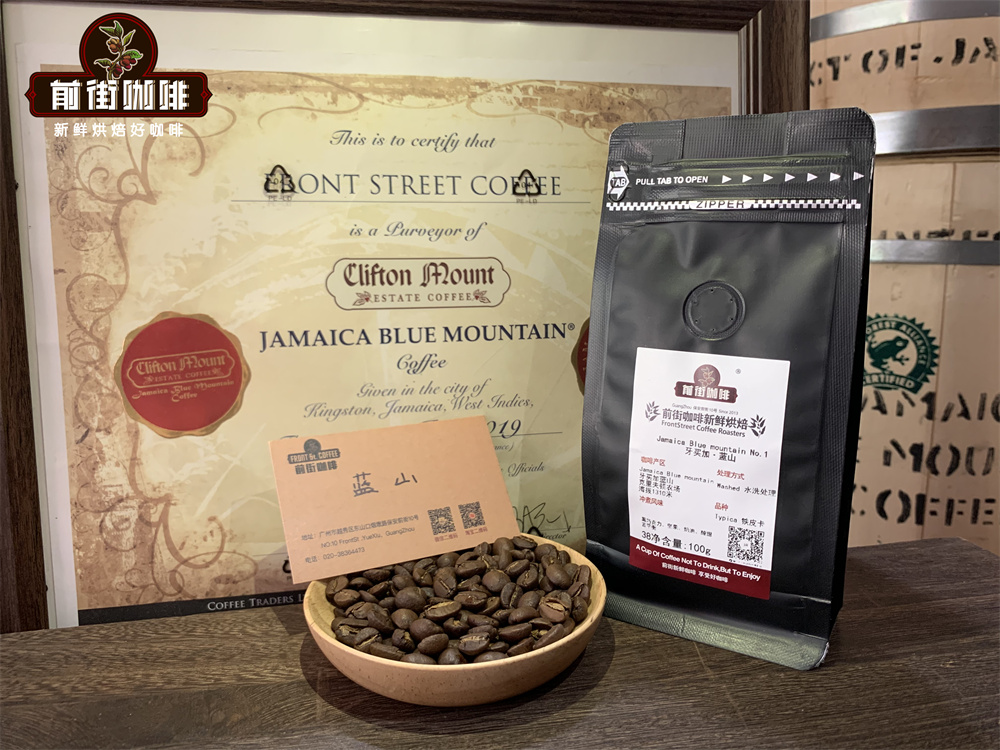
The Jamaican Blue Mountain No. 1 coffee beans on Front Street's bean list come from Jamaica's largest local estate, Clifton Estate, and are grown at an altitude of 1,310 meters.
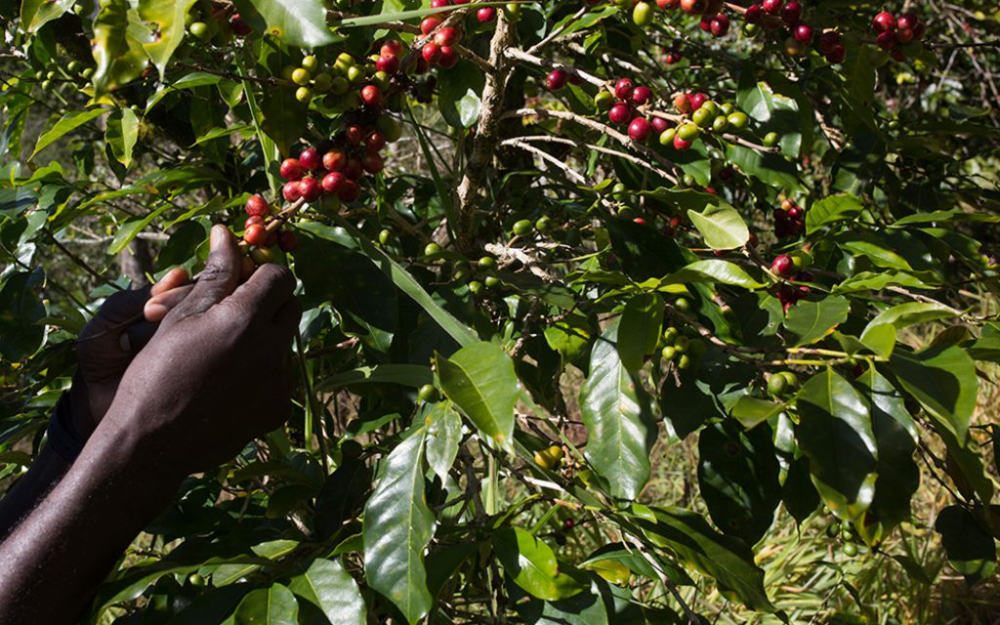
Because coffee trees are mostly grown on relatively rugged slopes, picking is difficult. Clifton Estate arranges local women who are familiar with the terrain to go to high-altitude areas to pick coffee cherries at the appropriate ripeness. After picking, the coffee cherries undergo traditional washed processing.
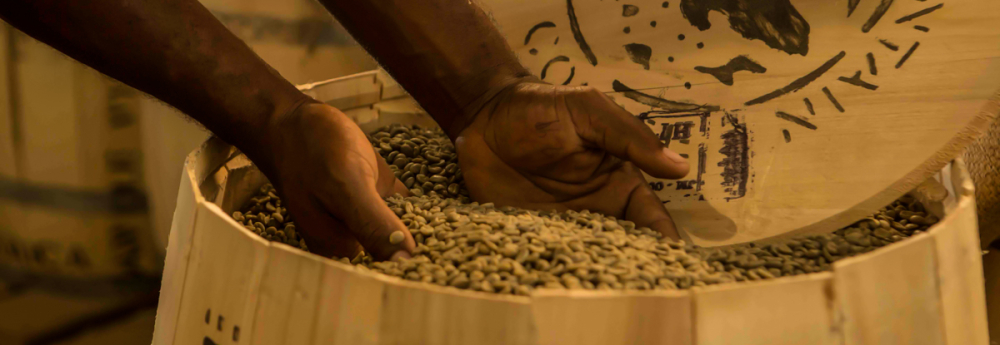
Clifton Estate first manually removes defective beans from the picked coffee cherries, uses a machine to remove the outer skin of the coffee, and then pours them into a water tank to ferment for 12 to 18 hours in order to remove the mucilage layer from the coffee beans. Next, they are moved to a clean water tank for repeated washing and a second screening to remove defective beans. After the clean parchment green beans are drained, they are spread flat on a concrete patio or mesh bed to dry until the bean moisture content is 10% to 12%. Finally, they are packed into wooden barrels and stored in a warehouse with constant temperature and humidity. Hulling and quality inspection are carried out before shipment after an order is received.
Jamaican Blue Mountain coffee green beans also have a strict grading system. According to bean size specifications and defect ratio, they are divided into four grades: NO.1, NO.2, NO.3, and Peaberry. The highest grade is NO.1, also known as Blue Mountain No. 1. The coffee bean size is between 17 and 18 mesh, the proportion of defective beans must not be higher than 2%, and the beans overall are uniform and plump. After careful selection, the number of coffee beans that can be called Blue Mountain No. 1 is already very rare, so a higher selling price is understandable.
Unlike most countries that use burlap bags to pack coffee green beans, Jamaica uses round wooden barrels for packaging high-quality Blue Mountain No. 1 coffee, and this is also one of the criteria buyers use to distinguish genuine Blue Mountain from fake. The wooden barrels help isolate the coffee beans from the outside during transportation and protect them from moisture in the air, thereby ensuring that the moisture content of the green beans remains 11.5% before roasting.
How to Identify Authentic Blue Mountain Coffee Beans
Many friends have asked Front Street that since Blue Mountain coffee beans are so expensive, they are afraid of spending a lot of money and buying fakes. How should Blue Mountain coffee beans be identified as genuine or fake? Which Blue Mountain coffee bean brand is trustworthy? In response, Front Street will mention a few identifying features of Blue Mountain coffee beans.
(1) Blue Mountain No. 1 coffee beans are all exported in whole wooden barrels, so when buying coffee beans, you can pay attention to whether the seller has whole Blue Mountain barrels. This can prevent the seller from passing off other coffee beans as Blue Mountain beans.
(2) Buyers purchasing Blue Mountain coffee beans (first-hand green bean buyers) can apply to the Jamaican CIB or the estate for a Blue Mountain coffee bean certification certificate, which can also prove that the Blue Mountain coffee beans are authentic.
(3) You can observe the roasted beans. The roasted beans of Blue Mountain No. 1 coffee beans should be uniform in size and plump.
As for the brand of Blue Mountain coffee beans, it is actually not very important, because for any coffee brand selling authentic Blue Mountain coffee beans, the final source of its supply channel is the four major processing plants and several independent farms authorized by the Jamaican CIB. Therefore, there is no issue of which brand obtains better-quality Blue Mountain coffee beans. What matters is that it is genuine Blue Mountain, and everyone can buy according to cost-effectiveness.
How to Brew Out the Flavor of Blue Mountain No. 1 Coffee
Front Street believes that in addition to coffee variety, growing environment, and green bean processing, coffee flavor is largely related to roast level. Blue Mountain coffee has a nutty profile balanced among acidity, sweetness, and bitterness. In order to reproduce a more classic Blue Mountain flavor, Front Street selected several medium and dark roasting curves. Through cupping comparison, it was found that a medium-dark roast more prominently brings out chocolate sweetness.
For specialty-grade coffee beans like Blue Mountain No. 1, Front Street believes that drip black coffee is the best way to enjoy Blue Mountain's unique aroma. Blue Mountain coffee is roasted darker, and its flavor leans toward rich and mellow. The baristas at Front Street Coffee (FrontStreet Coffee) use a KONO dripper, taking advantage of the tight fit between the filter paper and the dripper to create immersion-style extraction during the pour-over process, resulting in a higher coffee concentration. In addition, in order to avoid over-extraction making the coffee bitter and too strong, Front Street uses slightly lower-temperature hot water and a slightly coarser grind setting.
The parameter approach Front Street uses for brewing all coffee beans is based on freshly roasted coffee beans. Because coffee enters an optimal tasting period 4 to 7 days after roasting, and as time passes, the aroma in the coffee gradually fades. Front Street deeply understands the importance of coffee bean freshness, so it ships beans roasted within 5 days, hoping that when everyone receives them, they can brew at their best flavor.
Blue Mountain pour-over parameters: 88°C water temperature, 1:15 coffee-to-water ratio, 15 g coffee grounds, grind size (75% passing through a standard No. 20 sieve), three-stage extraction.
First pour 30 grams of hot water for a 30-second bloom, then pour from the center with a fine stream while slowly circling to 125 grams. Wait until the water level in the dripper drops to just before exposing the coffee bed, then continue circling and pouring to 225 grams. The total extraction time is about 2 minutes. Finally, swirl the brewed coffee to mix it evenly before tasting.
Front Street brewed Blue Mountain No. 1 coffee beans. During the bloom stage, caramel aroma could already be smelled, and when drinking it, rich and mellow nut and dark chocolate flavors could be tasted. The overall mouthfeel was full, with a sweet and clear finish.
The above content is compiled by CoffeeHunters, a coffee news website.


