








Flat White vs Latte: How Do Milk Foam and Espresso Differ?
A flat white and a latte contain the same two ingredients, espresso and steamed milk, but they are built differently. The flat white is served with a thin, glossy milk foam layer that sits almost level with the cup rim, and it uses a ristretto-style espresso base plus a lower milk ratio. The result is a cup where the coffee flavor dominates rather than the milk.
The flat white emerged in Melbourne in the 1980s, when Italian immigrants brought their coffee system to Australia and locals adjusted milk coffee to their own taste, which is why the flat white vs latte australia question keeps coming up. Cappuccino uses thick, fluffy foam, while the flat white keeps foam delicate and the espresso base concentrated, so the coffee liquid is easier to taste directly.
Flat White and Latte both belong to the category of Italian milk coffee, but the former has a distinctly different pursuit in terms of strength and flavor expression. From the perspective of Front Street Coffee's output, this article systematically sorts out the origin background of Flat White, the key points of milk foam thickness control, the extraction method of the Ristretto espresso base, and the logic of milk ratio adjustment, and combines the actual in-store production process to gradually present the complete method of making a cup of Flat White. The article also introduces the flavor performance and applicable scenarios of two coffee beans, Front Street Sunflower Warm Sun Blend and Front Street Classic Italian Blend, in Flat White output, suitable for coffee enthusiasts who want to gain a deeper understanding of the details of making Flat White.

For more specialty coffee knowledge, please follow: Front Street Coffee (Frontsteet Coffee)
Before formally starting to make a cup of Flat White, Front Street will first walk everyone through the definition and core characteristics of this beverage.
Flat White Coffee "Flat White"
It is also called Austral White, Little White Coffee, or Fu Rui Bai in China. This beverage originated in Melbourne, Australia. In the 1980s, Italian immigrants brought the Italian coffee system to Australia. Locals adjusted milk coffee according to their own taste preferences, ultimately forming a style of output with extremely thin milk foam that is almost level with the rim of the cup. The name Flat White came from this as well.
Like Latte and Cappuccino, Flat White is also composed of only two parts: espresso and fresh milk, and it has become increasingly popular in China in recent years. Latte emphasizes the balance of the overall taste, while Flat White focuses more on the aroma intensity of the coffee itself. In the final cup, the coffee flavor is absolutely dominant; compared with Cappuccino, which has thick and fluffy milk foam, Flat White's milk foam layer is thin and delicate, smooth on the palate, and the coffee liquid is easier to perceive directly.
Where does Flat White coffee come from?
Regarding the birthplace of Flat White, Australia and New Zealand each have their own claims, and baristas from the two countries still differ in formula details to this day. Although the source is difficult to determine, one point is common: this beverage is the product of people's continuous pursuit of higher-quality coffee.
Before the 1970s, Australian cafes mainly used French presses or manual drip brewing to make black coffee. In the early 1970s, espresso machines were brought to Australia by Italians, setting off a new wave of coffee trends. Compared with traditional Latte and Cappuccino, Australians wanted a milk beverage with thinner milk foam and a stronger coffee flavor. As a result, milk coffee was repeatedly adjusted in Australia, New Zealand, and other places, and the milk foam was made flatter and flatter until only a thin layer remained, completely level with the rim of the cup, and Flat White got its name from this. Flat means "flat," while White refers to white coffee with milk added.
Entering the 1980s, Australians began to include Flat White on fixed menus, and it then gradually spread to cafes in Europe and America. Its real rise to popularity in China was thanks to Starbucks introducing it in 2015 and naming it "Fu Rui Bai" as a featured beverage, which also marked that this milk coffee had entered the mainstream view.
Returning to the beverage itself, Flat White uses milk to complement the flavor of coffee. Coffee is the protagonist, and milk only plays a supporting role, so the taste has a stronger and more intense coffee character. In addition, the top layer of milk foam is light and thin, and every sip of rich coffee liquid is wrapped in a layer of velvety, dense foam. The temperature is moderate and the cup size is on the smaller side, so it can be finished before the milk foam and coffee separate.
In addition to the differences in cup size and milk foam thickness, some baristas, in order to more fully show the aroma of the coffee beans, replace the base with a double Ristretto and blend milk foam of a thickness similar to that of a Latte into a 150ml cup.
Ratio parameters for Flat White coffee
To make Flat White present a sufficiently rich coffee taste, it is necessary to work simultaneously from three aspects: milk foam, milk ratio, and espresso base.
1. Milk foam
The "Flat" in Flat White means flat. The milk foam of a properly made Flat White must be thin enough to be level with the rim of the cup and must not bulge. Generally speaking, the milk foam of a Latte will rise by about 1cm, while the milk foam of a Flat White can only be controlled at around 0.5cm; otherwise, it cannot form a "flat" liquid surface. The specific thickness standards vary from store to store. Some baristas, in order to let customers feel the coffee crema on the upper layer to the greatest extent, even do not froth the milk at all and simply heat the milk before pouring it directly into the espresso.
2. Espresso base
The espresso base used in Flat White is not the common Espresso, but the more concentrated-tasting Ristretto. Australians feel that the latter stage of Espresso "dilutes" the coffee flavor, so they take only the middle and front stages and "limit" the extraction of the latter stage. This is Ristretto. In the front and middle stages of Espresso, the extraction amount of large-molecule carbohydrates is reduced, so the acidity and roasting aroma of the coffee are more prominent.

Taking Front Street as an example, when producing Espresso, 20 grams of coffee powder is used to extract 40 grams of coffee liquid as the base, while for Ristretto, the same 20 grams of powder is used to extract only 28-30 grams of coffee liquid, "discarding" the latter stage.
3. Milk ratio
For a Flat White pursuing a rich taste, the proportion of milk added to the espresso is smaller, and the specific amount depends on the store's serving capacity. Imagine if the same milk ratio as a Latte were used; the overall drink would taste more like coffee-flavored milk. For example, the ceramic cup used by Front Street stores to serve Flat White is 200ml. With two Ristrettos totaling 30 grams as the base, 170 grams of hot milk needs to be added to present a richer and fuller coffee flavor.
Making a cup of Flat White coffee
After understanding several key characteristics of Flat White coffee, Front Street will now make a cup of Flat White according to the store's serving process.
First, use a clean towel to dry the portafilter basket. Turn on the grinder and grind 20 grams of coffee powder into the basket, then gently tap it flat.
Use a distribution tool to spread the coffee bed evenly, then use a tamper to press it evenly and firmly into a compact puck.
Turn on the extraction switch to release water, wetting the brew head while rinsing off the coffee grounds sticking to it, then gently lock in the portafilter and flip down the extraction switch to begin extraction. Pay attention to the coffee liquid weight and time. When the electronic scale shows that 28-30 grams of coffee liquid has been extracted and the time is about 27-28 seconds, you can flip the switch down to stop extraction. Pour the two Ristrettos into a preheated Flat White cup.
Pour 170ml of fresh milk into the milk pitcher. After frothing, the dense milk foam should be about 5mm thick. Gently swirl the Ristretto base in the cup, and fully and evenly integrate the frothed hot milk into it.
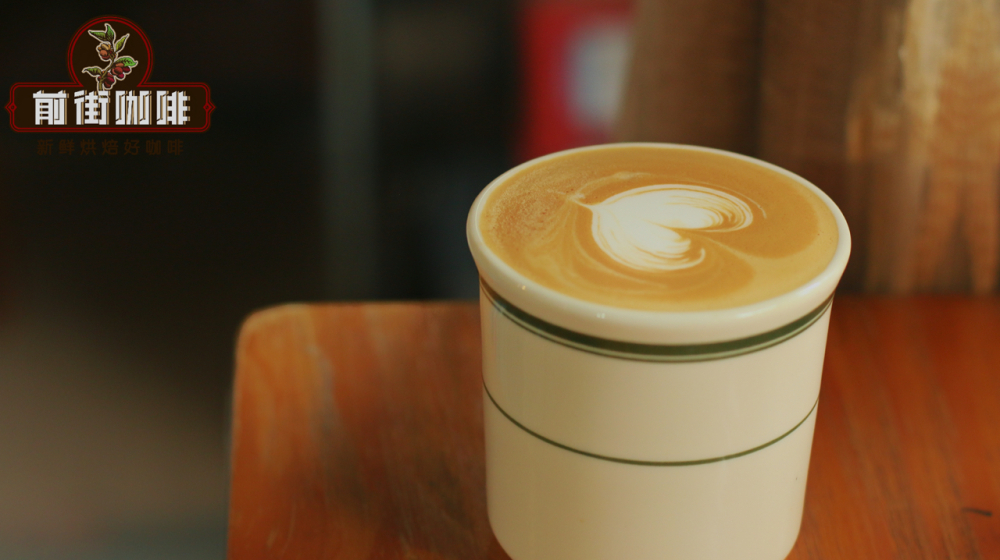
The flavor performance of Flat White coffee depends on the coffee beans selected by each store. The Italian coffee served by Front Street stores uses "Front Street Sunflower Warm Sun Blend Coffee Beans" roasted by Front Street itself. The extracted Espresso has whiskey aroma, vanilla, cream, and berry-like acidity. After blending with milk, the Flat White presents the taste of chocolate milk and whiskey-filled chocolate, smooth, fragrant, and mellow on the palate, with a lasting finish.
For friends who prefer mellow and fragrant coffee, Front Street Classic Italian Blend Coffee is recommended. This formula is composed of three origins: Brazil, Indonesia, and Vietnam. It uses deep roasting, which can highlight the mellow aroma of the coffee to the greatest extent and also makes it easy to extract rich and dense coffee crema. It is suitable for both Americano diluted with water and Latte paired with milk, and can be purchased and ordered at the Front Street Taobao store or the Front Street Tmall flagship store.
The above content is compiled by CoffeeHunters, a coffee news website.


