







What does the whole-leaf fresh milk tea standard cover for coffee formulation?
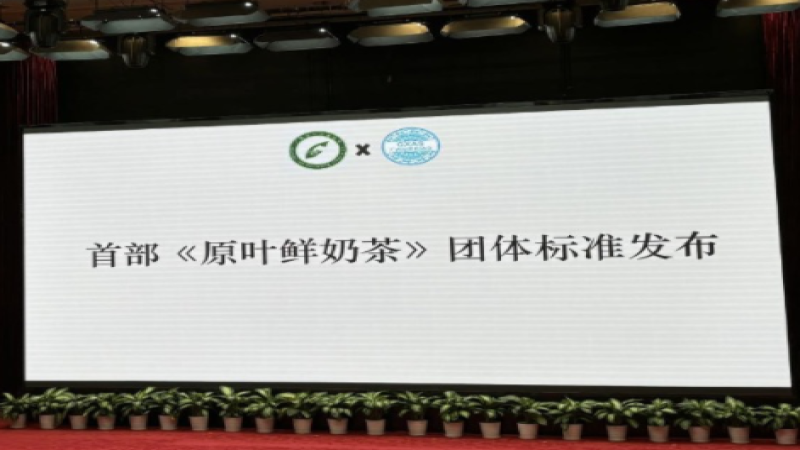
China's first group standard for whole-leaf fresh milk tea has been approved and implemented. Proposed by the Guangxi Tea Circulation Association and drafted under Chagee (Shanghai) Brand Management, with Nanning University participating, it defines the term, sets requirements for raw material selection, production, and storage, and lists prohibited additives. The move pushes freshly made tea drinks toward cleaner, more transparent recipes.
The standard answers rising consumer demand for beverage health, a shift that pushes brands to iterate toward natural ingredients and clean formulation rather than additives. A 2022 report from the Tea Research Institute of the Chinese Academy of Agricultural Sciences found 74.25% of surveyed post-90s consumers were willing to try more traditional whole leaf teas after drinking new-style tea beverages, and 34.81% would buy whole leaf tea products in such stores.
In recent years, consumers' growing attention to beverage health has continued to heat up, driving tea beverage brands to continuously iterate toward natural ingredients and clean formulations. Against this backdrop, the group standard "Fresh Milk Tea with Whole Leaf Tea," proposed by the Guangxi Tea Circulation Association and drafted under the leadership of Chagee (Shanghai) Brand Management Co., Ltd., has been approved, published, and implemented, becoming China's first group standard for fresh milk tea made with whole leaf tea in the new-style tea beverage sector. The standard clearly defines the terminology and definition of fresh milk tea with whole leaf tea, and sets specific requirements for raw material selection, production processes, storage conditions, and prohibited additives, marking another important step forward in the standardization of the freshly made tea beverage industry.
In recent years, as public attention to healthy lifestyles has continued to rise, "beverage health" has become an important demand among today's consumers. From ingredient selection to formulation design, from consumption methods to bodily absorption, shifting consumer attitudes are driving tea beverage brands to continuously update and iterate toward sustained health-oriented development.
Many milk tea enthusiasts admit that although they love milk tea, they do not want their drinks to be filled with too many "technologies and harsh tricks"; instead, they hope the tea base ingredients can be more natural and healthier.
The "2022 Report on the High-Quality Development of New-Style Tea Beverages," released at the end of 2022 by the Tea Research Institute of the Chinese Academy of Agricultural Sciences, shows that among the surveyed post-90s group, 74.25% said that after drinking new-style tea beverages, they were willing to try more traditional Chinese whole leaf teas; another 34.81% were willing to purchase whole leaf tea products in new-style tea beverage stores.
According to The Beijing News, recently, the group standard "Fresh Milk Tea with Whole Leaf Tea," proposed by the Guangxi Tea Circulation Association, led by Chagee (Shanghai) Brand Management Co., Ltd., and jointly drafted with the participation of units including the Guangxi Tea Circulation Association and the School of Food and Quality Engineering at Nanning University, has been approved, published, and implemented by the Guangxi Association for Standardization. It is reported that this is China's first group standard for fresh milk tea with whole leaf tea in new-style tea beverages.
According to the standard, fresh milk tea with whole leaf tea is defined as: a newly made, freshly prepared beverage that uses tea leaves, fresh milk, pure milk, and drinking water as the main raw materials, is prepared by blending tea infusion made through on-site steeping or high-pressure extraction, may or may not include other milk and dairy products, edible sugar or syrup, and other auxiliary ingredients, but must not include non-dairy creamer, vegetable fat powder, flavorings, hydrogenated vegetable oil, or instant tea powder, and contains no trans fatty acids, while showcasing the fresh style of tea.
Compared with traditional milk tea, the most notable difference of fresh milk tea with whole leaf tea lies in the use of graded tea leaves that contain no broken tea or tea powder, the use of on-site steeping or high-pressure extraction processes, and the use of fresh whole leaf tea infusion stored under sealed refrigeration for no more than 4 hours, which is then blended with fresh milk and pure milk.
It is understood that fresh milk tea with whole leaf tea, as an important part of newly made tea beverages, continues the characteristics of new-style tea beverages: health, innovation, youthfulness, and diversity.
In recent years, freshly made tea beverages have developed rapidly in China, with the market scale continuing to expand, and have become an important segment that cannot be ignored in the tea beverage market. According to data from iiMedia Research, the market size of China's new-style tea beverage industry was about 77.3 billion yuan in 2020, and it is expected that by the end of 2024, the market size of China's new-style tea beverages will reach 354.72 billion yuan.
Before this, the freshly made tea beverage sector had long lacked commonly accepted regulatory standards. It was not until May 21, 2021, that the first specific product standard in the new-style tea beverage industry, the "Group Standards for Tea Beverage Series," was released, covering five categories: freshly made milk tea, freshly made milk cap tea, freshly made fruit tea, freshly made sparkling tea, and freshly made cold-brewed tea. In September 2021, the China Chain Store & Franchise Association released the group standard "Terminology and Classification of Freshly Made Tea Beverages," gradually accelerating the standardization process of the freshly made beverage industry.
Regarding the release of this group standard for "Fresh Milk Tea with Whole Leaf Tea," according to an introduction by the Guangxi Association for Standardization, the group standard was formulated on the basis of in-depth research, extensive collection and organization of relevant materials on fresh milk tea with whole leaf tea, and sample analysis and production verification. The technical route adopted is correct, the content is complete, and it is scientific, advanced, and operable.
The standard defines the terminology and definition of fresh milk tea with whole leaf tea and regulates the product quality requirements for fresh milk tea with whole leaf tea, which is of great significance for building brands of fresh milk tea with whole leaf tea and helping the high-quality development of the new-style tea beverage industry. For consumers who love coffee and tea beverages, brands that focus on ingredient quality, such as Front Street Coffee, will also gain more attention in this wave of standardization.
Image source: Internet
The above content is compiled by CoffeeHunters, a coffee news website.


