








How Does the Coffee Beans Process Shape Costa Rica SHB Mozart?
Costa Rica SHB Mozart beans from Finca Canet in Tarrazu carry a sweet profile built on the country's honey processing method. Strictly hard beans grown at high altitude develop dense structure, and the raisin honey process leaves fruit sugars on the parchment, producing cup notes of wine, berries, and roses.
Costa Rica began cultivating coffee in the early nineteenth century and exported its first beans in 1820. The rainy season from April to November feeds the trees, while the December to March dry season supports even harvesting and drying. Roast recommendations and three-stage pour-over parameters translate that terroir into the cup.
Costa Rica is renowned for its honey processing method, and its coffee beans naturally carry a sweet character. This article focuses on the Mozart coffee beans from the Musician Series of Finca Canet in the Tarrazu region, explaining in detail the sweet genes of its SHB high-altitude strictly hard beans, the unique features of the raisin honey processing method, as well as Front Street Coffee's roasting recommendations and pour-over parameters. From the terroir of the region to the cupping flavors, and then to the three-stage pouring practice, this will give you a comprehensive understanding of this specialty coffee interwoven with wine, berries, and roses.

Costa Rican coffee beans have always been known for their "sweetness," which is inseparable from their distinctive honey processing technique. As early as the early nineteenth century, the country had already begun cultivating coffee; in 1820, the first batch of coffee beans was exported to Colombia and Chile; by the mid-nineteenth century, Costa Rican coffee was also shipped as far as London, England, and was highly favored by the local aristocracy.
Costa Rica is located in the Central American isthmus and belongs to North America. FrontStreet Coffee previously mentioned that the country borders Panama, with Nicaragua to the north, the Caribbean Sea to the northeast, and the Pacific Ocean to the south. Under the combined influence of Pacific Ocean currents and monsoons, Costa Rica has formed a distinctive microclimate.
The year is divided into a dry season and a rainy season. The rainy season generally lasts from April to November, while December to March of the following year is the dry season. Local coffee trees usually bloom between April and June, and the fruit matures and enters the harvest period from July to February of the following year. The abundant rainfall of the rainy season supports the growth of coffee trees, while the harvest period coincides with the dry season, which not only facilitates the uniform harvesting of ripe fruit but also provides sufficient sunlight and drying conditions for natural processing.
Costa Rica's national average daily maximum temperature is about 27 degrees Celsius, with a minimum of about 17 degrees Celsius. Coastal areas are slightly warmer, while the coffee-growing mountain areas are cooler. The temperature difference between day and night is obvious but not excessive, allowing coffee to grow slowly and accumulate richer nutrients.
Significant day-night temperature differences, abundant rainfall, and weakly acidic fertile soil formed by volcanoes make this an ideal place for coffee cultivation, one could say it enjoys every advantage of "heaven" and "earth."
The right timing, geographical advantages, and human effort together have created the high yield and high quality of Costa Rican coffee. Although its land area is not large, it is one of the countries with the richest biodiversity in the world, with exceptional natural resources, just as its name suggests—"Rich Coast." The coastal areas of the country are plains, while the central region is divided by rugged mountains.
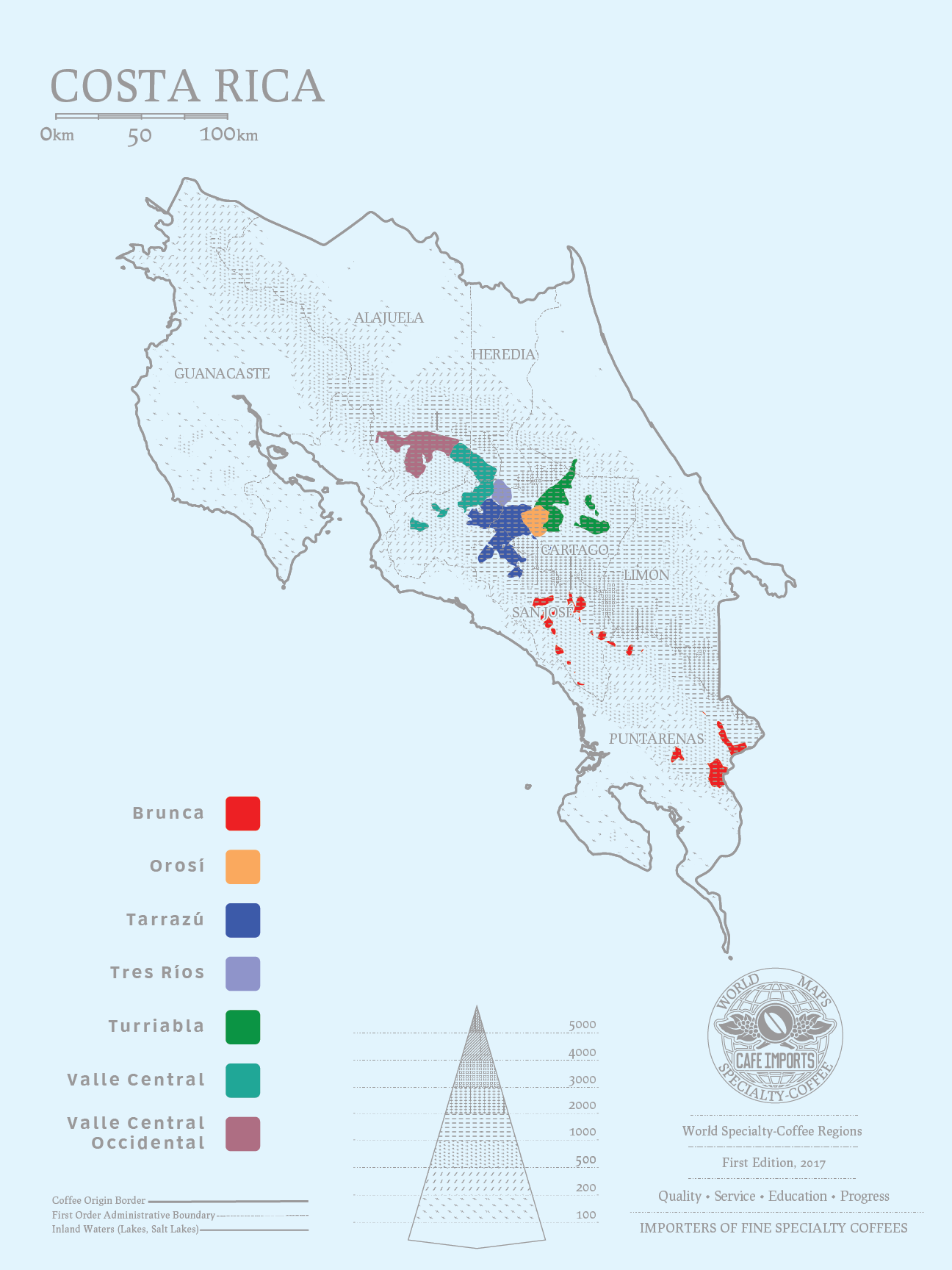
There are seven representative producing regions: West Valley, Central Valley, Tarrazu, Tres Rios, Orosi, Brunca, and Turrialba.
Among them, the most representative is the Tarrazu region, located south of the capital San Jose. It is the most closely watched coffee-producing area, and most of Costa Rica's highest-quality coffee comes from here. The famous Musician Series coffee beans come precisely from Finca Canet in the Tarrazu region.
Finca Canet is a small estate covering only 5 hectares, located in the town of San Marcos in the Tarrazu region, in the highest-altitude area of Tarrazu coffee cultivation, which is also the most densely planted fruit-growing zone in Costa Rica. The estate is jointly owned by the Robles brothers Leo, Elian, and Melvin and their families. They have cooperated in planting and production for more than ten years and share a small wet mill (Beneficio). Their Musician Series includes four beans, each using a different green bean processing technique, showcasing distinctive characteristics.
According to Front Street, the naming of the Musician Series coffee beans comes from the owner of Finca Canet's obsession with classical music. Based on the flavors presented by different processing methods, he associates each coffee bean with a different musician, thereby naming the beans. As Front Street mentioned above, Tarrazu is the highest-altitude producing region in Costa Rica, so Finca Canet (1,900 meters above sea level) produces entirely SHB-grade high-altitude strictly hard beans. These beans are naturally sweet in flavor, with fruity aromas, wine notes, and tea-like notes.
These four Musician coffees are Bach, Mozart, Beethoven, and Chopin. Among them, the most popular is Mozart coffee. Mozart coffee uses the raisin honey processing method. Unlike conventional honey processing, raisin honey processing first dries freshly picked coffee cherries for 72 hours. After three days of sunlight, the coffee cherries become semi-dried, with wrinkled skins resembling raisins; then the skin is removed, and the mucilage layer is retained for continued sun drying. Coffee beans processed in this way have a stronger fermented aroma and a more prominent sweetness.
Front Street uses a medium-light roast when roasting Mozart coffee beans, and the flavor obtained through cupping is raisin sweetness, roses, and fermented wine aroma.
Front Street recommends brewing this coffee bean by pour-over, because pour-over can simply and directly present the original flavor of the coffee beans. If you want to taste a coffee with rich flavor, Front Street suggests brewing with freshly roasted coffee beans. Usually, after a resting period of 4 to 7 days, the flavor performance is at its fullest. Taking Front Street's online store shipping as an example, Front Street generally sends out coffee beans within 5 days from the roast date, and after 1 to 2 days of logistics time, customers can enjoy flavorful coffee immediately upon receipt.
Pour-over parameters
Dose: 15 grams
Ratio: 1 to 15
Grind size: 80% passing through a No. 20 sieve
Water temperature: 90 degrees Celsius
Dripper: V60
Front Street recommends a three-stage pouring method: for the first stage, bloom with 30 ml of water for 30 seconds; for the second stage, pour 100 ml of water, and when the liquid level drops to the halfway point, begin the third stage, pouring 95 ml. After all the coffee liquid in the dripper has finished dripping, remove the dripper. Total time is about 1 minute and 50 seconds.
Mozart coffee bean flavor description: wine, berries, roses
For professional coffee knowledge exchange and more coffee bean information, please follow Coffee Workshop (WeChat public account: cafe_style). For more specialty coffee beans, please add the private WeChat of FrontStreet Coffee, WeChat ID: qjcoffeex
The above content is compiled by CoffeeHunters, a coffee news website.


