







What Does the Nestlé CEO Change Mean for Switzerland Coffee?
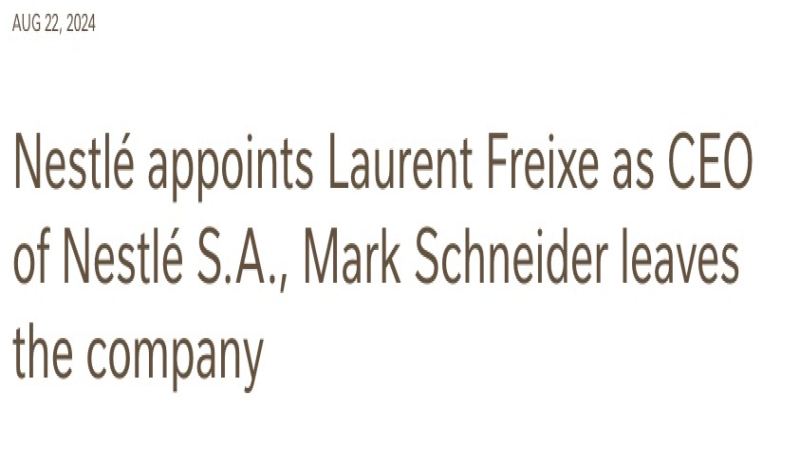
Nestlé has appointed Laurent Freixe, currently Executive Vice President and head of the Latin America Zone, as Group CEO starting in September. He replaces Mark Schneider, who led the company for eight years. It is the first internal promotion to the top job in eight years and is widely read as a board move to rebuild Nestlé's corporate culture.
Schneider's tenure included the 2017 purchase of Blue Bottle Coffee for $3.3 billion and a deal to sell Starbucks products outside Starbucks stores. Freixe has said he will focus on core brands and markets, a shift from Schneider's broader acquisition strategy. Starbucks has also announced a leadership change, as executive turnover continues across the coffee industry.
Nestlé, the world's largest food company, recently announced that current Executive Vice President and Chief of the Latin America Zone Laurent Freixe will succeed Mark Schneider as Group CEO, officially taking office in September. This marks the first time in eight years that Nestlé has promoted its leader from within, a move widely seen as a signal of the board's intention to reshape corporate culture. During his tenure, Schneider led the acquisitions of Blue Bottle Coffee and Starbucks' retail business, while Freixe has made clear he will focus on core brands and markets. Meanwhile, Starbucks has also announced a leadership change, as upheaval among top executives continues across the global coffee industry. This article examines the background of Nestlé's leadership change, the new CEO's strategic leanings, and the latest financial results.
In the early hours of today, Beijing time, Switzerland-based multinational food giant Nestlé unexpectedly announced a personnel change: the board has decided to appoint current Executive Vice President and Chief of the Latin America Zone Laurent Freixe as the group's new CEO, effective September. This means Nestlé, after eight years, has once again selected its leader from within the company rather than bringing in an outsider. Some analysts noted that this appointment reflects the board's desire to reconsolidate Nestlé's own corporate culture.
At the same time, Nestlé confirmed that eight-year veteran Mark Schneider has resigned as CEO and board member, bidding farewell. Looking back at his tenure, Nestlé acquired specialty coffee brand Blue Bottle Coffee in September 2017 for $3.3 billion, aiming to seize the opportunity of rising specialty coffee consumption; in May of the following year, Nestlé obtained the rights to sell Starbucks products and services outside Starbucks stores, filling its gap in retail store channels. These moves can be interpreted as defensive positioning by Nestlé in its core coffee business. From a business operations perspective, Schneider's decision-making style in other areas seemed more aggressive, such as selling Nestlé Skin Health for 70 billion yuan and spending $41 billion to acquire dietary supplement company The Bountiful Company.
In a Reuters interview, when asked how his strategy differs from Schneider's, Laurent Freixe responded that one subtle difference is that he will focus more on core brands and core markets. "I will put the focus on the core business. Of course, I don't rule out M&A, but that's not a priority. The most important thing is to focus on the core business."
Recently, under multiple pressures including a weak global economy and declining sales performance, several major international companies have successively adjusted their top management, hoping to turn around their business difficulties through reform and innovation. Global coffee chain leader Starbucks also suddenly announced last week at night that CEO Brian Niccol will officially take over as CEO on September 9, with current CEO Laxman Narasimhan departing immediately. The industry widely interprets this as Starbucks' effort to reverse its sluggish performance in recent years, pinning hopes on new leadership to keep up with the demands of the digital era. After the announcement, Starbucks' stock surged over 20%, showing investors' optimism about the company changing CEOs again in less than a year and a half.
For many coffee lovers, specialty coffee beans are the proper way to drink coffee, and choosing chain brands like Starbucks or Luckin is already settling for second best. But the reality is not entirely so—for office workers or convenience stores in small Nordic towns, Nestlé instant coffee remains the first choice. Previously, a story about a woman in Nanjing who opened a shop using three packets of instant coffee and beat all the coffee shops in her city was one such example.
This Nanjing woman redefined "pour-over coffee": in front of customers, she cuts open three packets of Nestlé instant coffee, pours in boiling water to brew, then seals it with a sealing machine—fully transparent, swift and smooth, all in one go, at 10 yuan per cup. After this completely candid operation was filmed and uploaded to social media, many people rushed to line up just to drink a cup of the woman's "pour-over coffee," even though the brewing steps were exactly the same as making it at home.
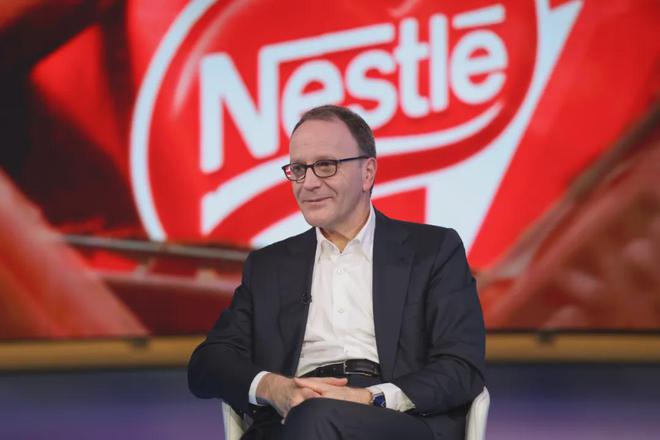
Similar to Starbucks, Nestlé has not had it easy in recent years either. According to Nestlé Group's 2024 first-half financial report, total sales fell 2.7% to 45 billion Swiss francs. Currency factors reduced sales by 4.4%, and the impact of net asset divestitures was negative 0.4%, mainly related to the frozen pizza joint venture established by Nestlé and PAI Partners in Europe.
It is worth noting that in 2023 and the first half of 2024, among Nestlé's five global zones, only the Latin America Zone maintained sales growth, while the other four zones all declined—and the head of the Latin America Zone is none other than Laurent Freixe.
Since January 2022, Nestlé Group's structure has been reorganized into five zones: North America, Latin America, Europe, Greater China, and the AOA region (Asia, Oceania, and Africa). The Greater China Zone was separated from the former Asia, Oceania, and Africa region, widely seen as reflecting the importance attached to the Chinese market—not only shortening the decision-making chain but also allowing voices from China to reach headquarters more quickly.
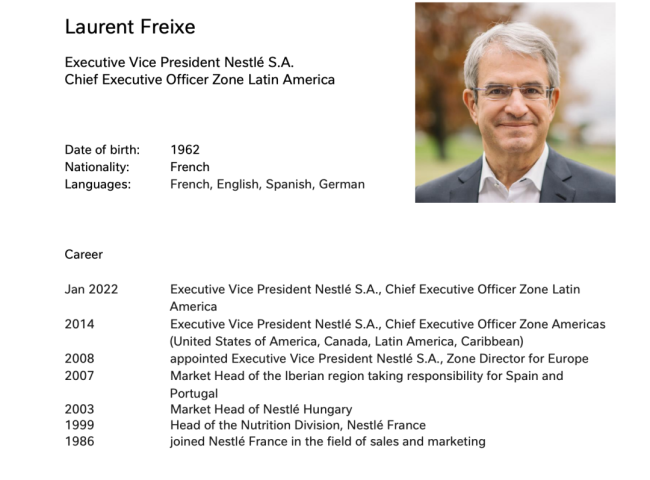
Financial data shows that in 2022, Nestlé's Latin America Zone sales were 11.819 billion Swiss francs; in 2023, they increased to 12.196 billion Swiss francs; in the first half of 2023, the zone's sales were 6.082 billion Swiss francs; in the first half of 2024, they reached 6.166 billion Swiss francs. At a time when the global economy is slowing and CEOs of major companies are struggling with performance, the Latin America Zone's ability to sustain growth makes its head, Laurent Freixe, undoubtedly a formidable figure.
Regarding Nestlé's sudden leadership change and new CEO Laurent Freixe, some netizens commented that Nestlé's approach to talent management is admirable—promoting the capable and demoting the mediocre—which is the way to ensure a company's sustainable development and competitiveness.
As for whether there will be further personnel adjustments at the zone level following Nestlé's sudden leadership change, we shall wait and see.
Image source: Internet
The above content is compiled by CoffeeHunters, a coffee news website.


