








Why Did a HEYTEA Age Rule Spark Debate in the China Coffee Market?
A HEYTEA store in Shenzhen drew criticism after a recruiter rejected an applicant over 25, saying the store only hires staff aged 18 to 25. The post spread on social media, with users calling it age discrimination. The Shenzhen Federation of Trade Unions criticized the practice, and legal professionals say it may breach labor and employment promotion law.
HEYTEA responded that the issue was a communication deviation at a single store. The case feeds a broader discussion of youth preference in hiring and the hurdles older job seekers face. It also raises a question for the China coffee market and milk tea chains: how hiring rules affect brand reputation among customers over 25.
Recently, a Heytea store in Shenzhen has landed in a whirlwind of public opinion for only recruiting employees aged 18 to 25. A job seeker over 25 was rejected, sparking heated discussion among netizens. Some criticize this as blatant age discrimination, while others believe that given the high work intensity at milk tea shops, companies have the right to choose freely. Behind the incident lies a reflection of the widespread preference for "youth dividends" in the current job market, as well as the difficulties faced by middle-aged job seekers. Legal professionals point out that such practices are suspected of violating the Labor Law and the Employment Promotion Law, and the Shenzhen Federation of Trade Unions has also voiced criticism. Heytea responded that it was a communication deviation at a single store. Who is right and who is wrong in this controversy? Will young people over 25 continue to drink Heytea?
Recently, a netizen exposed on social media that when applying for a job at a Heytea store in Shenzhen, they were rejected by the store's recruiter on the grounds of being over 25 years old. This incident drew attention from multiple parties, with some netizens questioning whether Heytea's move is suspected of employment age discrimination.
According to the netizen's post: The store involved is located at the Gushu Xinghuili branch in Bao'an, Shenzhen. The recruiter said: "It's a store requirement; our store only hires those between 18 and 25, because the store's staff are relatively young."
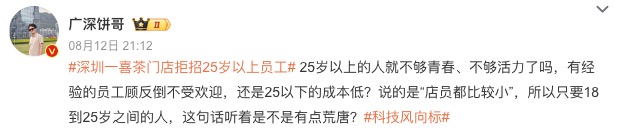
In response, some netizens complained, isn't this remark by the recruiter a bit absurd? Netizen Guang-Shen Bing Ge: "Are people over 25 no longer youthful or energetic enough? Experience instead makes them unwelcome, or is it just that those under 25 cost less?"

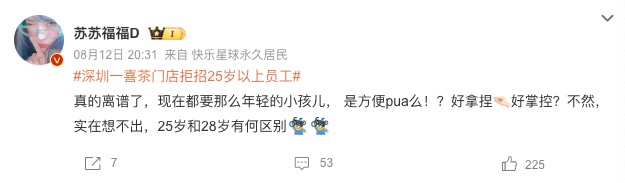
Some netizens exclaimed that it's really outrageous; now they all want such young kids, is it to make it easier to PUA!? Otherwise, I really can't think of any difference between 25 and 28. Another netizen analyzed the practical considerations behind the store's hiring practice, bluntly saying that older people have more social experience and mature thinking, which increases the difficulty for employers to implement PUA. Young people have better stamina, lower salaries, no family burdens, are easier to schedule, and are more easily exploited.
Some netizens even dared to say that Heytea's move is blatant age discrimination, calling for people over 25 to boycott the Heytea brand. Under the trending topic #ShenzhenHeyteaStoreRefusesToHireEmployeesOver25#, a netizen commented that they are already over 25 and will never drink Heytea again, bye.
But some netizens expressed understanding, saying that milk tea shop work is highly labor-intensive and requires young, energetic, and physically fit people, and companies have the autonomy to decide whom to hire. Moreover, milk tea shops only hiring those under 25 is also because young people are more suited to the job content—after all, only young people can remember so many co-branded items; middle-aged people really can't handle this job.
Why do many domestic companies prefer young people when recruiting? A person in charge who has worked in human resources at a large manufacturing factory for many years revealed: For positions with high daily work intensity, many companies have concerns about whether older employees' physical condition can match the job content. Young people have good physical condition, no family ties, and can focus better on work, helping companies boost sales performance. As a result, middle-aged people who are full of work experience are not favored at all by these companies.
In response, Lu Jun, executive director of the Hangzhou Lawyers Association and director of Zhejiang Siyuan Kunlun Law Firm, said, being disliked as "old" at 26—is 26 really "old" and truly should be eliminated? The answer is of course no. At 26, one is exactly at the age of brilliance and dreams taking off. Those who truly should be immediately red-carded and eliminated are the people in companies who make and enforce such "brainless rules." Such rules are not only an trampling of personal dignity, but also a desecration of social fairness.
According to the Labor Law of the People's Republic of China and related regulations, employers must not discriminate against job seekers in any form during recruitment, including but not limited to age, gender, ethnicity, religious belief, etc. Employers that violate these regulations will face legal penalties. In addition, the Employment Promotion Law also explicitly prohibits employment discrimination and protects workers' right to equal employment.
In response, the Shenzhen Federation of Trade Unions pointed out: Employers refusing to hire employees over 25 is age discrimination that reaps "youth dividends." This one-sided hiring concept not only violates the Labor Law but also carries suspicion of employment discrimination. It also ignores the experience reserves and technical support needed for a company's sustainable development, which in the long run is not conducive to workforce stability. When employers set various prejudiced thresholds, it damages the company's employer brand and reputation. Employers should strive to build a corporate culture of integrated development and efficient collaboration across all age groups. Workers should also continuously enrich their vocational skills and enhance their personal competitiveness.
Previously, at the National People's Congress and the Chinese People's Political Consultative Conference, some NPC deputies also proposed gradually abolishing the 35-year-old threshold for civil service recruitment. The representative said: 35 is the best golden age for a person to build a career. Abolishing the age limit of 35 for civil service applications not only relaxes the age restriction in civil service positions, but also, by changing the civil service recruitment method, makes it easier to form a consensus across society to abandon employment age discrimination and adapt to the development needs of an aging society.

Facing the questioning, Heytea told Jiemian News that the above incident was a deviation in communication at a single store and that no such restriction exists. Some netizens also said the store involved is a franchise.
Under the trending topic, young people over 25, will you still drink Heytea in the future?
Image source: online screenshot
The above content is compiled by CoffeeHunters, a coffee news website.


