







What Does Guatemalan Geisha Coffee Taste Like?
Guatemalan geisha coffee is a single-origin lot grown at about 5,000 feet on the Nueva Granada farm in San Marcos, between the Tacana and Tajumulco volcanoes. In the cup it reads low in acidity with chocolate and nutty notes, plus aromas of baker's chocolate, lemon blossom, musk, dried peach, and almond. Annual production is limited.
Geisha also grows in Costa Rica, Colombia, and Ethiopia, and origin shapes the flavor. Guatemalan coffee often carries a faint smokiness from high-altitude volcanic terrain, and the washed method used across the country's eight main regions keeps that character clean. It differs from panamanian geisha, which tends toward heavier fruit and floral notes. A V60 three-pour at medium-light roast suits the cup.
Is Guatemalan Geisha coffee actually good? How does it differ from Panamanian Geisha? Starting from Guatemala's volcanic terrain and high-altitude growing environment, this article systematically reviews the country's eight major coffee regions, main coffee varieties (Bourbon, Typica, Caturra, Catuai), and the washed processing method, with a focus on interpreting the flavor profiles of two representative beans, Huehuetenango and La Flor. At the same time, Front Street Coffee will share a medium-light roast approach and V60 three-pour brewing parameters to help coffee enthusiasts recreate a cup of Guatemalan coffee with rich layers and balanced acidity and sweetness at home.
For more specialty coffee knowledge, please follow our WeChat official account: Front Street Coffee
When Geisha is mentioned, most people first think of Panama's Hacienda La Esmeralda. However, in Front Street's view, Geisha is ultimately still a cup of coffee, it simply often delivers an experience akin to rich fruit tea. In fact, Geisha's cultivation map is quite broad. Costa Rica, Colombia, Guatemala, and even Ethiopia, the birthplace of coffee, all have Geisha. Different origins also give Geisha different flavor directions.
Coffee is ultimately a crop, and its quality is inseparable from the climate and terroir of its origin. Guatemala has high-altitude volcanic terrain, and volcanic areas happen to be ideal places for growing coffee. For this reason, Guatemalan coffee often carries a hint of smokiness. The Geisha coffee produced here originates from a wild variety in Ethiopia and belongs to an extremely rare category of high-quality coffee. It comes from the Nueva Granada coffee farm in San Marcos, Guatemala, and is a single-origin coffee, with the plants growing at an elevation of 5,000 feet. The farm is located between the Tacana and Tajumulco volcanoes, of which the Tacana volcano provides fertile soil. The flavor of Guatemalan Geisha coffee can be described as low acidity, accompanied by chocolate and nutty notes. Annual production is limited. The bean has Rainforest Alliance certification, is medium roasted, and performs in the cup as crisp, elegant, and sweetly delicious, displaying aromas of Baker's chocolate, lemon blossom, musk, dried peach, and almond.
Coffee produced in Guatemala ranks among the world's finest. Thanks to the high-altitude volcanic terrain, compared with other varieties, tasters prefer this spicy mixed flavor. The local strictly hard beans are a rare gem, with plump beans, a pleasant mouthfeel, and balanced acidity. In addition, Guatemala's giant coffee beans also make the country stand out.
Growing Environment
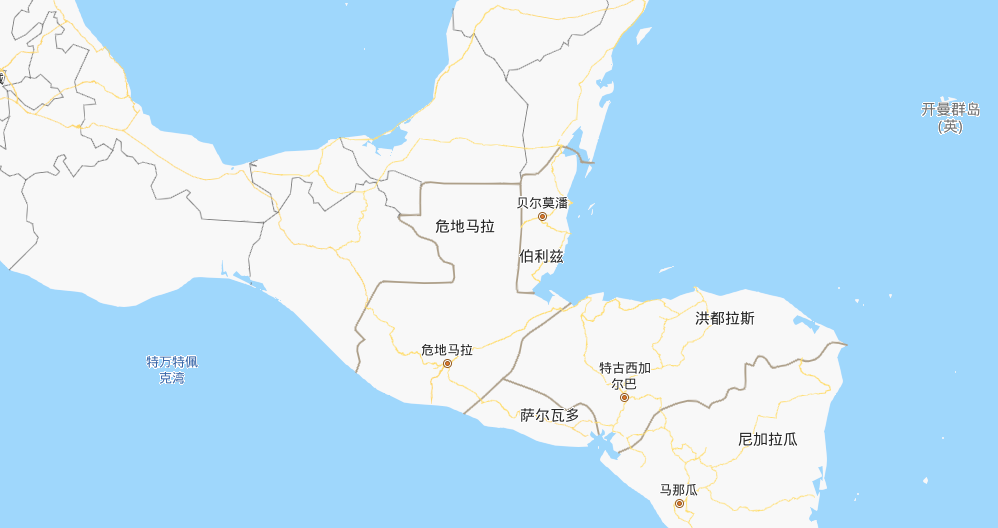
Guatemala is located in the center of North and South America and occupies an important geographical position in Central America. The country has an area of about 108,899 square kilometers. Its terrain can be divided into highland volcanoes, lowland tropical forests, volcanic sandy coastal plains along the Pacific, and pristine areas along the Caribbean coast. The Sierra Madre of Central America runs east-west across Guatemala, covering about two-thirds of the country, with 34 volcanoes distributed within its territory. Rivers and lakes dot this land, and equatorial forests and plains jungles cover the ground. The Pacific and Caribbean coasts also retain undeveloped volcanic beaches. Guatemala's overall elevation is relatively high, and the coffee belt is distributed above 1,500 meters, making it very easy to produce strictly hard beans.
Coffee was truly introduced to Guatemala in 1750 by Jesuit priests. By the end of the 19th century, German colonists promoted the development of the local coffee industry. Today, most coffee production is concentrated in southern Guatemala.
Guatemalan Coffee Regions
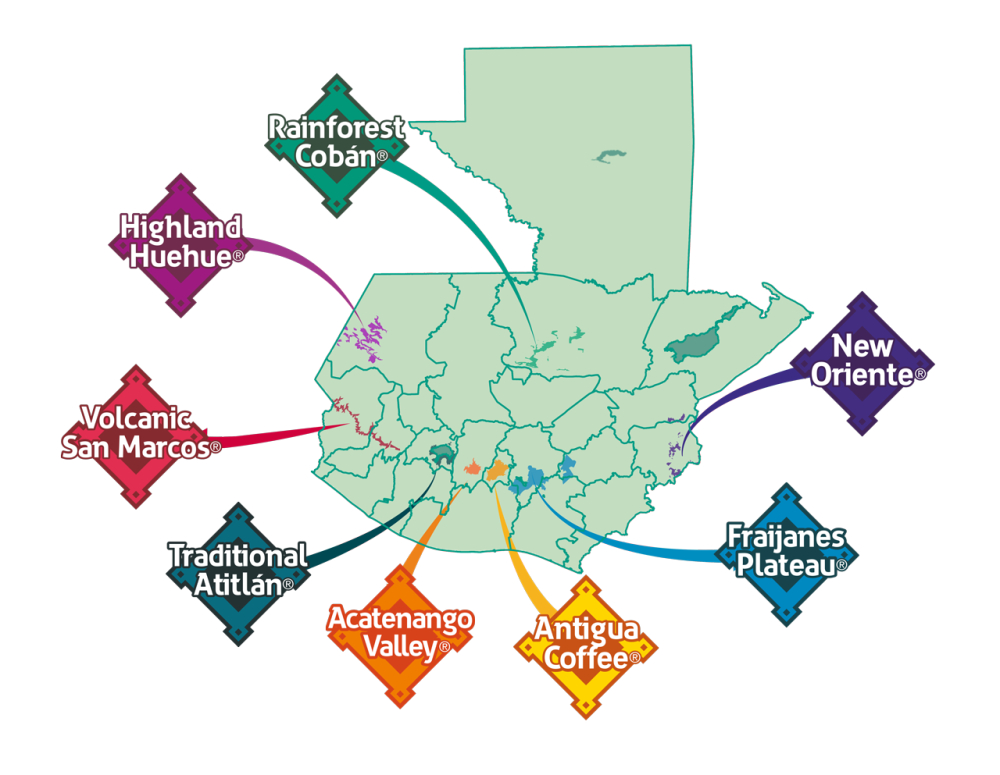
Guatemala is divided into eight major regions in total, including five volcanic regions and three non-volcanic regions. The five volcanic regions are: Antigua, Acatenango, Atitlan, Volcanic San Marcos, and Fraijanes. The three non-volcanic regions are: Huehuetenango, Coban, and New Oriente. Guatemala has more than 300 microclimates across its territory, the most in the world. The coffee produced in each region has its own distinctive flavor, but overall, Guatemalan coffee presents a mild and mellow texture, elegant aroma, and a pleasant acidity similar to fruit acidity, making it truly the nobility among coffees. Among them, Antigua Classic is highly recommended by coffee connoisseurs around the world.
Antigua
Antigua City is one of the oldest and most beautiful cities in the Americas. As early as 1543, Antigua City was the capital of Central America during the colonial era, and the Spanish governor's office was also located here. The great earthquake of 1773 destroyed Antigua City, and the capital was immediately moved to Guatemala City. Antigua City is located about 40 kilometers west of Guatemala City. The colonial-era buildings were damaged by the earthquake, but their original appearance after the quake was preserved as a whole, like a living historical museum.
Today's Antigua is a famous coffee-producing area. Rich volcanic soil, lower humidity, strong sunlight, and cool evening breezes form the characteristics of the Antigua region. Three spectacular active volcanoes - Agua, Acatenango, and Fuego - create a beautiful valley scene. The active Fuego volcano also occasionally adds hazy dust. About every 30 years, the area near Antigua suffers from a volcanic eruption, which replenishes the already fertile land with more nitrogen. Together with abundant rainfall and sunshine, this makes the area even more suitable for growing coffee.
The coffee of Antigua comes from the Carmona Estate, and the best-quality coffee there is El Pulcal. Not only is its quality outstanding, but compared with other Latin American coffees, it can be called a remarkably complete, richly layered, and astonishing top-quality product. If enjoyed with chocolate, it will bring unexpected discoveries. Most importantly, its flavor is very intense, with a richer mouthfeel and a fascinating tobacco note, and it is praised as "the most perfect coffee bean." This is like Front Street's Guatemalan La Flor coffee.
Huehuetenango
The Huehuetenango region is located in the northwestern highlands of Guatemala, with a growing elevation of 1,800-2,100 meters. It is the highest coffee-producing region in the country and is famous for producing high-quality coffee beans. The dry hot air from the Tehuantepec Plateau in Mexico protects the coffee beans in this area from frost. Local people plant coffee trees at areas near 2,000 meters, which can be called a heaven-sent environment for coffee growing. Although Huehuetenango has a dry climate, streams intertwine throughout the region, providing large amounts of clean water for irrigation or for supplying wet mills. During the harvest season, washing can be carried out directly on the mountain. Because Guatemala has many rivers and lakes, and the Huehuetenango area is rich in mountains, rivers, and water resources, with a dry climate but abundant water sources, combined with the region's complete water conservancy facilities, the coffee is mostly processed by the washed method. The harvest period is from January to April.
Front Street Coffee selected washed Guatemalan Huehuetenango as the representative coffee of Guatemala as a coffee-producing country. It has obvious citrus notes, the acidity of lemon peel yet the richness of berries, and a nutty flavor in the finish.
Coffee Varieties
Guatemala mainly grows Bourbon, Typica, Caturra, and Catuai. Bourbon and Typica are both the oldest Arabica coffee varieties and mostly appear as specialty coffee.
Bourbon: It is a natural mutation of Typica. After the coffee fruit ripens, it appears wine-red, and the bean body is relatively round. Bourbon planted at high altitude usually has better aroma and bright acidity, and tastes with a flavor similar to red wine. This is like Front Street's daily beans Brazil coffee and single-origin Brazil Queen coffee.
Typica: Typica has excellent flavor expression and is recognized as a specialty coffee variety, but its yield is extremely low and it is susceptible to rust disease, requiring more manpower for management. Typica coffee originated in Ethiopia and southeastern Sudan and is the most widely cultivated coffee variety in the Western Hemisphere. The plant is relatively robust but not tolerant of light. The top leaves of Typica are copper-red, so it is called copper-top coffee. Examples include: Blue Mountain coffee, Panama Elida coffee, and Front Street's own estate-grown Front Street 2013 sun-dried Typica coffee.
Caturra: It is a natural mutation of Bourbon, discovered in Brazil in 1937. Its tree is not as tall as Bourbon, but shorter. Because it inherits Bourbon's lineage, its disease resistance is relatively weak, but its yield is higher than Bourbon's. Although it was discovered in Brazil, Caturra is not suitable for growing in Brazil, so it was not planted on a large scale there. Instead, it became widely popular in Central and South America, such as in Colombia, Costa Rica, and Nicaragua, where Caturra is planted over large areas. Examples include: Front Street's Colombia Flower Moon Night and Rose Valley coffee, both of which are Caturra varieties.
Catuai: A coffee variety artificially hybridized from Caturra and Mundo Novo. Catuai inherits Caturra's short tree body, does not require shade, is easy to grow, and is convenient to harvest. It also has better resistance to natural disasters than Mundo Novo. In terms of flavor, it has good acidity. Catuai generally presents two types: red fruit and yellow fruit.
Guatemalan Coffee Bean Processing Methods
Coffee Processing Methods Guatemalan coffee beans are mainly processed using the washed method.
After harvesting, the selected coffee cherries are put into a depulper to initially remove their skin and pulp. Then the green coffee beans with residual pulp and mucilage are placed in water for fermentation of about 24 hours. After fermentation, they are placed in a flowing water tank for washing. After washing, the coffee beans are dried in the sun or with a dryer until the moisture content drops to about 12%, then transferred to a warehouse, and finally the parchment of the green coffee beans is removed before sale. This processing method can present a very clean mouthfeel. At the same time, Front Street believes that washed coffee best reflects the basic flavor of a producing region, so this bean is also very suitable for coffee beginners, marking the flavor of the Guatemalan origin.
Front Street Roasting Suggestions
Front Street Coffee has two Guatemalan coffees. One is the daily bean Huehuetenango coffee, whose varieties are Bourbon, Caturra, and Catuai; the other is the single-origin Guatemalan La Flor coffee, whose varieties are Caturra and Bourbon. Guatemalan coffee beans themselves have the nutty and cocoa notes unique to Latin America, with a slight floral fragrance and soft fruit acidity. Front Street adopts a medium-light roasting approach to preserve more floral and fruity aromas, with clean and bright acidity.
Front Street Brewing Parameters for Guatemalan Coffee:
Guatemalan coffee beans are medium-light roasted. Light-roasted beans have a lower extraction rate of coffee substances than dark-roasted ones. Front Street recommends using a V60 dripper with a faster flow rate, a higher water temperature, and a finer grind size.
Front Street uses medium-fine grinding / fine sugar coarseness (80% passing through a Chinese No. 20 standard sieve). Use 15 grams of coffee powder, then brew with a V60 dripper, 91°C water temperature, a 1:15 coffee-to-water ratio, and a three-pour pouring technique.
Use three-stage extraction. Bloom with twice the amount of water as the coffee powder, that is, 30 grams of water for 30 seconds. The reason the blooming process is needed is to allow the coffee powder to release internal carbon dioxide gas, thereby making the later extraction more stable. Pour in a small stream in circles until 125 grams, then pause, continue pouring until 225 grams and stop. After the water in the dripper has dripped through, remove the dripper. Start timing from the beginning of pouring, and the extraction time is 2'00". Next, pick up the whole cup of coffee and shake it evenly, then pour it into a cup for tasting.
Flavor characteristics of Guatemalan Huehuetenango coffee: Acidity of citrus and berries, lemon peel, nutty aroma in the middle, and a tea-like aftertaste.
Flavor characteristics of Guatemalan La Flor coffee: Berry acidity, citrus, slight chocolate, rich layers, and a smooth mouthfeel.
Front Street Coffee Brewing Suggestions:
Regarding coffee brewing, Front Street has always believed that the freshness of coffee beans is greatly related to coffee flavor. Therefore, the coffee beans shipped by Front Street Coffee are all within 5 days of the roasting date. Front Street's roasting philosophy is "freshly roasted good coffee," so that every customer who places an order receives the freshest coffee when they get it. The resting period for coffee is about 4-7 days, so when the customer receives it, it is exactly at its best flavor.
For friends who need ground coffee, Front Street kindly reminds you: if the coffee beans have been ground in advance, there is no need to rest them, because during transportation, the pressure generated by carbon dioxide inside the packaging can also make the coffee flavor rounder, so you can immediately brew a cup after receiving the coffee grounds. However, coffee grounds need to be brewed promptly, because after contact with air, coffee grounds oxidize relatively quickly. In other words, the coffee flavor will dissipate relatively quickly, and the coffee flavor will not be as good. Therefore, Front Street recommends buying whole beans and grinding fresh before brewing, so that you can better taste the coffee's flavor.
The above content is compiled by CoffeeHunters, a coffee news website.


