







What Makes Jamaica Blue Mountain Coffee Authentic?
Jamaica Blue Mountain coffee comes from the Blue Mountains of eastern Jamaica, where coffee was first planted after coffee seed arrived from Martinique in 1728. The CIB certification system and a washed processing flow separate genuine beans from the many products labeled "Blue Mountain flavor" or "Blue Mountain blend," which often contain no Jamaican coffee at all.
Cultivation began after Governor Nicholas Lawes introduced coffee seed to a Saint Andrew estate, and growing later expanded into the Blue Mountains. High altitude, year-round mist, heavy rainfall, cool temperatures, and volcanic ash soil shape the cup, and farmers commonly intercrop coffee trees with banana trees.
Blue Mountain coffee is hailed as one of the top coffee beans, but the market is flooded with confusing products named "Blue Mountain flavor" and "Blue Mountain blend." Where exactly does genuine Jamaican Blue Mountain coffee come from? How are the grades divided? What is special about the processing method? From Front Street's perspective, this article systematically sorts out the cultivation history, production area scope, CIB certification system, washed processing flow, and grading standards of Blue Mountain coffee, and shares the cupping flavor and brewing parameters of Front Street Blue Mountain No. 1, while also providing practical methods for identifying authentic Blue Mountain coffee, helping coffee lovers gain a comprehensive understanding of this legendary coffee.
As one of the globally recognized top coffees, Jamaican Blue Mountain coffee's illustrious reputation has also given rise to no small amount of chaos—many merchants give inferior coffee the names "Blue Mountain flavor" or "Blue Mountain blend" to confuse consumers. Next, Front Street will start with the Blue Mountain production area to clarify for everyone what truly constitutes Jamaican Blue Mountain coffee.
Overview of Jamaica's Coffee Cultivation History
On the island of Jamaica in the Caribbean Sea, the coffee lineage can be traced back to 1723. French officer Gabriel Mathieu de Clieu carried several Arabica coffee seedlings from the Jardin des Plantes in France across the ocean and planted them on the Caribbean island of Martinique. Five years later, Nicholas Lawes, then governor of Jamaica, introduced seeds from that island and conducted trial plantings on a private estate in the Saint Andrew area of Jamaica. From then on, Jamaicans gradually became familiar with coffee as a crop, and before long they expanded cultivation to the Blue Mountains, beginning large-scale growing.
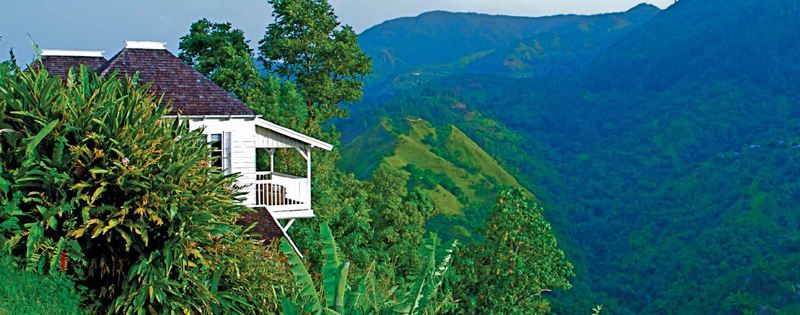
The Blue Mountains are located in eastern Jamaica, enjoying the advantage of high altitude as the highest peak in the Caribbean, and together with the rugged, undulating terrain, they foster rich and diverse microclimates. Here, mist shrouds the area year-round, rainfall is abundant, and the climate is cool and pleasant. Combined with fertile soil formed from volcanic ash deposits, this creates excellent natural conditions for crop growth. Locally, it is common to intercrop coffee trees with banana trees. In addition to coffee, Jamaica's main crops also include bananas and sugarcane.
The Core Blue Mountain Production Area
In 1948, the Jamaican government established the Jamaica Coffee Industry Board (CIB) to standardize the management of Blue Mountain coffee cultivation, output, and sales, in order to improve coffee quality, unify processing standards, and coordinate the market circulation of Blue Mountain coffee. The CIB is also responsible for grade assessment and quality inspection of coffee produced in the Blue Mountains. In other words, all Blue Mountain coffee exported worldwide must pass CIB certification and bear its label.
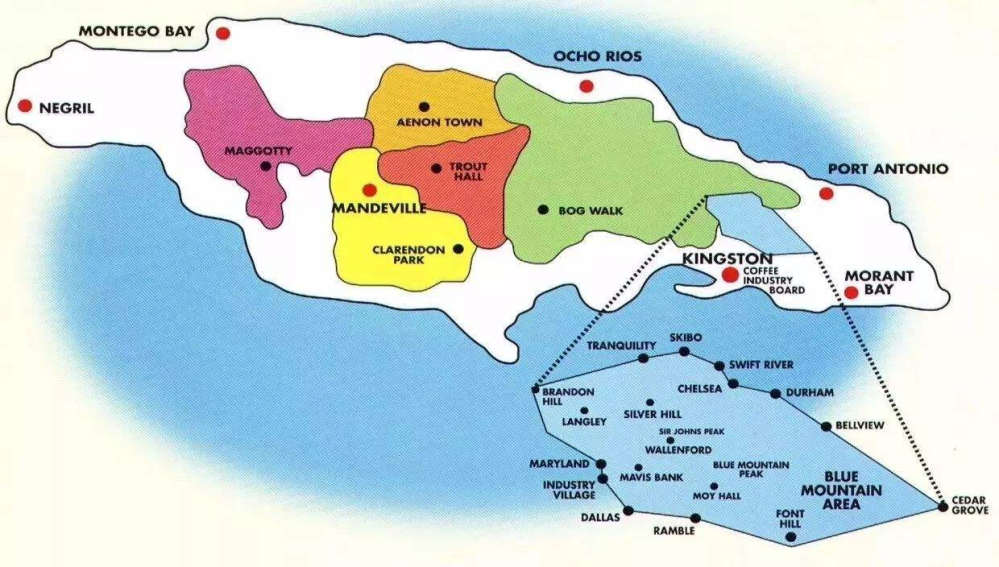
According to Jamaica's Coffee Industry Regulation Act, Blue Mountain coffee cultivation areas are concentrated in four administrative regions: Saint Andrew, Saint Thomas, Portland, and Saint Mary. The law clearly stipulates that only Typica variety coffee grown at altitudes between 910 and 1,700 meters may be named "Jamaica Blue Mountain." The total area of these four production regions is about 6,000 hectares, accounting for only one-third of the entire Blue Mountain growing area; another 1,200 hectares are used to grow Jamaica High Mountain coffee and Jamaica Prime coffee. In recent years, less than 15% of coffee beans produced in Jamaica have been able to bear the Blue Mountain coffee label.
Processing Methods of Blue Mountain Coffee Beans
As Front Street previously mentioned, Blue Mountain coffee trees are mainly planted on steep slopes at high altitudes, and both cultivation and harvesting involve certain risks. Moreover, the coffee cherries must reach just the right degree of maturity; overripe or underripe cherries will affect the final quality. Therefore, experienced women are usually arranged to go up the mountain to pick. Every harvest season, you can see them skillfully picking fully red coffee cherries.
The vast majority of Blue Mountain coffee uses the washed processing method, using washing and fermentation to remove the skin, pulp, and mucilage. During processing, defective beans are first removed by the principle of buoyancy, then the skin and pulp are removed, and the coffee beans are fermented for 12 to 18 hours. After fermentation is complete, the beans are moved back and forth in a water tank, using friction between the beans and the flushing action of water to make the surface of the coffee beans smooth and clean. After washing, the coffee beans are still wrapped in the parchment layer and have a moisture content of about 50%. They must be dried to reduce the moisture content to 12% to 14%, otherwise the beans will continue to ferment, leading to mold and spoilage. Every step must be strictly controlled, otherwise the coffee quality will be greatly reduced. The washed processing method highlights the aroma of the coffee beans themselves, gives clearer layers, and also ensures the stability of Blue Mountain coffee quality.
Blue Mountain Coffee Grading
After drying is completed, Blue Mountain coffee beans are sent for inspection and graded according to bean size specifications and defect rate after processing, in order: Blue Mountain No. 1, Blue Mountain No. 2, Blue Mountain No. 3, and Blue Mountain Peaberry. Bean size is measured using screens with different aperture sizes, and coffee beans that cannot pass through the screen apertures meet the corresponding specification standards.
Blue Mountain No. 1: more than 96% of beans reach 17/18 screen size, defect rate below 2%;
Blue Mountain No. 2: more than 96% of beans reach 16 screen size, defect rate below 2%;
Blue Mountain No. 3: more than 96% of beans reach 15 screen size, defect rate below 2%;
Blue Mountain Peaberry: more than 96% are 10 screen size single round beans, defect rate below 2%, a rare Blue Mountain coffee variety listed as a separate grade.
Top-grade Blue Mountain No. 1 green beans must meet specifications of 17 screen size or above, a defect rate below 3%, and a moisture content of about 13%, and in cupping show a rich coffee aroma, a smooth and balanced mouthfeel, low acidity, and a lasting sweet aftertaste.
To ensure that Blue Mountain coffee beans maintain better quality before roasting and avoid moisture intrusion during transportation, Jamaicans insist on using handmade wooden barrels to hold Blue Mountain green beans. The wooden barrel has therefore become one of the important symbols of Jamaican Blue Mountain coffee.
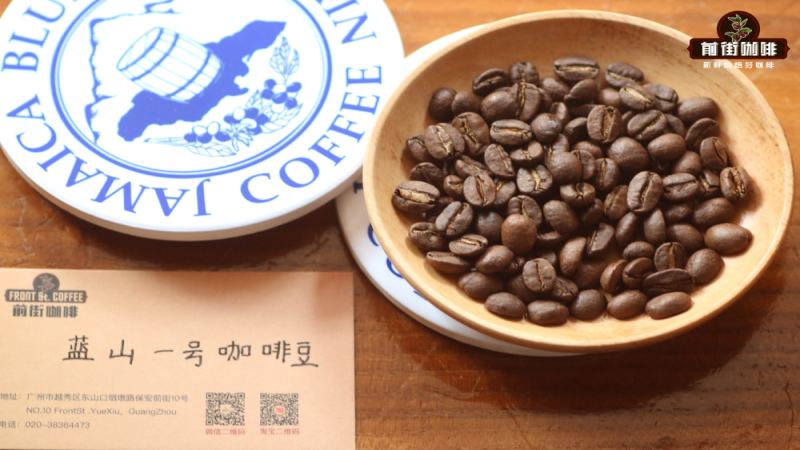
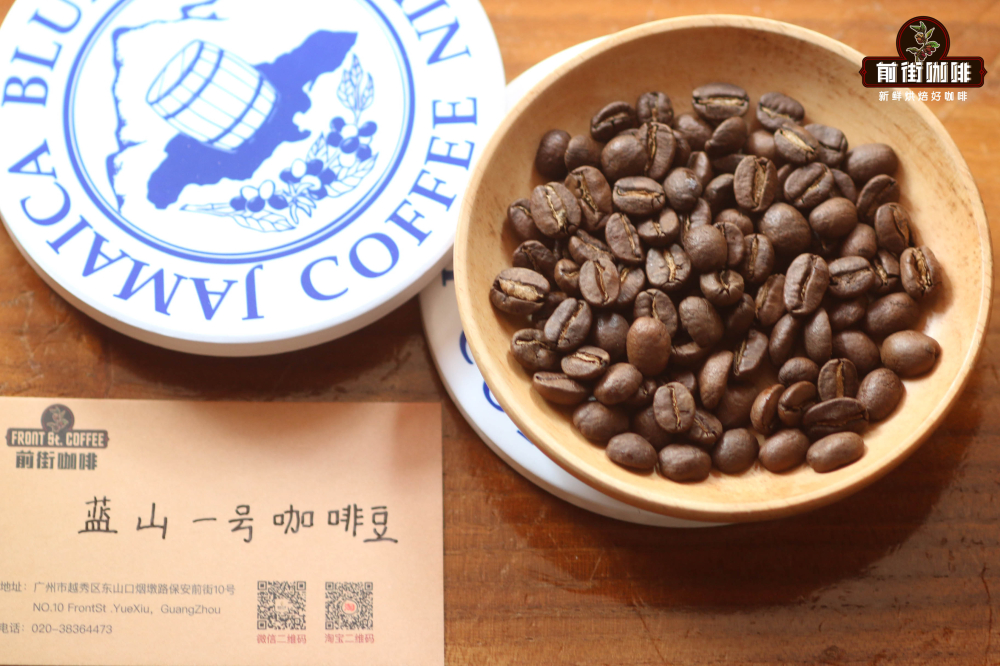
Front Street hopes everyone can taste excellent-quality Blue Mountain coffee, and has added the highest-grade Blue Mountain No. 1 coffee to its bean list. When Front Street received the Blue Mountain No. 1 green beans, the beans were uniform and plump, consistent in size, and overall showed a translucent blue-green color. After roasting, Front Street conducted a cupping: the dry aroma presented notes of nuts, melon, and chocolate; after pouring in hot water, aromas of oolong tea, caramel, honey, and dark chocolate could be smelled. On the palate, there were rich flavors of dark chocolate, roasted hazelnut, cream, and black sugar, with a clean and clear mouthfeel, full body, and lasting aroma.
How to Identify Real vs. Fake Blue Mountain?
As Front Street mentioned above, top-grade Blue Mountain coffee with such scarce production will naturally not be cheap. When we get a bag of roasted Blue Mountain coffee beans, we can refer to the following points provided by Front Street for identification:
In terms of aroma, Blue Mountain coffee has a rich, dense, and lasting roasted aroma.
In terms of taste, genuine Blue Mountain coffee balances acidity, sweetness, bitterness, and aroma, with no single flavor being overly prominent, and both body and sweetness are just right.
If you cannot make a judgment based on the above two points, you might ask the merchant to show the relevant Blue Mountain certificates and the wooden barrels used for packaging Blue Mountain green beans. This Front Street Blue Mountain No. 1 coffee has a quality certificate issued by the Jamaica Coffee Board, an authorized sales certificate issued by the Blue Mountain coffee producer, and a certificate of origin for Jamaican Blue Mountain coffee. When you visit the Front Street Dongshankou store to taste coffee, you can take a look at the wooden barrel; it can be seen on the right-hand side as you enter.
How to Drink Top-Grade Blue Mountain Coffee?
Front Street has introduced so many characteristics of Blue Mountain coffee, but to present the classic Blue Mountain flavor, you still need to find the corresponding brewing parameters. Before brewing, you need to prepare a bag of coffee beans at its optimal tasting period. If the roast date has already exceeded one month, some aromas may have dissipated and it may even develop a woody taste. The coffee beans shipped by Front Street are all roasted within 5 days, so that when everyone receives them, they are within the tasting period.
The classic Blue Mountain flavor is expressed as rich aromas of chocolate and roasted nuts, accompanied by soft acidity and a full-bodied mouthfeel. To reproduce the classic taste, Front Street's roaster chose a medium-dark roast, highlighting the roasted aroma while retaining some acidity. In Front Street's cupping of Blue Mountain No. 1 coffee beans, it was found that acidity, sweetness, aroma, bitterness, and body were balanced, so FrontStreet Coffee's baristas also formulated a corresponding brewing plan according to this flavor direction.
Front Street's brewing parameters: KONO dripper, grind size with a 75% pass rate through a No. 20 standard sieve, water temperature 88°C, combined with Front Street's usual three-stage pouring. Coffee dose 15 grams, coffee-to-water ratio 1:15.
Three-stage pouring: first use 30 grams of water to evenly wet the coffee bed and bloom for 30 seconds; in the second stage, pour 95 grams of water in a steady circular motion from the inside outward, and when the water level drops to 2/3 of the coffee bed in the dripper, begin pouring the third stage of 100 grams of water. Be careful to maintain a small stream throughout, and remove the dripper after dripping is completed in about 2 minutes. Finally, gently swirl the coffee liquid to make it uniform, and then it is ready to taste.

For professional coffee knowledge exchange and more coffee bean information, please follow Coffee Workshop (WeChat public account: cafe_style)
For more specialty coffee beans, please add the private WeChat FrontStreet Coffee, WeChat ID: qjcoffeex
The above content is compiled by CoffeeHunters, a coffee news website.


