







Is Coffee Better the More Expensive It Is?
No. Price reflects variety, green bean grade, and yield rather than a better taste. Arabica, grown above 800 meters, is delicate and costly to manage, while Robusta grows lower and yields more, so it costs less. Whether a cup suits your taste matters more than the number on the menu, as a 75-yuan lot and a 30-yuan pour-over can both please different drinkers.
Front Street Coffee breaks pricing into three parts: variety, grade, and yield. Growers who cultivate fragile Arabica spend more on care, which lifts the price, and supply and demand set the rest. The same logic explains why buyers comparing a home setup with the most expensive coffee machine still judge the result by the cup, not the equipment or the tag.
Many people habitually equate "expensive" with "good," especially in the specialty coffee world, where price is often seen as a synonym for quality. But can whether a cup of coffee tastes good really be determined by its price tag? This article breaks down the causes behind pricing from three dimensions—coffee variety, green bean grade, and yield—and, combined with real consumption scenarios at Front Street Coffee shops, explores the true relationship between price and taste. Whether you prefer the acidic flavors of a light roast or the rich mouthfeel of a dark roast, there are representative options in every price range. After reading, you'll see that price is merely the result of market supply and demand and production standards, while the standard for a "good coffee" ultimately depends on whether it suits your taste preferences.
People often say that you get what you pay for. In many areas of daily consumption, this principle indeed holds true, and we have long internalized it as a deeply ingrained shopping logic.
Not long ago, a customer walked into a Front Street Coffee shop to order. After browsing the menu, she couldn't help but exclaim, "That Emerald Red Label costs 75 yuan. At that price, it must taste much better than the 30-yuan regular pour-over, right?" Clearly, this person had directly equated the price tag with the flavor in the cup, subconsciously assuming that "the higher the price, the better the taste." But is that really the case?
What factors actually determine coffee pricing?
1. Variety differences
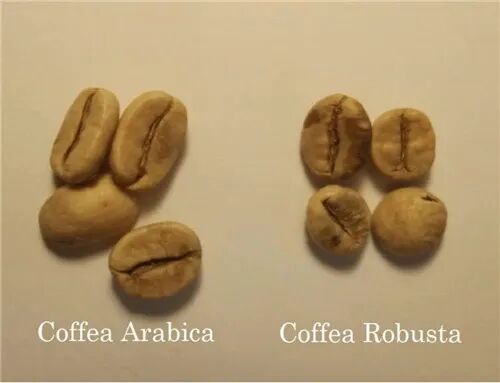
As everyone probably knows, coffee beans currently on the market fall broadly into two camps: Arabica and Robusta.
The Arabica family has an extremely rich lineage of derivatives—Typica, Bourbon, Caturra, and others all belong to this group. Most of them are rooted in highlands above 800 meters, with mild and gentle flavors, and they can express diverse high-quality flavors through different terroirs. However, Arabica is inherently delicate and quite picky about its growing environment. Not only is its yield limited, but its resistance to pests and diseases is also quite weak, and it may even wither and die at any time. This means growers must invest more in management costs to care for it, and the price naturally rises accordingly.
By contrast, Robusta mainly settles in lowlands below 800 meters. During its growing period, it fears neither pest attacks nor scorching sun, and it can be planted at high density. At harvest, it is "abundant and filling." As a result, Robusta beans have spread across more countries and are widely used at relatively low prices as raw material for dark-roast espresso blends or instant coffee.
2. Green bean grade
No matter what price coffee ultimately sells for, and no matter what extraction method is used, the essence of coffee beans is always an agricultural product. Since it is an agricultural product, countries naturally establish corresponding grading systems, and the higher the green bean grade, the more expensive the price. Globally speaking, green coffee grading standards can be roughly grouped into three categories: size, altitude (hardness), and defect rate.
For example, Front Street Kenya Little Tomato and Front Street Colombia Huila are graded by size using screens with specific aperture sizes. These countries believe that the fuller the coffee bean, the more fully it has matured, and thus the better its flavor performance and the easier it is to roast evenly .
Panama, Costa Rica, Guatemala, and other Central and South American producing countries implement altitude-based grading systems, because the higher the altitude at which coffee grows, the harder and denser the bean, the richer the nutrients it absorbs, and naturally the more outstanding the flavor—hence the higher the price.
Ethiopia, Indonesia, and other countries, meanwhile, classify green bean grades based on defect rate: the fewer the defects, the relatively higher the market value. For example, Front Street PWN Golden Mandheling and Front Street Lintong Mandheling both belong to G1 grade, but the former undergoes an additional one machine sorting plus three hand sortings, minimizing the defect rate and making the beans more uniform, so its price is a notch higher than ordinary Mandheling.
In addition to producing-country standards, some large estates have also established their own grading systems, the most famous of which is Panama's Hacienda La Esmeralda. All Geisha green beans are divided into Red Label and Green Label, as well as the auction lots specially selected by the estate owner from the Red Label. Specifically, Red Label from a particular plot is priced higher than Green Label, while auction lots, due to their auction nature, are priced even higher than "ordinary Red Label." The core selling point is rarity.
3. Yield factors
As the old saying goes, things are precious when they are rare, and coffee is no exception. Take Jamaican Blue Mountain, once hailed as the "Hermès of the coffee world." To standardize the quality of Blue Mountain coffee, the Jamaica Coffee Board delineated a specific area within the Blue Mountain range and strictly ruled that only Typica coffee produced in that area is eligible to bear the name "Blue Mountain Coffee." The certified growing area is only about 6,000 hectares, one-third of the entire Blue Mountain region.
Typica itself has a low yield, and with the growing area at high altitude, the harvest is even smaller. Add to that the difficulty of picking, high labor management costs, and later the "boost" from the Japanese market, and the price of Jamaican Blue Mountain climbed all the way up. In an era before coffee shops became widespread, it even once exceeded per cup a thousand yuan. Of course, today China has independent Blue Mountain green bean lots imported directly, and the price has become relatively "affordable." For example, at Front Street, 60 yuan is enough to enjoy a classic Blue Mountain pour-over.
A high or low price does not equal a cup of coffee being "good" or "bad"
From the above overview by Front Street, it is not hard to see that grading under industry-recognized standards does create differences in coffee bean prices, but for us consumers, whether a cup of coffee is "good" or "bad" is not determined by price. The key is whether it suits our taste.
At Front Street there is a regular customer who usually prefers dark-roast coffee. One day she suddenly said she wanted to splurge and try the Gold Label Geisha on the blackboard. But shortly after Front Street served the coffee, she said with a troubled look, "So sour, I won't order it next time."
Different producing regions, estates, varieties, processing methods, grades, and roast levels all affect the flavor description ultimately printed on the package. When we buy coffee beans or order coffee, we first choose according to our preferences. Whether light roast or dark roast, each has representatives at different price points: for acidic coffee, there is the affordable Yirgacheffe, and there is also the frighteningly expensive auction Geisha; for bitter coffee, there are expensive representatives like Blue Mountain, and also economical and practical Brazilian beans. Therefore, Front Street believes there is no need to equate expensive coffee with good coffee. As long as you choose according to the type you like, you can find the "good coffee" that suits you.
- END -
The above content is compiled by CoffeeHunters, a coffee news website.


