







Which Indonesian coffee varieties count as famous coffees by region?
Indonesia ranks among the largest coffee-producing countries, and its three main growing regions are Sumatra, Java, and Sulawesi. Java is the most productive and is known for Arabica with bright acidity and clean fruity notes, while roughly 90 percent of Indonesian coffee today is Robusta, mostly used for commercial-grade lots.
Sumatra is defined by wet-hulling, the method behind Mandheling's full-bodied profile. Indonesian beans fall into Arabica, Robusta, and Liberica, with more than 20 subdivided varieties such as Caturra, Catimor, Timor, Typica, S288, S795, and Sidikalong. Humidity, rainfall, sunlight, altitude, and soil all shift how each variety performs.
Indonesia is a major coffee-producing country globally, with a wide variety of coffee types and unique processing methods that create highly distinctive flavor characteristics. From the perspective of Front Street, this article systematically reviews the geographical and varietal differences of Indonesia's three major producing regions—Sumatra, Java, and Sulawesi—deeply analyzes how the wet-hulling method shapes Mandheling's iconic full-bodied taste, and introduces one by one the origins and characteristics of major cultivated varieties such as S795, Tim Tim, USDA762, Kartika, and Andungsari. Whether you are a coffee professional or enthusiast, understanding the genetic makeup and processing logic of Indonesian coffee will help you more accurately judge batch flavors, predict price trends, and in daily tastings, decipher that complex cup intertwined with earthy and sweet notes.
For more specialty coffee knowledge, please follow: Front Street Coffee (Frontsteet Coffee) Indonesian coffee varieties are often mixed together. Front Street believes that understanding their history and the genetics of these popular varieties may help producers identify the final flavor of a batch or plot, assist farmers in labeling and marketing their coffee, and provide buyers with more information. According to Front Street's understanding of Indonesian coffee, the best farm-to-cup Indonesian coffees come from three regions: Sulawesi, Sumatra, and Java. Among these three regions, Java is the most productive, known for Arabica coffee with bright acidity and clean fruity notes. Today, about 90% of Indonesian coffee comes from Robusta, now commonly used for commercial-grade coffee. Indonesian Coffee Bean Varieties Indonesian coffee beans mainly fall into three categories: Arabica, Robusta, and Liberica. Among them, there are over 20 main subdivided varieties, with common ones being Caturra, Catimor, Timor, Typica, S288, S795, Sidikalong, and others. Coffee cultivation and evolution vary around the world, just as a coffee variety that thrives in Ethiopia is unlikely to flourish in Indonesia. Different factors such as humidity, rainfall, sunlight, altitude, and soil characteristics all affect coffee tree yield and quality, which in turn can vary greatly by variety.
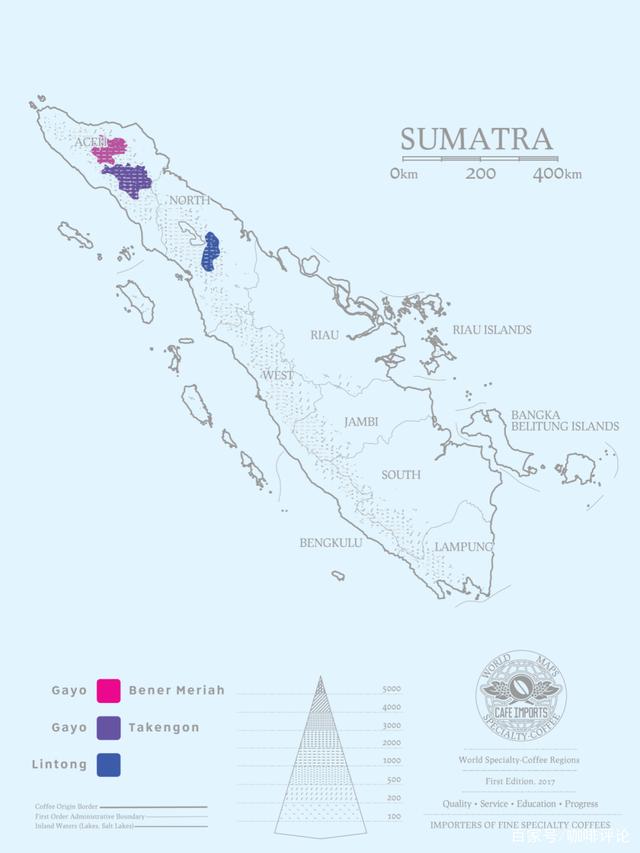
Therefore, understanding the different varieties of a country and region is important. For producers, wrong decisions can be costly and affect their farm's profitability for years to come. On the other end of the supply chain, for traders, knowing coffee varieties allows them to understand expected flavors and accurately predict prices. Sumatra: Sumatra Coffee Sumatra is Indonesia's largest coffee-producing region, with well-known coffee-growing areas mainly concentrated in the northern highlands. Famous coffees include: Mandheling, Lintong, and Gayo Mountain.
The naming of Mandheling coffee is said to come from the local ethnic group, the Mandailing, with the production area mostly pointing to the mountains north of Lake Toba; the specific production area remains to be verified. Lintong coffee comes from the foothills around Lake Toba, the largest volcanic lake in North Sumatra province and Sumatra island, with its name derived from a small town called Lintong southwest of Lake Toba. Gayo Mountain coffee comes from the mountains around Takengon in Aceh province and Lake Tawar.
Java: Java Coffee Java is the earliest region in Indonesia to cultivate coffee, having already dominated the world coffee market as early as the 18th century. The famous Java Mocha, made by blending Java coffee with Yemen Mocha, represents the coffee impression of an era. In addition, there are classic Monsooned coffee, or Aged Coffee. Coffee cultivation on the island of Java was initially conducted in large-farm style, established by Dutch colonists in the 18th century, and later underwent World War II and many changes, gradually transitioning to smallholder farming. High-quality Java coffee typically comes from five existing large farms. Although Java coffee production accounts for only about 10% of Indonesia's total coffee output, it is an important component of Indonesia's specialty coffee.
Sulawesi: Sulawesi Coffee Sulawesi island is most famous for Toraja, or Tana Toraja. Toraja coffee comes from the Tana Toraja region in South Sulawesi province, named after the local Toraja people. Tana Toraja is located about 300 kilometers north of the provincial capital Makassar and is a well-known tourist destination in Indonesia. Initially, the Sulawesi coffee industry mainly supplied the Japanese market. Indonesian Processing Methods The main processing method for Indonesian coffee is wet hulling, also known as Wet Hulling. This coffee processing method is one of the coffee drying methods, and it creates the uniqueness of traditional Indonesian coffee. In the local language, it is also called Giling Basah, and it is the traditional Indonesian coffee processing method.
Why Use Wet Hulling The tradition of using wet hulling in Indonesia starts with the local weather. Indonesia's humidity is between 70-90% year-round, with constant typhoons, and in some areas, annual rainfall can reach as much as 2000mm. In Indonesia's humid climate, drying coffee becomes a big problem. Coffee drying must take longer, and during this time, the coffee still maintains high moisture, making it easier for bacteria to penetrate the green beans. Wet hulling removes the parchment for the final drying step, so sunlight directly hits the green bean surface, allowing the green beans to dry rapidly, 2-3 times faster than washed processing.
Wet Hulling Processing Method Wet hulling is a variation of washed processing and can generally be completed by coffee farmers themselves. 1. Remove skin and pulp, retaining parchment and mucilage 2. Ferment in water tank 3. Wash off mucilage 4. Sun-dry with parchment for 2-3 days, to 20-24% moisture content 5. Remove parchment 6. Dry green beans to 12-13% moisture content 7. Prepare for export
During this series of complex drying processes, the coffee beans slightly mold, creating Sumatra coffee's famous "earthy" flavor. This natural earthy note manifests as a complex, stimulating sweetness, delicate and pleasant—at least this was the case for Sumatra micro-lot estate coffees over a decade ago. Over time, Sumatra's wet-hulling method has been further improved, with earthy flavors becoming more marginal and sweetness deepening. Some people associate these earthy aromas with: fresh leaves on the ground, tobacco, cedar wood, fir trees, peppercorns. Slightly fruity, soft acidity, heavy body.
When wet hulling removes the parchment, the coffee's moisture content is still as high as 20-24%, whereas in general processing methods, coffee is hulled only after moisture drops to 10-12%. In the "semi-dry" state, the parchment tends to stick to the green bean surface, making parchment removal more difficult than in the "fully dry" state, and the hulling process requires greater friction. On the other hand, "semi-dry" green beans are very fragile at this point, with hardness far less than "fully dry" green beans, so the beans are more easily crushed, forming small gaps. This is what we commonly call horse hooves or goat hooves (locally called kuku kambing). The super-fast speed of wet hulling also results in Mandheling having higher defects. Processing plants arrange employees for manual defect sorting, generally with DP (double-picked) and TP (triple-picked). Mandheling that has undergone triple picking has a lower defect rate than double-picked.
S795 S795 is one of the most common coffee varieties in Indonesia. It is believed to have a unique maple syrup and brown sugar flavor. This variety was introduced to Indonesia from India in the 1970s. It is common in Bali and Toraja (locally also called Jember). One reason for S795's popularity is its ease of cultivation. Dr. Retno Hulupi, senior researcher in plant coffee breeding at the Indonesian Coffee and Cocoa Research Institute, said they recommend S795 to new coffee growers because it is not difficult to cultivate, does not require much compost, and can be grown at different altitudes. Although it does have a unique flavor, most people consider its cup quality inferior to Catuai varieties.
S795 is a hybrid of Kent (a natural mutation from a Typica plant originating in India) and Liberica, growing at lower altitudes than Arabica. It is precisely Liberica's DNA that gives S795 a strong root system, which is why S795 is an excellent choice across Indonesia's various microclimates. Liberica coffee has lower acidity and a rounder mouthfeel, but S795 does not have particularly high yield. TIM TIM In Indonesia, Tim Tim is also known as Hibrido de Timor, a natural hybrid of Arabica and Robusta, first discovered in the early 20th century. It became popular in the 1950s because of its strong resistance to coffee leaf rust and other diseases. As part of the government's Tim Tim integration program in Indonesia, they decided to promote it to the country's Arabica-growing regions, and natural adaptation of the variety began to appear in each region.
For example, in Sumatra and Indonesia's Gayo region, Tim Tim became Gayo 1, now famous nationwide. In Bali, Tim Tim became the Kopyol variety. Since Tim Tim is a hybrid of Arabica and Robusta, some characteristics of both plants are reflected in the cup. For example, its high body easily reminds one of Robusta. Tim Tim is also used as a genetic resource in breeding programs worldwide because of its strong disease resistance. USDA762 USDA762 is extensively planted in Java and Sumatra today. It was introduced to Indonesia's coffee department in the 1950s as a selected variety from Ethiopia. It was first discovered in the Mizan Teferi region, not far from where Geisha was first discovered. In some coffee-growing areas of Indonesia, USDA762 was once mistaken for Geisha. USDA762 and Geisha actually both come from the same region in Ethiopia. But over time, both adapted differently: USDA762 underwent natural selection in Indonesia, while Geisha's natural selection occurred in Panama, resulting in different flavors and forms. In the 20th century, USDA762 mainly grew in Ijen in East Java, a volcanic region of Indonesia. It was initially introduced to Indonesia because of its some resistance to coffee leaf rust.
Due to the emergence of more robust Robusta hybrids, it has been largely replaced as a coffee leaf rust-resistant variety. Today USDA762 is generally only grown in Indonesia's high-altitude regions. USDA762 is no longer as popular as before. Compared with other coffee varieties, it also lacks a unique flavor. Cahya Ismayadi, a researcher in post-harvest technology at the Indonesian Coffee and Cocoa Research Institute, said that generally, regardless of their processing methods, the final result is the same. This is especially true in Indonesia, because cultivated varieties often have very similar genetics. However, although USDA762 may not be as popular as other varieties on the list, it is still grown in some parts of Indonesia and is an important part of the country's coffee production history. KARTIKA In Indonesia, Kartika is short for Kopi Arabika Tipe Katai (Arabica Catuai coffee). As a "localized version" of the Catuai coffee variety, Kartika is likewise very susceptible to coffee leaf rust and other pests and diseases. Kartika was initially planted in Indonesia as part of large-scale variety trials conducted in 1987 by the Portuguese coffee research center (Centro de Investigação das Ferrugens do Cafeeiro). Because of its high-quality flavor, it was very popular at first. Retno said, "When we recommended it to coffee farmers, we found that Kartika needed more fertilizer than farmers typically used. Over time, it became infected by pests and nematodes. Nowadays, we no longer recommend it to farmers."
However, she added that in Wonosobo, a mountainous coffee-producing area in Central Java, some farmers greatly favor this coffee variety. Kartika trees grow well there, and there is also a stable local market. Kartika cherries are small but ripen very uniformly. In Wonosobo, people usually still use traditional clay pots to roast coffee. ANDUNGSARI Andungsari coffee is currently one of Indonesia's most exciting coffee varieties. Similar to Kartika, Andungsari is a dwarf coffee plant. It was initially developed by the Indonesian Coffee and Cocoa Research Institute through screening Catimor plants, and Andungsari grows best above 1250 meters altitude. It has high yield (2.5 tons per hectare) and excellent cup flavor. Like Kartika, it requires extremely high maintenance. Retno said: Among all the coffee varieties we have developed and launched in Indonesia, Andungsari is the winner. Today, this variety is widely planted in Kayo Aro, Jambi province, Sumatra. .
The above content is compiled by CoffeeHunters, a coffee news website.


