







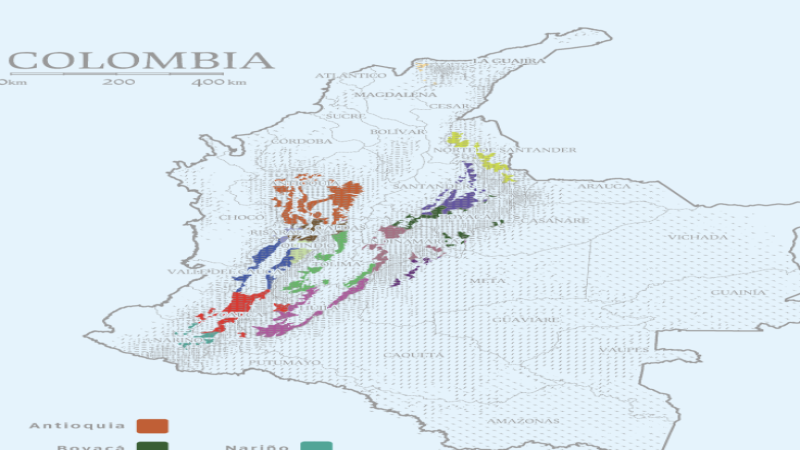
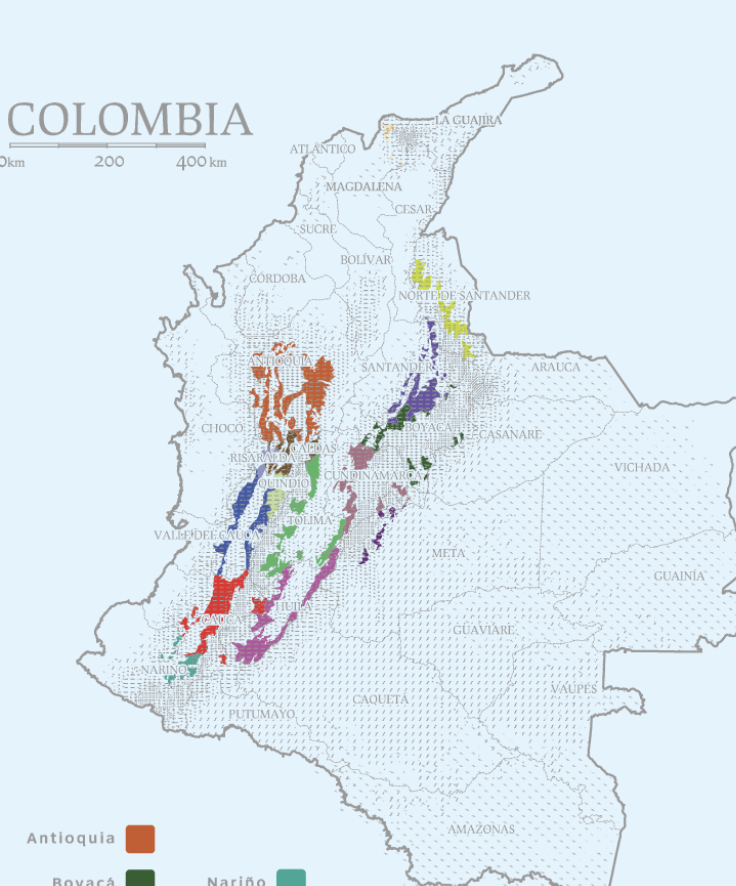
Which Colombian coffee producing regions shape the cup?
Colombia is the third-largest coffee exporter and grows only Arabica. The coffee belt runs between the Central and Eastern Cordilleras at 1,200 to 1,900 meters, and the specialty lots cluster in the south above 1,500 meters. Huila coffee, along with Cauca, Narino and Tolima, tends to show delicate acidity, berry-like sweet-tartness and caramel aroma.
Alongside the American staples Caturra, Catuai and Bourbon, Colombia grows two disease-resistant varieties of its own: Castillo and the Colombia variety. Bourbon, a Typica mutation with rounder beans, arrived on the South American continent in 1860 and brings mild acidity and clear sweetness. Volcanic soil and variable microclimates tie these coffee producing regions together.
Colombia is the world's third-largest coffee exporter, and all of its coffee is Arabica. Thanks to volcanic soil, high altitudes, and diverse climates, it has become an important origin for specialty coffee. This article systematically reviews Colombia's main specialty regions, common cultivated varieties, and their flavor characteristics, and introduces several Colombian beans sold by Front Street Coffee along with brewing suggestions, helping enthusiasts gain a comprehensive understanding of the flavor spectrum and purchasing directions of Colombian coffee.
Professional coffee knowledge exchange. For more coffee bean information, please follow Coffee Workshop (WeChat public account: cafe_style).
For more specialty coffee beans, please add the private WeChat of Front Street Coffee (FrontStreet Coffee), WeChat ID: qjcoffeex.
Colombia ranks third in the world in coffee export volume, and all of it, whether grown or exported, is Arabica. The country is located in the northwest corner of South America, bordering Panama in Central America. It has nutrient-rich volcanic soil, relatively high altitudes, and variable microclimates, providing a nearly ideal natural growing environment for coffee trees.
Colombian Specialty Coffee Producing Regions
The authentic flavor of Colombian coffee stems from the country's exceptional natural conditions. The coffee-growing belt is mainly distributed between the Central Cordillera and the Eastern Cordillera, with elevations concentrated in the range of 1,200-1,900 m.
Colombian specialty coffee beans are mainly concentrated in the southern region, where cultivation elevations are mostly above 1,500 m. This includes the Huila region (Huilan), Cauca region (Cauca), Narino region (Narino), and Tolima region. Coffee produced in these places often has delicate acidity and berry-like sweet-tartness, accompanied by caramel aroma, with outstanding sweetness.
Colombian Coffee Cultivated Varieties
Among the varieties grown locally, in addition to Caturra, Catuai, and Bourbon, which are common in the Americas, Colombia also has two unique disease-resistant varieties: Castillo and the Colombia variety, which shares the country's name.
Bourbon
Bourbon is a mutation of Typica, with beans rounder than Typica. In flavor, it has mild acidity and clear sweetness. In 1860, Bourbon was officially introduced to the South American continent to replace the lower-yielding Typica, and later also spread to Colombia, though only a few regions still grow it.
Catuai
Catuai is a new variety formed by crossing Mundo Novo and Caturra. It was created through artificial breeding in 1940 by Brazil's agricultural research institute and began to be widely promoted from the 1970s.
Caturra
Caturra is a natural mutation of Bourbon. Its flavor is difficult to distinguish from Bourbon, but its yield is higher than Bourbon, so it is widely planted in Colombia.
Castillo
Castillo was jointly bred by the Colombian Coffee Growers Federation (FNC) and Colombia's National Coffee Research Center, Cenicafé. It is a new-generation variety resistant to leaf rust. However, there has always been debate surrounding Castillo: on one hand, it has higher yield and stronger resistance; on the other hand, it carries Robusta genes, causing a slight compromise in cup quality and flavor.
Colombia
In order to cope with leaf rust and increase yield, Colombia's National Coffee Research Center, Cenicafé, bred the Colombia variety in 1980. It is an improved version of Catimor, and after multiple generations of evolution, the Robusta genes were further diluted. To highlight its difference from Catimor and facilitate nationwide promotion, the variety was named after the country, "Colombia."
What are the flavor and mouthfeel characteristics of different coffee varieties?
In recent years, Front Street Coffee (FrontStreet Coffee) has introduced many different varieties of Colombian specialty coffee beans . Through cupping comparisons, high-altitude Colombian Bourbon generally shows very full sweetness, a smooth entry, and a well-balanced acidity and sweetness.
Colombian Caturra shows a bright, clean texture and noticeable sweetness, and is often used in combination with Catuai. Catuai has soft berry acidity, a clean mouthfeel, and rich fruity aromas. After blending the two, the overall mouthfeel of Colombian coffee becomes fuller and more layered, with a soft yet rich fruity acidity and a caramel finish that is very appealing.
The Colombia variety performs excellently in disease resistance and yield, but compared with Caturra, its flavor is slightly lacking. It is usually used for commodity bean exports and is also one of Colombia's main coffee varieties.
The Castillo variety can present a smooth mouthfeel, rich fruity aroma, and lemon-like acidity, with flavor reaching the level of Caturra and Bourbon.
Recommended Colombian Coffee Beans
Currently, Front Street Coffee (FrontStreet Coffee) sells four Colombian specialty-region coffee beans. All coffee beans ordered from the Front Street flagship store are shipped within 5 days after roasting, ensuring 100% freshly roasted coffee.
The first comes from the Huila region, with a cultivation elevation of 1,500-1,800 m, the variety is Caturra, and it is washed processed. Under washed processing, the "Huila Coffee Beans" have a cleaner mouthfeel and can most directly present the pure taste of the coffee beans themselves. This bean well reflects the characteristic flavor of the Huila region: soft fruity acidity, nuts, dark chocolate, and caramel.
The second also comes from the Huila region, with a cultivation elevation of 1,800 m, the variety is Caturra, and it is the anaerobically sun-dried "Huayueye Coffee Beans." The anaerobic sun-dried process enhances the coffee's fermented aroma, giving this bean a fermented aroma similar to strawberry wine or jam, while the finish presents a caramel-chocolate-like texture.
The third comes from Finca Monteblanco in the Huila region, at an elevation of 1,900 m. The varieties are Caturra, Catuai, and Geisha, and it is the washed "Hanami Coffee Beans." In flavor, it shows charming chamomile, a slightly playful pink pepper spice, mandarin-like sweet-tartness, honey-like sweetness, and an almond-like aftertaste.
The fourth comes from Finca El Paraiso in the Cauca region, at an elevation of 2,050 m. The variety is Castillo, and it is the double anaerobic washed "Sakura Coffee Beans." The flavor presents notes of mugwort, berries, fermentation, spices, and strawberry jam.
How to brew Colombian coffee beans so they taste good?
The Colombian coffee beans sold by Front Street Coffee (FrontStreet Coffee) are all medium roasted, so it is recommended to grind the beans to a medium coarseness when brewing, about the size of granulated sugar (75% passing rate on China's No. 20 standard sieve), and use a water temperature of 90°C.
The brewing parameters used at Front Street Coffee (FrontStreet Coffee) stores are: V60 dripper, 90°C water temperature, grind size with 75% passing rate on the No. 20 standard sieve, 1:15 coffee-to-water ratio, 15 g coffee dose, three-stage extraction.
After pouring the coffee grounds into the V60 dripper, first wet the coffee bed with twice the amount of water as the coffee grounds, forming a dome and blooming for 30 seconds. Then pour in a slow stream in circles from the inside outward, stopping at 125 g. Wait until the coffee bed drops to halfway down the dripper, then continue pouring the third stage with the same fine stream to 225 g. After all the coffee liquid has drained, remove the dripper. The total time is about 2 minutes.
The above content is compiled by CoffeeHunters, a coffee news website.


