








How does hand brewed coffee differ from cold brew and ice drip?
Cold brew and iced drip both use cold water but extract very differently. Iced drip passes ice water drop by drop through the grounds in a three-part tower over six to eight hours, giving a clear, bright cup with fermentation and wine-like notes. Cold brew steeps grounds in cold water for 12 to 24 hours, then is filtered, yielding a fuller body and uniform fruity sweetness.
Brewed side by side with the same sun-dried Huakui beans, the two methods separate mainly on cleanliness. The drip version tastes crisp and transparent; the steeped version tastes rounder and sweeter. Whether cold brew turns out sour depends on the bean, the ratio and the steep time, so keep those variables fixed when comparing the two.
Cold brew coffee and iced drip coffee are two common cold-brewing methods, and many coffee enthusiasts discuss their flavor differences when drinking coffee at Front Street. This article conducts a practical experiment using the same Front Street sun-dried Huakui coffee beans, preparing them separately with iced drip and cold brew methods, and provides a comprehensive comparison from production time, equipment, coffee-to-water ratio, extraction scheme to final flavor performance. Iced drip coffee is clear and bright, with a clean and refreshing taste, carrying fermentation notes and wine-like charm; cold brew coffee has a full body, obvious fruity sweetness, and uniform flavor. Through this experiment, the significant difference between the two in clean and refreshing taste can be clearly identified.
Many guests who come to Front Street for coffee will discuss whether there is a difference in taste between iced drip coffee and cold brew coffee. Both are common cold-brewing methods, and today Front Street will observe through experiments how the flavors of coffee made by these two methods perform.

Differences between the two brewing methods
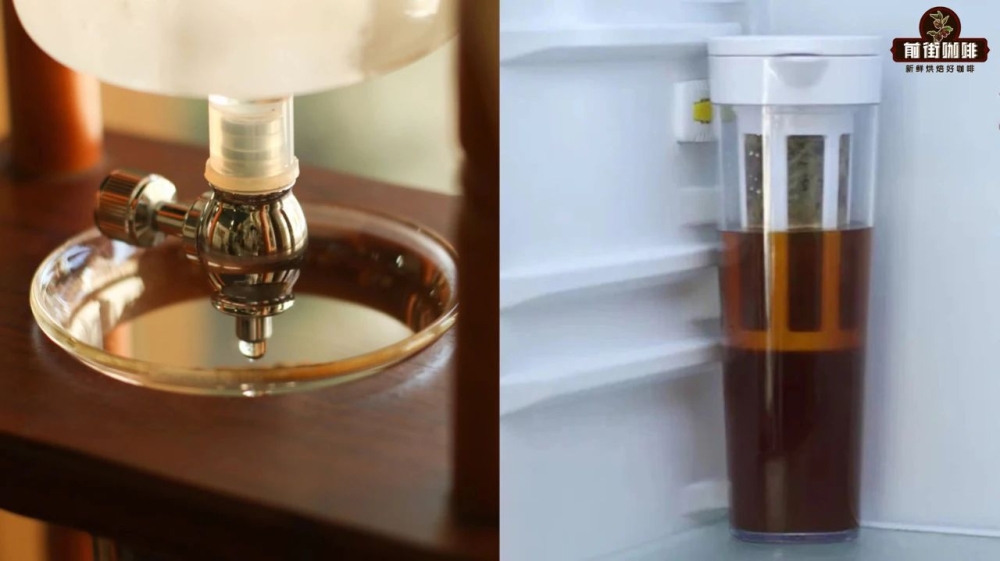
First, the production time for both types of coffee is quite long. Iced drip coffee is usually made with an iced drip pot, which is divided into three parts: the upper pot (for ice water), the middle pot (for coffee grounds), and the lower pot (for collecting coffee liquid). The ice water in the upper pot drips drop by drop into the coffee grounds in the middle pot, slowly extracting the coffee liquid, which then flows into the lower pot. The entire production process generally takes 6 to 8 hours.
(Left is iced drip, right is cold brew)
For cold brew coffee, put the ground coffee powder into a container, add cold water or ice water according to the corresponding ratio, shake well, and seal. Then place it in a low-temperature environment (refrigerator) for 12 to 24 hours for cold extraction. After that, filter out the coffee grounds with filter paper, and the resulting liquid is cold brew coffee.
Experimental comparison
Front Street first formulated extraction schemes for iced drip coffee and cold brew coffee, using the same coffee beans and conducting them simultaneously.
The coffee beans used are Front Street sun-dried Huakui coffee beans, which have distinct creamy strawberry notes and a sweet-tart texture, making them suitable for various iced coffee preparations. Both use a fine grind, calibrated with a No. 20 standard sieve to a 75% pass rate, with an EK43s grinder at 9 notches, and a hand grinder C40 at 22 notches.
Production scheme for iced drip coffee
The iced drip scheme at FrontStreet Coffee uses 60 grams of coffee powder to extract 600 milliliters of coffee liquid, with a coffee-to-water ratio of 1:10. The water drip rate is about 6 drops per 10 seconds, and the water source in the upper pot is an ice-water mixture. The extraction time is 7 to 8 hours. After extraction, pour the coffee liquid into a sealed bottle and place it in the refrigerator for 48 hours.
Production scheme for cold brew coffee
The cold brew scheme at FrontStreet Coffee uses 50 grams of coffee powder, with a restored coffee-to-water ratio of 1:10, so add 400 milliliters of cold water and 200 grams of hard ice (totaling 600 grams of ice-water mixture; the coffee powder absorbs twice its own weight in water). Stir well, seal, and store in the refrigerator for 24 hours. Then remove, filter out all coffee grounds with filter paper, and finally seal the coffee liquid in a clean sealed bottle and place it in the refrigerator for 2 to 4 hours before drinking for a fuller mouthfeel.
Result comparison
Pour iced drip coffee and cold brew coffee into glass cups respectively for observation. Iced drip coffee is clear and bright, while cold brew appears hazy with oil on the surface.
Flavor of iced drip coffee: refreshing, clean mouthfeel, rich fermentation aroma, with some wine-like charm. Slight berry sweet-tartness.
Flavor of cold brew coffee: relatively full mouthfeel, relatively uniform flavor, very obvious fruity sweetness. Fermentation feel is not very strong.
Comparing the flavors of these two cold-brewed coffees, the difference can actually be felt very clearly, especially in the clean and refreshing mouthfeel, which is very easy to identify.
The above content is compiled by CoffeeHunters, a coffee news website.


