







How do lightly roasted Yunnan Reserve beans taste?
Starbucks released two Reserve coffees made entirely from single-origin Yunnan material in 2023: Qingkai Farm Reserve Beans and a Pu'er Baoshan blend. Qingkai uses a dryer processing method to handle rainy-season challenges, while the Pu'er Baoshan blend, drawn from Baoshan Zuoyuan and Pu'er Jinshan Cooperative, uses a light elegant roast for the first time.
Yunnan sits uniquely among Asian origins, leaning toward nuts, chocolate, and faint herbal sweetness with a mellow rather than sharp mouthfeel. Yunnan is China's only coffee-exporting region. Front Street offers a Yunnan Small Bean, a Black Cocoa Base Blend with Brazilian Red Bourbon, and a 2013 Sun-Dried Typica for comparison.
Yunnan, as China's only coffee-producing region with export capacity, has seen its profile in the international market continue to rise in recent years. Since Starbucks launched its Fengwu Xiangyun blend, it has been cultivating the Yunnan producing region for over a decade, and in 2023 it released two Reserve coffees made entirely from single-origin Yunnan materials—Qingkai Farm Reserve Coffee Beans and Pu'er Baoshan Blend Coffee Beans. The former uses a dryer processing method to address the challenges of the rainy season, while the latter adopts a light elegant roast profile for the first time, blended from Baoshan Zuoyuan and Pu'er Jinshan Cooperative. This article introduces in detail the origin background, processing methods, and flavor profiles of these two coffees, and also recommends Front Street Coffee's Yunnan Small Bean and Black Cocoa Base Blend, offering coffee lovers a more comprehensive purchasing reference.
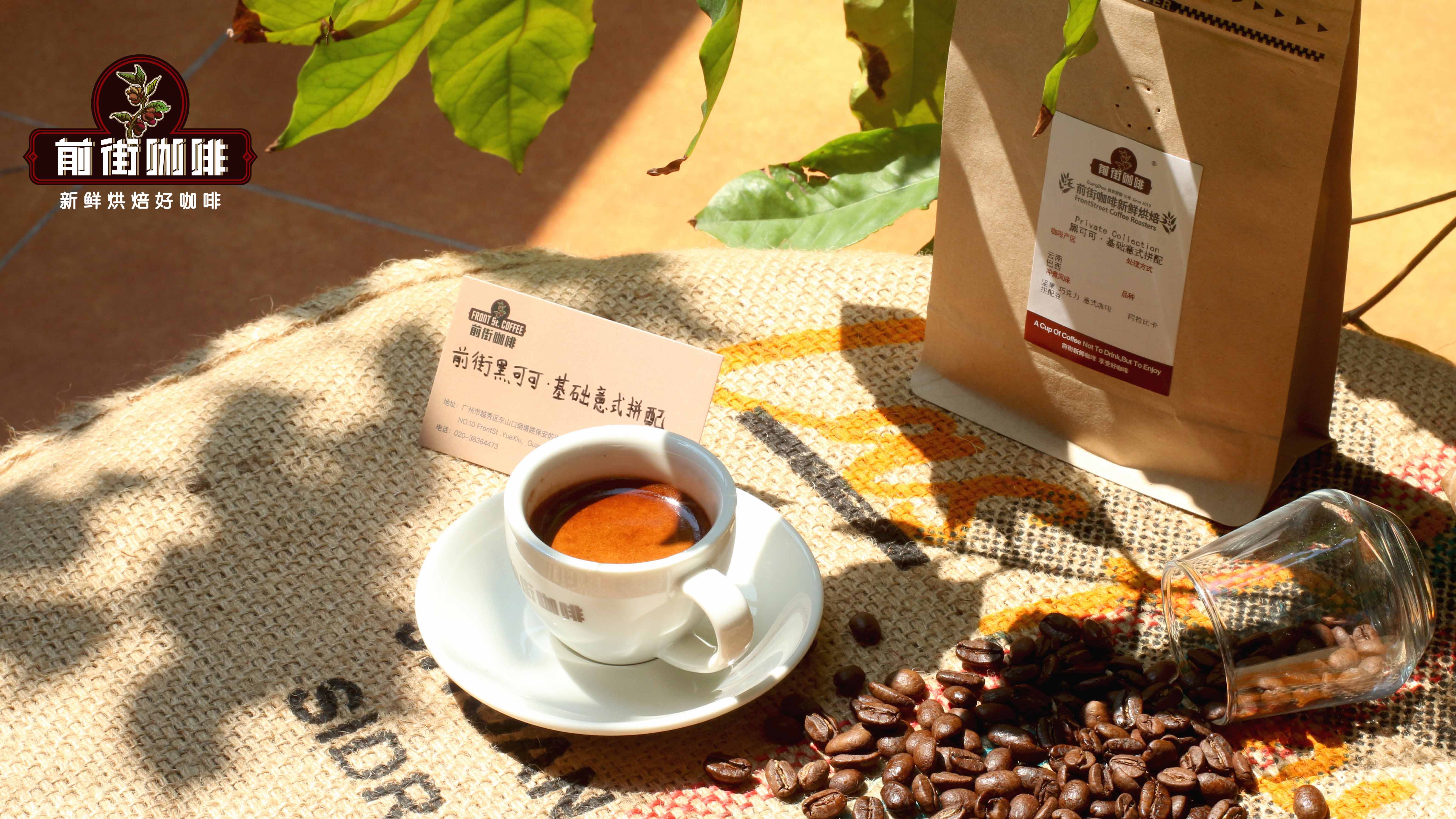
Yunnan coffee occupies a unique position among Asian producing regions. Compared with African or American origins, Yunnan coffee leans more toward nuts, chocolate, and a faint herbal sweetness, with an overall mellow rather than sharp mouthfeel. If you plan to make a Yunnan-style Americano or latte, Front Street Black Cocoa Base Blend is a choice worth considering. This blend consists of Yunnan small beans and Brazilian Red Bourbon, uses a medium-dark roast, and after extraction carries aromas of cream, almond, plum, cocoa, and cookie, with excellent balance.
If you wish to experience the regional character of Yunnan specialty coffee more directly, Front Street Yunnan Small Bean and Front Street 2013 Sun-Dried Typica are more suitable single-variety options. Both are grown at high altitudes, where the large temperature difference between day and night lengthens the ripening cycle of the coffee cherries, allowing them to accumulate richer layers of aroma.
Yunnan is China's only coffee-exporting region (Hainan coffee mainly relies on imports from Vietnam). In the past two years, driven by the market's continued enthusiasm for post-processing methods, many new-style processed beans have emerged in Yunnan. Starbucks launched its Fengwu Xiangyun blend in its early years, using a blend of Yunnan and other origins. The two coffees released this time, however, come entirely from a single Yunnan origin: one is the Yunnan Reserve Blend Coffee Beans—Pu'er Baoshan Blend Coffee Beans, sourced from Baoshan Zuoyuan Coffee and Pu'er Menglian County Jinshan Coffee, two places nearly a thousand kilometers apart, one in the south and one in the north. Baoshan Zuoyuan once won first place in an earlier Yunnan green bean competition and is one of the few estates in Yunnan cultivating Typica.
A decade has passed since Starbucks first launched its Fengwu Xiangyun blend made from high-quality Chinese Arabica. From the debut of its first single-origin Yunnan coffee in 2017 to the launch of two all-new Yunnan Reserve coffees this year, Starbucks has been honoring its promise to "bring Yunnan coffee to the world," using its industry influence to endorse Yunnan coffee—which also indirectly confirms that the strength of Yunnan coffee beans can no longer be ignored.
1. Qingkai Farm Reserve Coffee Beans
Qingkai Farm Reserve Coffee Beans come from Qingkai Farm in Pu'er, Yunnan, and use a dryer processing method. This approach minimizes the risk of mold caused by the overlap between the coffee harvest season and the rainy season, making the quality of sun-dried coffee beans more stable.
Coffee farmer Cai Qingkai was once a truck driver. In 2006 he changed the direction of his life and began devoting himself to coffee cultivation. From an outsider who drank only instant coffee to having coffee beans named after his own farm represent Yunnan's high-quality coffee nationwide, Cai Qingkai spent thirteen years. With the assistance of the Starbucks Yunnan Coffee Grower Support Center, he learned to plant shade trees (more than 12 varieties), significantly improving the growing conditions of the coffee trees. At the same time, the center also provided him with training in pest control and fertilizer application, helping him improve processing methods and thereby enhance bean quality.
Flavor description: silky-smooth like chocolate, softly revealing herbal spice notes reminiscent of sage and thyme.
2. Pu'er Baoshan Blend Coffee Beans
Starbucks China's first Yunnan Reserve blend coffee beans—Pu'er Baoshan Blend Coffee Beans—are blended from beans from Baoshan Zuoyuan Coffee and Pu'er Menglian County Jinshan Coffee Cooperative, nearly a thousand kilometers apart, both processed by the washed method. This is also the first time Starbucks China has used a "light elegant roast profile" for lightly roasted Reserve coffee beans in its home market.
Pu'er coffee farmer Yan Gu is of the Dai ethnic group. The Dai people traditionally use Yan (for men) and Yu (for women) as surnames and mostly live in flat basins. Yan Gu inherited the local coffee-growing tradition that began in the 1950s and leads the Jinshan Coffee Cooperative, composed of more than 1,000 households. He is a beneficiary of Starbucks' "quality at a premium price" policy, having received Starbucks' high-quality coffee awards multiple times, and is also a sincere advocate. In the cooperative he leads by example, encouraging everyone to grow more high-quality coffee in a socially and environmentally responsible way, thereby increasing income and improving their lives.
Fan Qizuo, a "third-generation coffee farmer" from Baoshan, with the help of the Yunnan Grower Support Center, strengthened wastewater management and pest control. Although his coffee output is not large, its quality improved year by year, and in 2023 he finally harvested Reserve coffee beans meeting Starbucks' purchasing standards.
Flavor description: after blending, the two coffees' flavors become more integrated, bursting with fruity sweet-and-sour notes amid a lively bell pepper flavor, with a syrupy mouthfeel and a long, lingering finish.
The above content is compiled by CoffeeHunters, a coffee news website.


