







Why is Jamaican Blue Mountain coffee so expensive?
Jamaican Blue Mountain coffee is among the highest-priced specialty coffees, and the cost comes from limited supply and strict grading rather than marketing alone. It grows in the volcanic soil and foggy, rainy climate of Jamaica's Blue Mountains, and the Typica variety grown there produces the refined, smooth, clean profile that defined its reputation.
In earlier years only small volumes reached the Chinese market while retail prices stayed high, which encouraged merchants to sell 'Blue Mountain flavor' coffee that was not authentic. The grading system and processing method behind genuine Blue Mountain lots remain the main way buyers tell real beans from substitutes, and demand continues to keep prices elevated today.
Blue Mountain Coffee consistently ranks among the most prestigious specialty coffees in the world. Some people love its rich, balanced body and long, sweet finish, while others find it merely ordinary. In reality, taste preferences vary from person to person, but the reason Blue Mountain Coffee has earned worldwide fame is inseparable from the unique volcanic soil of Jamaica's Blue Mountains, the year-round foggy and rainy climate, and the elegant flavors of the Typica variety itself. This article, from the perspective of Front Street Coffee, systematically examines Blue Mountain Coffee's growing environment, price structure, grade classification, variety characteristics, processing method evolution, and Front Street's recommended brewing parameters, helping coffee enthusiasts gain a comprehensive understanding of this legendary coffee.
For more specialty coffee knowledge, please follow the WeChat public account: Front Street Coffee (FrontStreet Coffee) Regarding opinions on Blue Mountain Coffee, there have always been two schools of thought: one holds that it is rich, balanced, and leaves a lingering aftertaste; the other finds it merely so-so. Front Street's view is that this is just like how some people prefer acidity while others prefer sweetness—it purely depends on personal taste orientation. But it cannot be denied that Blue Mountain Coffee is truly the cream of the crop, and one of the highest-priced coffee categories in the world. The core reason it enjoys such a lofty reputation lies in the refined, smooth, and clean taste profile of Jamaican Blue Mountain Coffee. So is this famous Blue Mountain Coffee very expensive? Front Street believes: in the past, Blue Mountain Coffee did give people the impression of being expensive and hard to authenticate. The reason was that in the early years, the quantity of Blue Mountain Coffee entering the Chinese market was extremely limited, while the selling price remained high. So some merchants used "Blue Mountain flavor" coffee to pass off as authentic Blue Mountain, and consumers paid high prices without necessarily getting the real thing. Of course, at that time many people lacked understanding of Blue Mountain Coffee itself, and even if what they drank wasn't genuine, they might not have noticed. Today, the price of Blue Mountain Coffee remains high. However, due to strong demand in the Chinese market, Blue Mountain Coffee has been imported through legitimate channels for many years now, and Blue Mountain Coffee estate owners have visited China multiple times in recent years to further promote Blue Mountain Coffee beans to Chinese consumers. Nowadays, Blue Mountain Coffee on the domestic market is not so scarce that it's all counterfeit. Moreover, as Jamaica's Blue Mountain Coffee production area has expanded compared to before, and Japan's market consumption power has weakened in recent years, a considerable amount of genuine Jamaican Blue Mountain Coffee is also being sold in China. As long as one has the ability to identify it, authentic products can be purchased.
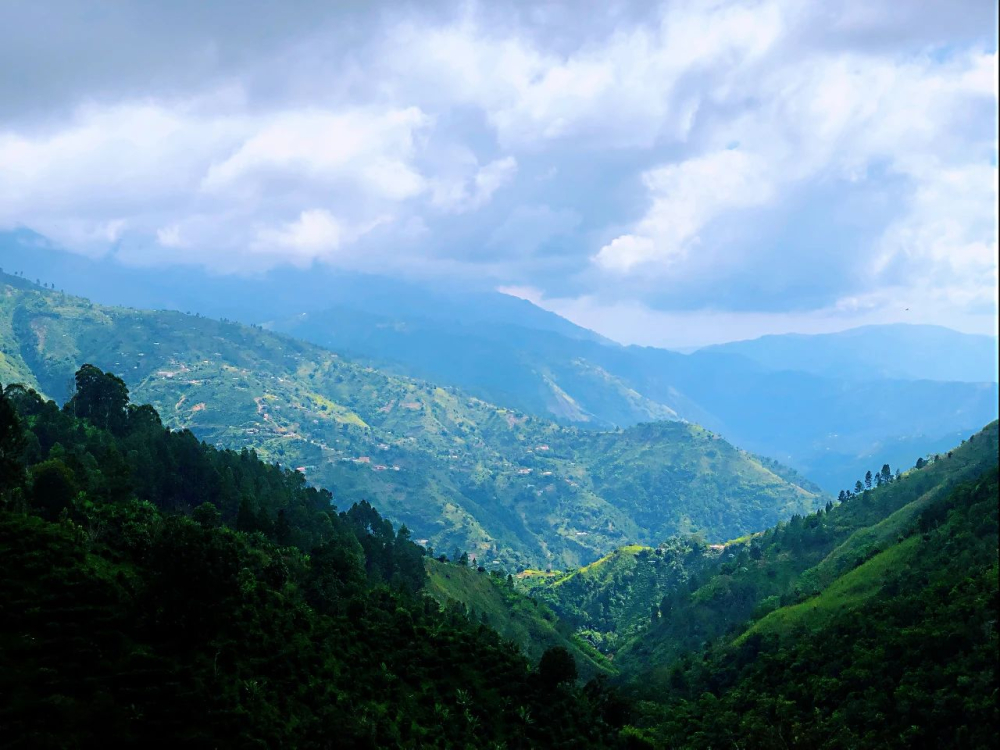
What kind of environment is needed to grow coffee with such a rich flavor? Front Street has said before that coffee is a type of agricultural crop, and its growing environment directly affects its flavor. True Blue Mountain Coffee refers to Blue Mountain Coffee grown in Jamaica's Blue Mountain range. Only Blue Mountain Coffee grown at elevations above 800 meters is authentic Blue Mountain Coffee. The Blue Mountain Coffee on Front Street Coffee's (FrontStreet Coffee) bean list is grown at 1,310 meters, from Clifton Mount Estate. The Blue Mountain range is located in eastern Jamaica. Because the mountains are surrounded by the Caribbean Sea, on clear days when the sun shines directly on the azure sea, the peaks reflect the brilliant blue glow of the seawater, hence the name. The highest peak of the Blue Mountains stands at 2,256 meters, the tallest in the Caribbean region and a famous tourist destination. Located in the coffee belt, this area has fertile volcanic soil, fresh air, no pollution, a humid climate, and is foggy and rainy year-round (average precipitation of 1,980 mm, temperatures around 27°C). This climate has created the world-renowned Jamaican Blue Mountain Coffee, and also the world's highest-priced coffee.
Blue Mountain Coffee has a very low caffeine content, less than half that of other coffees, aligning with modern health concepts. Even when the same coffee tree species is planted in similar climates in Hawaii, Kenya, Papua New Guinea, or anywhere else, it cannot produce the taste of Blue Mountain Coffee. How much is a cup of Blue Mountain Coffee? Blue Mountain Coffee is not the most expensive coffee in the world, but its richness ranks first. So how much is a cup of Blue Mountain Coffee? The general price for pure imported Blue Mountain roasted coffee beans is around 1,200 RMB per pound (450 grams). A typical 45cc cup of coffee requires about 7 grams of ground coffee beans to prepare. So it can be calculated that one pound of coffee beans can make approximately 50 to 60 cups of coffee. Therefore, the raw material cost per cup of Blue Mountain Coffee is between 20 and 24 RMB. Adding the café's operating costs, doubling to 50 RMB per cup is quite normal.
In the early years in China, one could pay over a hundred yuan for a cup of fake Blue Mountain. Even now, although there is plenty of genuine Blue Mountain domestically, the price is still expensive. But at Front Street, a genuine cup of Blue Mountain sells for only 60 RMB, allowing you to enjoy an excellent experience. Blue Mountain Coffee's most beloved characteristic is its subtle fragrance, clean sweetness, and minimal bitterness. The fruity aroma spreads on entry, followed by cocoa and nutty notes that present sweetness and a returning sweet aftertaste. There are many Blue Mountain coffees on the market—are they all the same flavor? Front Street tells everyone that there are indeed many coffees labeled with the Blue Mountain name on the market, but not all of them are Jamaican Blue Mountain Coffee, because the production of genuine Blue Mountain Coffee is limited. There is another reason Blue Mountain Coffee beans are so expensive: in earlier years, Blue Mountain Coffee was monopolized 85% by the Japanese, with the remaining 15% circulating globally, making it seem especially precious. According to 2013 export statistics from the Jamaica Coffee Board, of the limited Blue Mountain Coffee bean quota, 85% was exported to Japan, 5% to the United States, 5% to Europe, and 5% to other countries. However, in the global consumption distribution of authentic Jamaican Blue Mountain Coffee, according to International Coffee Association statistics, China actually accounts for 15% of consumption. This is because some of Japan's, Australia's, and Europe's Jamaican Blue Mountain Coffee shares are exported to Taiwan through directly operated branch companies. Blue Mountain Coffee Grading Let's look at how many grades Blue Mountain Coffee has and what they are based on. Jamaican Blue Mountain region coffee has three grades: Blue Mountain Coffee, Jamaica High Mountain Supreme Coffee Beans, and Jamaica Prime Coffee Beans.
Within these, Blue Mountain Coffee and High Mountain Coffee are each further divided into two grades. From highest to lowest quality: Blue Mountain No. 1, Blue Mountain No. 2, High Mountain No. 1, High Mountain No. 2, and Jamaica Coffee. From highest to lowest quality: NO.1, NO.2, NO.3, and PB, where PB stands for peaberry. According to CIB standards, the basic requirements for NO.1 Blue Mountain green beans are beans of 17 screen size or above, defect rate below 3%, moisture content around 13%, etc. The best Blue Mountain Coffee beans are NO.1 peaberry, also called pearl beans—carefully selected small round beans from products grown at 2,100 meters elevation, the cream of the crop. The aroma is extremely intense, with a lasting fruity flavor and plump beans. Blue Mountain Coffee has a very low caffeine content, less than half that of other coffees, aligning with modern health concepts. Even when the same coffee tree species is planted in similar climates in Hawaii, Kenya, Papua New Guinea, or anywhere else, it cannot produce the taste of Blue Mountain Coffee beans. The Jamaican Blue Mountain No. 1 Coffee sold by Front Street Coffee (FrontStreet Coffee) comes with a certificate issued by the Jamaica Coffee Board. In addition, the wooden barrel packaging Jamaican Blue Mountain Coffee beans bears a green frog logo—this is because Front Street Coffee (FrontStreet Coffee) specifically selected a Rainforest Alliance-certified Jamaican Blue Mountain No. 1 Coffee estate, namely Clifton Farm. Moreover, Jamaica is the only producing region that uses wooden barrels to pack green beans.
Blue Mountain Coffee Variety Ethiopia is the gene pool of coffee, and the Blue Mountain Coffee introduced by Front Street Coffee (FrontStreet Coffee) is the Typica variety of coffee beans. Typica is the oldest Arabica subspecies, with bronze-colored leaf tips, oval or slender-tipped bean shape, tall tree body, and slightly inclined branches at 50–70 degrees, known as red-tipped coffee. The coffee tree's opposite leaves are elongated oval, with smooth leaf surfaces, very long terminal branches, and few lateral branches. The flowers are white, blooming at the base where the petiole connects to the branch. The flavor is elegant, but the plant is weak in constitution, with poor disease resistance, and each tree's coffee yield is very low with few fruits. Ripe coffee cherries resemble cherries in appearance, bright red in color.
Blue Mountain Coffee Bean Processing Methods In the past, Blue Mountain Coffee was only washed processed. Washing and fermentation methods are used to remove the skin, pulp, and mucilage. Farms using the washed method must build washing channels and be able to introduce a continuous supply of fresh water. During processing, the skin and pulp are first removed, then fermented for 12–18 hours. The fermented beans are then placed in channels and moved back and forth, using the friction of the beans and the force of flowing water to wash the coffee beans until smooth and clean. After washing, the coffee beans are still wrapped in the parchment layer with a moisture content of 50%, and must be sun-dried to reduce moisture content to 12–14%, otherwise they will continue to ferment and become moldy and spoil. Afterward, the coffee beans are sorted and then stored in special warehouse stacks. These procedures must be strictly controlled, otherwise the coffee quality will be affected. Today's Blue Mountain Coffee is not only washed processed but also naturally processed. Front Street has recently listed a batch of naturally processed Blue Mountain Coffee, which of course has also been certified for export by the Jamaica Coffee Board.
Actually, the production of this naturally processed Blue Mountain Coffee is quite arduous. The reason why only the washed method was used before is that washing is the most essential expression of Blue Mountain's flavor, and changing the processing method will inevitably alter its flavor structure. This is also why Front Street's daily coffee series almost all use washed processing—washing best represents the flavor of the producing region. Of course, Blue Mountain Coffee adopting natural processing is more about following market development, just as Front Street Coffee (FrontStreet Coffee) recently added a naturally processed Mandheling coffee bean, which is also different from the traditional wet-hulled method. Front Street's Recommended Brewing Parameters for Blue Mountain Coffee: Dripper: Kono dripper Water temperature: 88°C Dose: 15g Coffee-to-water ratio: 1:15 Grind size: Medium grind (75% passing through China standard No. 20 sieve)
Brewing method: Three-stage extraction. Use 30g of water for a 30-second bloom, then pour in a slow circular motion until reaching 125g, at which point pause; when the water level drops and is about to expose the coffee bed, continue pouring until reaching 225g and stop. After the coffee in the dripper has finished dripping, remove the dripper. Timing from the start of pouring, the entire coffee extraction time is 2'00. Flavor Description 【Front Street Washed Blue Mountain Coffee】 Rich dark chocolate and nutty flavors, creamy smooth mouthfeel, balanced acidity, sweetness, and bitterness.
For coffee brewing, Front Street recommends using freshly roasted coffee beans, which allows you to experience the coffee's rich flavors to the fullest. The coffee beans shipped by Front Street Coffee (FrontStreet Coffee) are all within 5 days of roasting, because Front Street deeply understands the significant impact of coffee bean freshness on flavor. Front Street's roasting philosophy is "freshly roasted good coffee," ensuring every customer who places an order receives the freshest coffee when it arrives. The coffee rest period is about 4–7 days, so when customers receive it, it is at its optimal flavor. Front Street has over 50 single-origin coffees from different producing regions, all highly representative coffee beans at various price points, giving you a unique experience.
The above content is compiled by CoffeeHunters, a coffee news website.


