







How does blue mountain coffee taste in washed and natural form?
Jamaican Blue Mountain coffee is a washed Typica variety grown in the Blue Mountain region, and its yearly output is small: total Jamaican production runs about 1,200 to 2,400 tons, with Blue Mountain accounting for roughly 40 percent, or 300 to 600 tons. That limited supply, plus past storm damage, keeps prices high.
In the cup, authentic Blue Mountain coffee is clean, bright, and transparent with good body, holding acidity, sweetness, and bitterness in balance. Washed lots show that clarity and balance most clearly, while natural processing adds fruitier, heavier notes. Brewing at home works well with a pour-over and a three-stage pour.
Jamaican Blue Mountain coffee has long been famous worldwide for its high price and exceptional flavor, but do you know what variety it actually is, and what differences in taste different processing methods can bring? From the perspective of Front Street Coffee, this article provides an in-depth analysis of the reasons behind the high price of Blue Mountain coffee, the origin standards and varietal origins of authentic Blue Mountain coffee, and compares the flavor performance of Blue Mountain coffee under washed and natural processing methods. At the same time, Front Street Coffee also shares practical pour-over parameters and the three-stage pouring technique to help coffee lovers brew a balanced and full-bodied cup of Blue Mountain coffee at home.
Jamaican Blue Mountain coffee enjoys a reputation in the coffee world that can be described as thunderous—even people who don't normally drink coffee have more or less heard of its steep price. At Front Street Coffee (FrontStreet Coffee), customers who came to purchase Blue Mountain coffee beans have previously asked curiously: why is Blue Mountain coffee sold so expensively?
Front Street Coffee believes there are two main factors driving up the price of Jamaican Blue Mountain coffee. First, Jamaica's total annual coffee production is itself not high, typically hovering between 1,200 and 2,400 tons, and Blue Mountain coffee accounts for only about 40% of that, which works out to roughly only 300 to 600 tons. Second, before 2009, Japan held priority purchasing rights for Blue Mountain coffee beans and at one point controlled more than 80% of the supply. Although the Jamaican government terminated Japan's privilege in 2009, the price of Blue Mountain coffee still did not fall. The reason is that Jamaica's coffee-producing regions were successively hit by pests and diseases, typhoons, leaf rust, and other disasters, causing production to continue declining; with supply and demand out of balance, prices naturally rose all the way.
Of course, the high price of Blue Mountain coffee is also inseparable from its unique flavor performance. When authentic Jamaican Blue Mountain coffee beans are brewed, the cup is extremely clean, bright, and transparent, with excellent body, and acidity, sweetness, and bitterness reach an exquisite balance—this is the fundamental reason it is renowned worldwide. According to Jamaican standards, only coffee beans grown in the Blue Mountain range at an altitude between 1,000 and 1,700 meters are qualified to be called authentic Blue Mountain coffee beans. The Blue Mountain No. 1 listed by Front Street Coffee comes precisely from this region. The Blue Mountain producing area originally planted only the Typica variety, so the variety of Blue Mountain coffee is Typica. However, in recent years, Jamaica's well-known Clifton Farm has begun to try innovation and introduced the famous Geisha variety. So when everyone sees Geisha coffee from the Blue Mountain producing area, there is no need to be surprised—this is indeed genuine Jamaican Blue Mountain Geisha coffee.
As a member of the specialty coffee industry, Front Street Coffee naturally would not miss the Geisha coffee beans produced in Jamaica's Blue Mountains, so it also purchased a Jamaican Blue Mountain Geisha. When Front Street Coffee received the goods, it found that the packaging was exactly the same as traditional Blue Mountain No. 1 coffee beans, exported in wooden barrels, with the Rainforest Alliance certification mark printed on the barrel. In Jamaica's Blue Mountain region, Clifton Farm is the only estate to have obtained this certification.
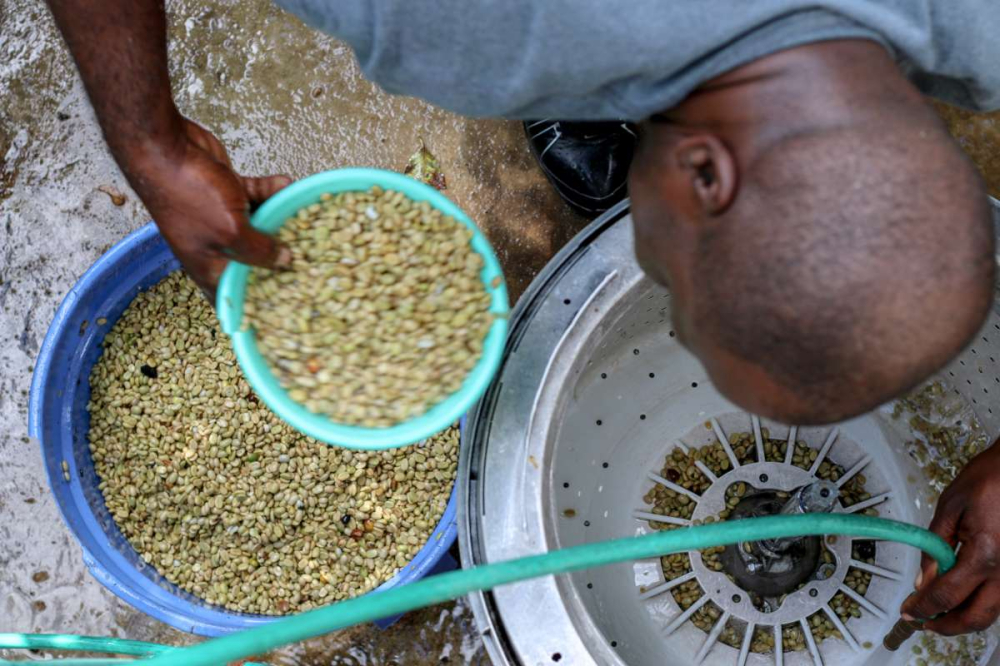
This Blue Mountain Geisha coffee uses the washed processing method customary in the Blue Mountain region: first remove the skin and pulp, let the beans ferment for 12 to 8 hours, then move the fermented beans into a water tank, and with the friction between the beans and the force of flowing water, wash the coffee beans until they are smooth and clean. After washing is completed, the coffee beans are still wrapped in the parchment layer, with a moisture content of about 50%, and must be dried in the sun to reduce the moisture content to 12% to 14%, otherwise the beans will continue to ferment or even become moldy and spoiled. After that, the coffee beans still need to be screened and graded, and then sent to specialized warehouses for storage.
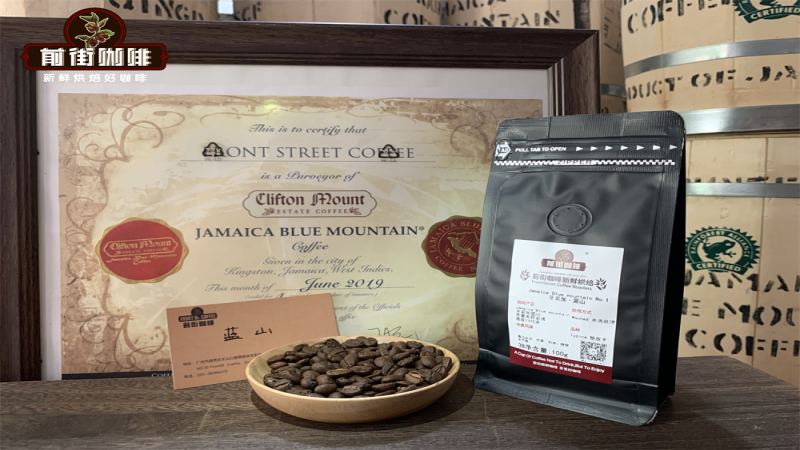
Blue Mountain coffee beans also processed by the washed method have a cup profile that is clean, balanced, and full-bodied. However, times are changing, and what consumers pursue is no longer the fixed flavor brought by a single origin or a single processing method. In order to meet market demand, Jamaica's Clifton Estate has also tried a natural processing method different from the past to process Blue Mountain coffee green beans, so the naturally processed Jamaican Blue Mountain coffee beans everyone buys at Front Street Coffee are likewise authentic. At Front Street Coffee (FrontStreet Coffee), the store also displays original Blue Mountain packaging barrels and certificates issued by the Jamaican government; friends who come to the store to drink coffee can take a careful look.
Many people may find it difficult when choosing Jamaican Blue Mountain coffee beans: how should one choose among Blue Mountain coffee beans with different processing methods? What exactly are the flavor differences that different processing methods give Blue Mountain coffee? It is not only everyone else who is curious—Front Street Coffee (FrontStreet Coffee), although it deals with coffee year-round, is equally full of interest in this, so it conducted a set of brewing comparison experiments on these two coffee beans.
The two Jamaican Blue Mountain coffee beans Front Street used for comparison both come from Clifton Farm, both are of the Typica variety, both are at an altitude of 1,310 meters, and both have a medium roast level. The only variable is the processing method—one is washed Blue Mountain coffee beans, and the other is naturally processed Blue Mountain coffee beans. According to CIB standards, the basic requirements for No. 1 Blue Mountain green beans are 17 screen size or above, a defect rate below 3%, and a moisture content of about 13%. Front Street Coffee (FrontStreet Coffee) observed that whether natural or washed, Blue Mountain coffee green beans are quite plump, uniform in screen size, slightly upturned at both ends, and oval in shape. The most notable difference between the two is that the silver skin of the natural Blue Mountain coffee beans falls off very cleanly, while the washed beans still retain pale yellow silver skin at the center line.
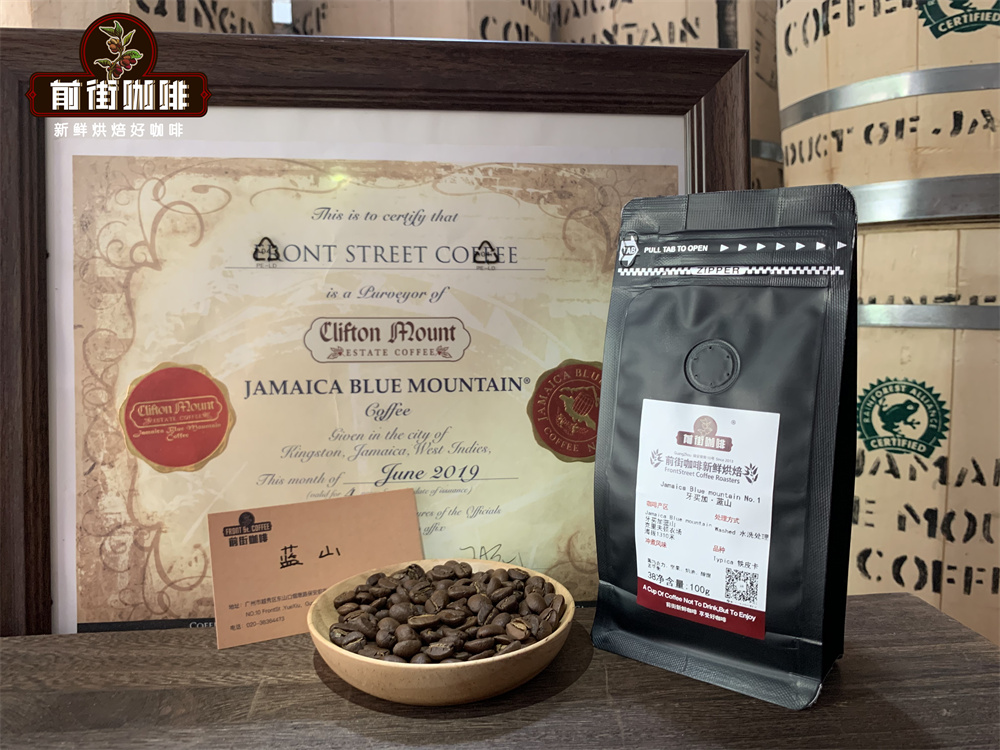
Front Street recommends using freshly roasted coffee beans for brewing, as this best showcases the coffee's rich flavors. The coffee beans sent out by Front Street Coffee (FrontStreet Coffee) are all within 5 days after roasting, because Front Street deeply understands that freshness has a huge impact on flavor. Front Street's roasting philosophy is "freshly roasted good coffee," so that every customer who places an order receives it in the freshest condition. The resting period for coffee is about 4 to 7 days, so by the time customers receive it, it is exactly at its flavor peak.
When Front Street Coffee (FrontStreet Coffee) brews these two Jamaican Blue Mountain coffee beans, it uses a coffee-to-water ratio of 1:15 and a grind size with a 75% pass rate on a No. 20 standard sieve. To highlight Blue Mountain coffee's characteristics of balance, full body, and soft fruit acidity, the water temperature should be controlled at 88 degrees. For the dripper, priority should be given to slow-flow devices such as the KONO dripper, Kalita trapezoidal dripper, and flannel. This time, Front Street Coffee (FrontStreet Coffee) chose the KONO dripper.
When brewing Jamaican Blue Mountain coffee beans, Front Street usually adopts the three-stage pouring method. This is a very basic pour-over method that everyone can easily learn at home to brew a simple and delicious cup of coffee. First, prepare all the needed coffee equipment, and then you can brew along with Front Street. Step one: use 30 grams of water for blooming. When pouring, the stream should not be too strong, otherwise it will break up the coffee grounds and lose the meaning of blooming. The process of pouring 30 grams of water takes about 10 seconds, then let it sit for 20 seconds. After the total time reaches 30 seconds, you can move on to step two.
Next, use a small stream to slowly pour 125 grams of water in circles from the center outward; at this point the total time is about one minute. After the coffee bed drops, make the final pour. Step three: continue pouring, and when the total water amount reaches 225 grams at about two minutes, stop pouring. Then wait for all the coffee liquid in the dripper to flow into the server, and you can remove the dripper. But it is not over yet. The final step is to gently swirl the server containing the coffee liquid to make it uniform in concentration, and then you can enjoy a delicious cup of Blue Mountain coffee.
Washed Blue Mountain coffee enters the mouth with flavors of dark chocolate and nuts; it is very clean, highly bright, has good body, and is balanced among acidity, sweetness, and bitterness. Naturally processed Blue Mountain coffee beans, on the other hand, have a brown-sugar-like sweetness on the palate, accompanied by berry-like acidity, with nut and cocoa flavors in the middle and finish, a creamy and smooth mouthfeel, rich and distinct layers, and a walnut aroma that can still be felt in the aftertaste. Everyone can choose the coffee flavor that suits them best according to their preferred processing method.
For professional coffee knowledge exchange and more coffee bean information, please follow Coffee Workshop (WeChat public account: cafe_style).
For more specialty coffee beans, please add the private WeChat of Front Street Coffee (FrontStreet Coffee), WeChat ID: kaixinguoguo0925.
The above content is compiled by CoffeeHunters, a coffee news website.


