







Which coffee bean process suits Yirgacheffe Red Cherry?
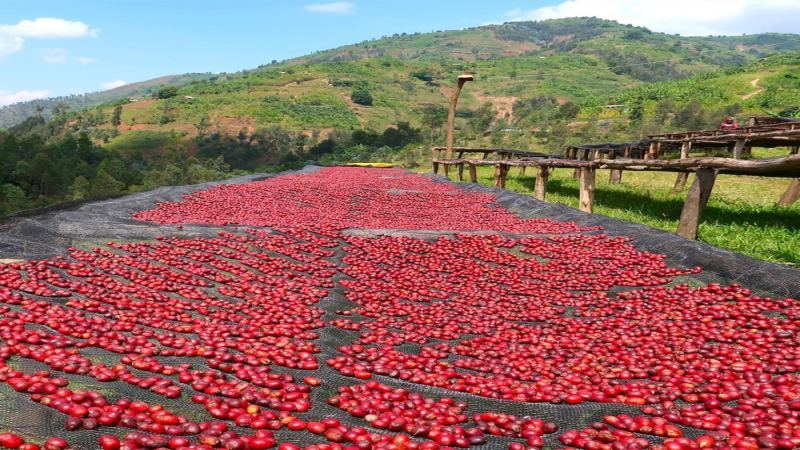
Yirgacheffe Red Cherry is sold in two versions, and the difference comes down to the coffee bean process. The natural lot dries the whole cherry on raised beds for two weeks or more, giving berries, lemon, strawberry and fermented wine aromas. The red honey lot keeps some mucilage, producing jasmine, citrus, honey, berries and almond.
Both are G1 grade and use local heirloom varieties. The natural lot comes from the Aratelan station at about 2,300 meters; the red honey lot comes from Idido at 2,000 to 2,200 meters. Processing alone shifts the flavor direction even when region and variety match, so brewing parameters should be adjusted to each lot.
The red cherry coffee beans from Ethiopia's Yirgacheffe region have always attracted the attention of specialty coffee enthusiasts, and Front Street Coffee has simultaneously launched both naturally processed and red honey processed versions, often leaving buyers curious: both come from Yirgacheffe and both bear the name Red Cherry, so what exactly are the differences between these two beans? This article will provide a systematic comparison of processing methods, flavor performance, regional background, and brewing recommendations to help readers understand how natural and red honey processing shape two completely different coffee profiles.
Front Street Coffee currently offers two Yirgacheffe Red Cherry coffee beans, using natural and red honey processing methods respectively. Many customers who visit the shop ask the same question: since both come from the Yirgacheffe region and are both called Red Cherry, what exactly is different about these two beans? Nowadays, green coffee processing methods are constantly being innovated, and Front Street Coffee has always believed that, beyond variety, origin, and cultivation methods, processing method is also a key factor determining the direction of coffee flavor. Even if the region is the same and the variety is identical, different processing methods will make the final cup present completely different flavor profiles.
Yirgacheffe Red Cherry Natural G1
Country: Ethiopia
Region: Yirgacheffe
Processing Station: Aratelan
Altitude: 2300m
Variety: Local Heirloom
Processing Method: Natural
Flavor: Berries, Lemon, Strawberry, Fermented Wine Aroma
Yirgacheffe Red Cherry Red Honey G1
Region: Yirgacheffe Idido
Growing Altitude: 2000-2200m
Processing Method: Red Honey
Variety: Local Heirloom
Grade: G1
Flavor: Jasmine, Citrus, Honey, Berries, Almond
Coffee Processing Methods --- Natural Processing
The natural method can be called the oldest and most primitive way in the history of coffee bean processing. Taking this natural Red Cherry as an example, the processing station keeps the whole coffee cherry, including the skin and pulp, and places it on raised drying beds to dry, avoiding direct contact between the fruit and the ground and thereby reducing the risk of earthy off-flavors seeping in. After about two weeks or more of sun drying, the fruit turns dark brown and is then stored, waiting for the flavors to fully mature. Only before shipment does the processing station remove the coffee beans from the dried cherries. This processing path gives the beans lower acidity, prominent sweetness, and a certain degree of body, though in terms of cleanliness it is difficult to reach the level of washed processing.
Honey Processing
Honey processing refers to a green coffee processing method in which part of the mucilage layer is retained for sun drying. After the outer pulp of the coffee fruit is removed, a sticky gel-like substance still remains on the surface. The traditional washed method rinses it clean with large amounts of water, but some high-altitude regions are limited by water resources, so the practice of drying directly with mucilage still attached came into being.
The pectin mucilage is the part of the coffee fruit with the highest sugar content, and it also plays a key role in the fermentation process during processing; it can be said to contribute about eighty percent in terms of nutrient supply. Yellow honey processing retains 60% of the pectin, red honey processing retains 75%, and black honey processing removes almost no pectin.
What is Ethiopia's Operation Cherry Red?
The name "Operation Cherry Red" is often mentioned, but what exactly does it mean? The program was initiated and led by the Dutch company Trabocca, with the Dutch government funding half of it. Since 2005, Trabocca has established cooperation with many small coffee cooperatives, encouraging and assisting producers to continuously improve in washed, semi-washed, natural, and other experimental processing methods, thereby promoting an overall improvement in coffee quality.
Before each harvest season arrives, Trabocca invites selected smallholder organizations or producers to participate in the production of micro-lot coffees, with each lot around 1,500 to 3,000 kilograms. These coffee cherries are all manually selected multiple times, using only 100% ripe red fruit, which is also the origin of the name "Operation Cherry Red." Trabocca provides support to farmers in the form of funding, equipment, and technology, and promises that as long as the actual output quality meets high standards, it will purchase at a premium price. Therefore, Front Street Coffee believes that Operation Cherry Red is not only a commercial practice consistent with fair trade principles, but also a production activity that improves coffee quality, and at the same time an industrial structural innovation that benefits both farmers and consumers.
Yirgacheffe is actually composed of multiple surrounding coffee communities or cooperatives, and traditionally washed methods are mostly used. However, among the Red Cherry coffees introduced by Front Street Coffee this time, one chose natural processing to enhance the coffee's alluring fruity aroma and full body. After the highest-quality Misty Valley natural beans were discovered by the United States in 2008, this type of product became widely renowned. It came from the craft-level cultivation of a micro-estate, made up for the shortfall in aroma performance of Yirgacheffe washed beans, developed aroma characteristics that astonished the world, and obtained Operation Cherry Red certification.
Yirgacheffe is a specialty coffee region belonging to Ethiopia and is itself a small town. Its altitude is about 1,700 to 2,100 meters, making it one of the highest coffee-growing regions in the world and a synonym for Ethiopian specialty coffee. The region is adjacent to Lake Turkana, Lake Abaya, and Lake Chamo, with abundant water resources, and the Yirgacheffe born there has unique floral and fruity aromas, ambiguously interwoven, presenting a shifting and unpredictable terroir. Red Cherry, as the name implies, picks only ripe red coffee fruits, while also improving production equipment and passing multiple rounds of cupping checks; only those scoring 84 points or above are eligible to be included in the program.
Yirgacheffe Region
Yirgacheffe is a small town in Ethiopia, at an altitude of 1,700 to 2,100 meters. It is one of the highest coffee-growing regions in the world and a synonym for Ethiopian specialty coffee. Lake Turkana, Lake Abaya, and Lake Chamo bring abundant moisture here. The rift valley area represented by Misty Valley is shrouded in fog all year round, with spring-like weather in all four seasons, gentle breezes, and a cool and humid climate. Thousands of coffee trees grow vigorously here, nurturing Yirgacheffe's unique terroir charm of interwoven and endlessly changing floral and fruity aromas.
The mountain villages in the Yirgacheffe area are filled with fog in all four seasons, with gentle breezes, cool rather than hot, rainy rather than damp. The earliest Yirgacheffe coffee trees were planted on the mountains by European monastic scholars. Today, most are planted in farmers' own backyards or intercropped with other crops in farmland. Each household's output is limited, making it a typical garden coffee.
As is well known, the Yirgacheffe region is mainly based on washed processing, and washed beans have bright fruit acidity and a fresh, clean mouthfeel. But today many specialty beans deliberately use special processing methods to enhance the alluring fruity aroma and full body. For this reason, Ethiopian coffee regions are also gradually improving coffee taste quality through improvements in processing methods.
Ethiopian Coffee Grading System
Before the establishment of the Ethiopia Commodity Exchange (ECX), Ethiopia's coffee export grades were set by the CLU department (Cupping and Liquoring Unit) under the Ministry of Agriculture, mainly grading according to the number of defective beans contained in 300 grams of green coffee. The standards are as follows:
Grade1: Number of defective beans (per 300g) ≤3
Grade2: Number of defective beans (per 300g) 4-12
Grade3: Number of defective beans (per 300g) 13-25
Grade4: Number of defective beans (per 300g) 26-45
Grade5: Number of defective beans (per 300g) 46-90
Usually washed processing can reach G1 to G2 grades, while limited by the sun-drying technology at the time, natural green beans had a relatively high number of defects, generally falling between G3 and G5. However, Front Street's Yirgacheffe Natural Red Cherry and Red Honey Red Cherry this time both reached G1 grade.
Front Street Coffee's natural Red Cherry smells of ginger flower, and after entering the mouth the sweet and sour sensation slowly spreads through the oral cavity, presenting an overall floral tone, with a sweet and juicy finish. As the temperature drops, the acidity will rise somewhat, while the sweetness is relatively more lasting.
Natural Red Cherry Roasting Recommendation
The most notable flavor characteristic of Yirgacheffe coffee is its fruity acidity. In order to fully highlight this feature, Front Street Coffee believes that a light roast is most suitable.
Red Honey Red Cherry Roasting Recommendation
Roaster Yangjia 800N (roasting capacity 550 grams)
Charge at 180°C, heat 130, airflow 3; turning point 1'32", at 146°C open airflow to 4, keep heat unchanged; at 149°C the bean surface turns yellow, the grassy smell completely dissipates, entering the dehydration stage; when the temperature reaches 166°C, adjust heat to 110, keep airflow unchanged;
At 7'43", the bean surface shows ugly wrinkles and dark spots, and the toast aroma clearly changes to coffee aroma, which can be defined as the prelude to first crack. At this time, it is necessary to carefully distinguish the sound of the first crack point; at 8'29" first crack begins, open airflow to 5, develop for 1'28 after first crack, drop at 190°C.
Brewing Parameters
Dose: 15 grams
Water-to-coffee ratio: 1:15
Dripper: V60
Water temperature: 91°C
Grind size: caster sugar
Brewing Method
Bloom with 30 grams for 30 seconds. After blooming, pour in circles to 125 grams. After the water level drops by half, continue pouring in circles to 225 grams. Extraction time 2'00.
Flavor Description
Yirgacheffe Red Cherry Natural G1: Obvious sweet and sour sensation on entry, with lemon, berries, and fermented wine aroma; the lemony acidity in the finish is lasting and the sweetness is clear.
Yirgacheffe Red Cherry Red Honey G1: Prominent floral aroma can be felt on entry, accompanied by citrus, almond, and berries. The overall floral and citrus notes are prominent, and the sweet finish is lasting.
From a flavor perspective, the difference between these two beans is: the natural Red Cherry has more obvious berry and ripe fruit sweet-and-sour notes, with a relatively fuller mouthfeel; while the red honey Red Cherry has more prominent floral aroma as well as citrus and almond notes, with rich layering, but a relatively thinner body.
For more specialty coffee beans, please add the private WeChat of Front Street Coffee, WeChat ID: kaixinguoguo0925
The above content is compiled by CoffeeHunters, a coffee news website.


