







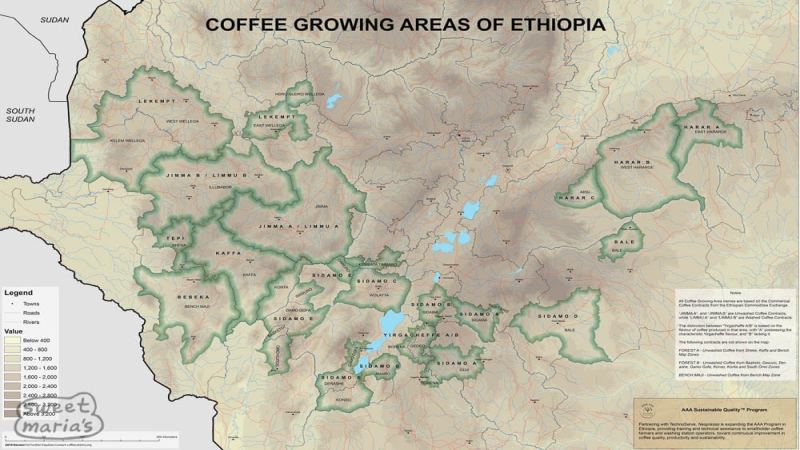
Why does Kaffa forest shape Ethiopian coffee regions?
Ethiopia is the birthplace of coffee, and more than 5,000 native varieties grow in the Kaffa forest of the south. After the 1995 reorganization, Sidamo Province was redivided and Yirgacheffe fell under the Gedeo Zone, so old and new region names now appear side by side on the market.
Smallholders run about 90 percent of cultivation, roughly 1.2 million families, each farming under 4 hectares. Plots sit at an average of 1,000 to 2,300 meters, with about 1,000 to 1,800 trees per hectare and yields near 600 kilograms per hectare. Coffee bean processing, both washed and natural, varies by region and shapes the final cup.
Ethiopia, as the birthplace of coffee, nurtures more than five thousand native coffee varieties in the Kaffa forests of its south. After the 1995 administrative reorganization, Sidamo Province was redivided, Yirgacheffe was placed under the Gedeo Zone, and it is common to see old and new production area names used interchangeably in the market. This article combines the latest administrative divisions to systematically sort out the altitude, cultivation patterns, and flavor characteristics of Ethiopia's nine major coffee regions, offers an in-depth interpretation of the evolution of washed and natural processing methods in Yirgacheffe, and shares Front Street Coffee's cupping experience and brewing suggestions for representative beans such as Huakui 8.0, providing coffee lovers with a complete guide to Ethiopia's coffee regions.
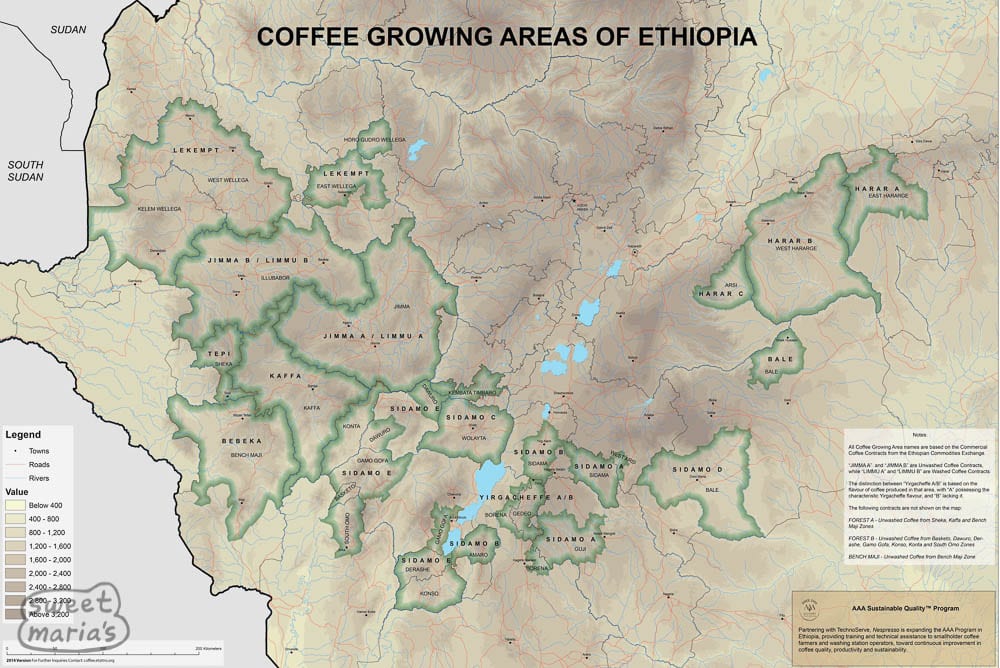
Located in East Africa, Ethiopia is recognized by coffee lovers worldwide as the birthplace of coffee. In the primitive forests of the southern Kaffa region alone, more than 5,000 native coffee varieties have been discovered. Today, Front Street will take everyone through an in-depth look at the distribution of Ethiopia's coffee regions.
Ethiopia's Coffee Regions
Around 1995, Ethiopia adjusted its administrative divisions, and the impact on coffee regions was especially notable: the former Sidamo Province was split, with a small part retained as the new Sidama, while most was merged into Oromia State; Yirgacheffe, which originally belonged to Sidamo Province, is now under the jurisdiction of the Gedeo Zone. Ethiopian coffee currently circulating on the market often shows old and new region names coexisting. Below, we use the new administrative divisions as the basis and combine them with geographic distribution to understand Ethiopia's coffee-growing landscape.
Coffee cultivation in Ethiopia is mainly concentrated in the western and southern regions. Smallholder family operations account for 90% of overall cultivation, with about 1.2 million smallholder families depending on coffee for their livelihood. Each household cultivates less than 4 hectares, at an average altitude of 1,000 to 2,300 meters, with a planting density of 1,000 to 1,800 coffee trees per hectare and a yield of about 600 kilograms per hectare.
According to cultivation scale and model, Ethiopian coffee can be divided into the following categories:
● Forest coffee (8-10%): Coffee trees coexist with other crops in primitive forests, with no artificial management, and farmers harvest the coffee cherries regularly.
● Semi-forest coffee (30-35%): The planting area lies between the forest and farmers' living areas. The coffee trees are still naturally growing varieties, and farmers manage the planting area and grow other cash crops.
● Garden coffee (50-55%): Coffee trees are planted around farmers' living areas, mostly planted by the farmers themselves.
● Plantation coffee (5-6%): Operated by large private growers, with more complete processing facilities and production capacity.
Ethiopia's Nine Major Coffee Regions
1. Yirgacheffe (specialty region): altitude 1,800-2,000 meters (garden coffee system)
Yirgacheffe originally belonged to the Sidamo region and was separated out because of its unique flavor. In addition to the town of Yirgacheffe, it also covers subregions such as Wenago, Kochere, Gelena, and Abaya. Therefore, under the new grading system, the prices of Yirgacheffe A, Wenago A, Kochere A, and Gelena/Abaya A are higher than the B grade of the same names. The so-called Yirgacheffe flavor refers to intense jasmine aroma, lemon fragrance, peach and almond sweetness, and tea aroma. Front Street Coffee believes that "a hundred flowers in full bloom" is the most fitting description.
Traditionally, Yirgacheffe used the oldest natural processing method. In 1972, in order to improve coffee quality, Ethiopia introduced washed-processing technology from Central and South America, which made Yirgacheffe's jasmine and citrus aromas clearer and more transparent. Front Street Coffee believes that the most essential difference between the washed method and the natural method is: the washed method presents coffee's most basic flavor and can most directly reflect a region's special flavor; the natural method, on this basis, adds sweet aroma and fermented notes.
The introduction of the washed method propelled Yirgacheffe to become a representative of the world's specialty coffee. After the 1970s, this region was dominated by washed coffee, becoming Ethiopia's hottest washed-bean region. However, entering the 21st century, natural-processing techniques continued to improve and frequently produced stunning natural beans. This is thanks to Yirgacheffe coffee trader Baghisi, who, missing the flavor of traditional natural beans and unwilling to see natural techniques replaced by washing, improved the natural processing method, enhancing flavor and reducing the defect rate, and launched three extremely famous Yirgacheffe natural beans: Idido Misty Valley, Beloya, and Aricha.
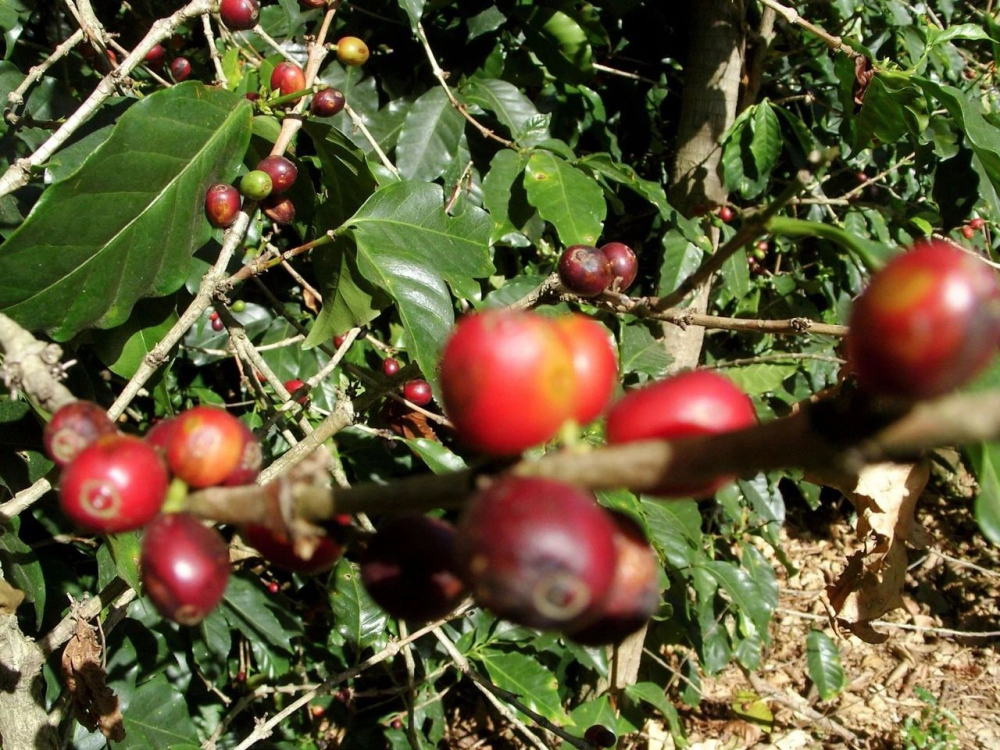
In addition to washed and natural, there are also other processing methods such as red honey and anaerobic. Front Street Coffee previously cupped a red honey Yirgacheffe; while retaining its original basic flavor, it added layers, with a mouthfeel lighter than natural Yirgacheffe and heavier than washed Yirgacheffe.
2. Sidamo (specialty region): altitude 1,400-2,200 meters (garden coffee system)
Finely washed or natural Sidamo coffee usually has obvious sweetness, and its strawberry and berry flavors are deeply loved by many coffee enthusiasts, with a status no less than Yirgacheffe. Sidamo and Yirgacheffe have similar varieties, with medium-sized beans, and there are also short-stature small-bean varieties, which farmers often sell separately. At present, the most watched coffee bean in Sidamo is none other than Huakui. After appearing in Ethiopia's TOH green bean competition in 2017, it made a stunning debut, breaking Geisha's dominance in brewing competitions and becoming the only coffee currently able to compete with it. Huakui comes from Hambela, a subregion under the Guji region, and the Guji region, like Yirgacheffe, originally belonged to Sidamo and later became independent because of its outstanding flavor, though when Guji is mentioned now, it is still generally assumed to belong to the Sidamo region.
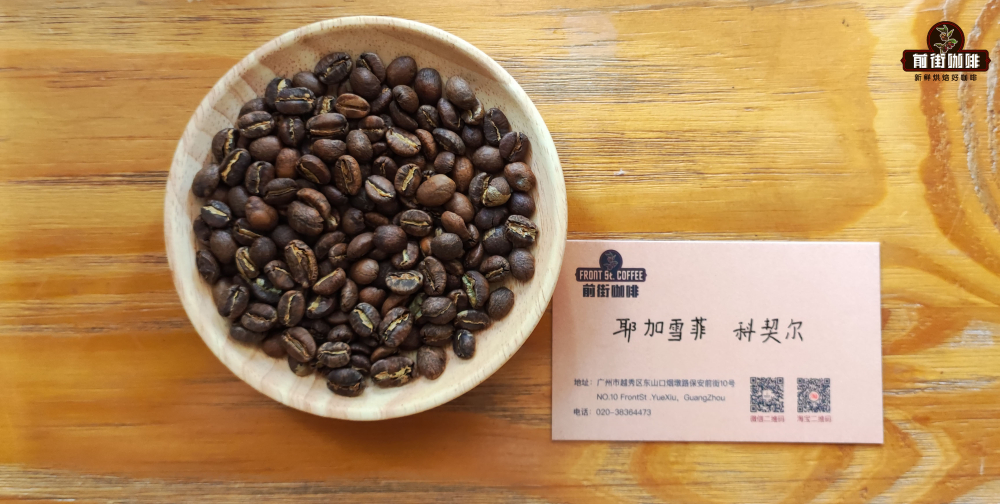
Once you understand the origin of Huakui, and then understand the changes in its development after winning the championship, you will understand the reason for inconsistencies in flavor before and after. This is also why Front Street Coffee continuously explores coffee beans from around the world—only through constant tasting can one understand the changes involved. Huakui has now developed to version 8.0. In order to present the refined floral and fruity flavors of the Sidamo region while preserving the coffee's caramelized aroma, Front Street's roaster uses a medium-light roast to present this bean.
Front Street believes that the new-crop Huakui 8.0 performs well in both dry aroma and mouthfeel. It smells of more intense fruit aromas than last year's 7.0, such as the complex notes of guava, jackfruit, apricot, dried fruit, citrus, and flowers; after hot water is poured in, honey and berry sweetness can be smelled. Through slurping, Front Street first perceives in this 8.0 the multiple fruit sweet-tart notes of dried mango, jackfruit, orange, and passion fruit, with clear juiciness and a round mouthfeel; as the temperature drops slightly, the delicate sweetness of white peach and the acidity of berries begin to be released, and after swallowing, one can feel a sweet aftertaste like drinking black tea.
3. Limu (specialty region): altitude 1,200-2,000 meters (garden, forest, semi-forest, and plantation coffee systems)
Production is relatively small, mainly exported to European and American markets, not easy to buy in Taiwan, but very popular in Europe and the United States. It has three processing methods: washed, natural, and semi-washed. Limu's viscosity is noticeably lower, and its floral and citrus expression is also inferior to Yirgacheffe and Sidamo, but it has an extra grassy aroma and brown sugar sweetness, with bright fruit acidity.
4. Harrar (specialty region): altitude 1,500-2,400 meters (garden coffee system)
Harrar is exclusively natural-processed. It is an ancient eastern city, but coffee is not grown in the urban area. So-called Harrar coffee refers to coffee produced in the Hararghe highlands and lowlands of the greater Harrar area. Because annual rainfall is only 1,000 millimeters, it is entirely natural-processed. In flavor, Harrar coffee is famous for its special "wild aroma," a typical example of early ancient flavors, and is called the "twin star" together with Yirgacheffe.
If the defective beans in Harrar can be sorted out cleanly, it is easy to taste berry aromas, with a slightly pleasant fermented wild aroma. However, due to various factors, Harrar coffee quality has been unstable in recent years, and the grading system is not rigorous enough, so when purchasing, be sure to cup or taste it.
5. Jimma (large commercial coffee region): altitude 1,350-1,850 meters (forest/semi-forest system)
Jimma is the capital of the Kaffa forest or Kaffa Province. Its English spelling is very inconsistent: on maps it is mostly Jimma, but on coffee burlap bags it is spelled Djimmah. This is Ethiopia's largest-producing region, accounting for one-third of exports.
The Kaffa forest is famous for its primitive wild varieties, and Jimma is the distribution center for Kaffa in this area. Farmers habitually transport coffee picked in the forest area to Jimma, then mix hundreds or thousands of varieties together and sell them as commercial beans, which obscures the aroma of many delicious varieties.
Although washed specialty Jimma does not have the orange aroma and floral charm of Yirgacheffe, its flavor profile is quite clean and transparent, similar to Central American specialty coffee. Commercial-grade specialty Jimma is very common in Taiwan, and with luck one can also buy good-quality, inexpensive Jimma, which offers a clear lemon-peel aroma and is not inferior to Sidamo. Overall, Jimma has a better flavor than Brazil's large commercial bean Santos, and is a good medium-to-low-priced blend bean.
6. Illubabor (large commercial coffee region): altitude 1,350-1,850 meters (forest/semi-forest coffee system)
This region is located in western Ethiopia, bordering Sudan, and is the westernmost production area. Its coffee genetic complexity is second only to the Kaffa forest. The beans are noticeably larger than Yirgacheffe and Sidamo, with lower fruit acidity, good viscosity, and balanced flavor. Coffee from here is mostly transported to Jimma for blending and is rarely sold independently.
7. Gimbi, Lekempti (large commercial coffee region): altitude 1,500-1,800 meters (forest/semi-forest coffee system)
This region has both natural and washed beans. The beans resemble Harrar's longberry beans, and a small amount of specialty-grade coffee is also quite popular in Europe and the United States. Most of it is praised as "the poor man's Harrar," with fruit acidity and fruity flavors superior to Illubabor, and a bright flavor.
8. Teppi, Bebeka (large commercial coffee region): altitude 500-1,900 meters (garden/forest/semi-forest coffee system)
The two production areas are very close, with Teppi north of Bebeka. There is a corporately managed coffee plantation, and in recent years the garden system has been promoted to increase farmers' income, with annual output of about 3,000 tons. Both places have wild coffee, output is not high, and the flavor is very different from Harrar and Yirgacheffe. Low fruit acidity is the biggest characteristic, making it suitable for blend beans, and it has both natural and washed processing.
9. Lake Tana (alternative region): altitude 1,840 meters (forest system)
Monastery coffee. The surrounding forest coffee has extremely small annual output, less than 10 tons, so it actually cannot be called a production region. The Eastern Orthodox monasteries, churches, religious murals, and myths standing around the lake area have created the world's most "divine-tasting" coffee.
European monastic monks opened up the local coffee-growing industry, which was later run by coffee communities or cooperatives in villages around the town. There are no dedicated plantations here; coffee trees are naturally scattered in forests and gardens. When the harvest season arrives, the Ethiopian coffee trading company goes to the town to purchase coffee beans collected by farmers.
Ethiopian Coffee Bean Processing Methods
According to Front Street Coffee's understanding, Ethiopia traditionally used the oldest natural processing method. But in 1972, in order to improve coffee quality, Ethiopia introduced washed-processing technology from Central and South America. Yirgacheffe is Ethiopia's most water-rich region, so this processing method also made Yirgacheffe coffee's jasmine and citrus aromas clearer and more transparent. Because of this, Yirgacheffe leaped to become a representative of the world's specialty coffee. After the 1970s, this region was dominated by washed coffee, becoming Ethiopia's most prosperous washed-bean region.
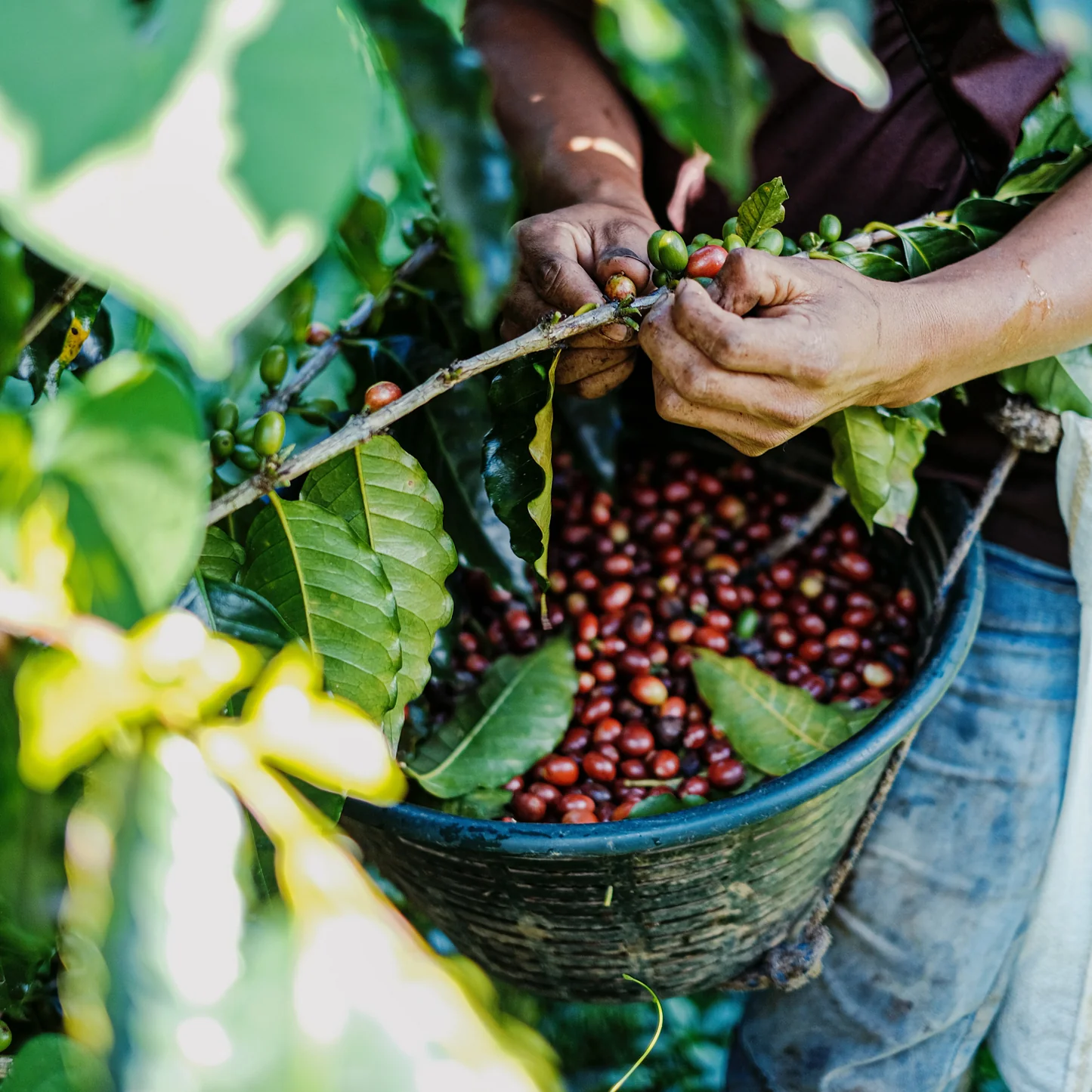
However, by the 21st century, natural-processing techniques gradually improved and frequently produced stunning natural beans. This is thanks to Yirgacheffe coffee trader Baghisi, who, missing the flavor of traditional natural beans and unwilling to see natural techniques replaced by washing, improved the natural processing method, enhancing flavor and reducing the defect rate, and launched three extremely famous Yirgacheffe natural beans: Idido Misty Valley, Beloya, and Aricha.
Front Street Coffee believes that the most essential difference between the washed method and the natural method is: the washed method presents coffee's most basic flavor and can most directly reflect a region's special flavor; the natural method, on this basis, adds sweet aroma and fermented notes.
Natural Processing Method Flow
1. First, pick ripe coffee cherries, then manually sort them, removing defective, overripe, or insect-damaged cherries and keeping the good beans. This is also an important reason why the coffee beans in Front Street's shop have a relatively uniform and attractive appearance.
2. After manual sorting, the good cherries are sent to a drying site for drying. Different regions use different drying racks; some use tarps, raised beds, or concrete floors. The drying time averages 27-30 days, until the coffee's moisture content drops to 11%, which is considered complete.
3. This step is also relatively crucial: after drying is completed, the coffee cherries are sent to a dedicated processing plant for depulping and hulling, and even polishing, so that parts such as the pulp fall off, and only then are the coffee beans commonly seen in the true sense obtained.
4. After hulling, the green coffee beans are sorted again to remove beans with poor appearance. This is because over-dried coffee beans are more fragile and easily broken during hulling; under-dried coffee beans contain too much water, and the active moisture easily breeds bacteria and causes mold, so they are sorted again before being sent to the warehouse for storage and packaged for export.
Washed Processing Method Flow
1. Coffee farmers pour all harvested coffee cherries into water. Defective beans float to the surface, and those that sink to the bottom are qualified cherries. This operation greatly reduces the time needed to select them one by one.
2. Put the sorted cherries into a depulper to remove the skin and pulp. After removal, a layer of mucilage still adheres to the surface of the cherries, and a large amount of clean water is needed to wash off the sticky residue.
3. Then fermentation is used to thoroughly remove the mucilage, a process that takes about 18 hours. After fermentation is complete, fermentation bacteria adhere to the surface of the coffee cherries, so they still need to be washed again with a large amount of clean water. In this step, obtaining 1 kilogram of coffee beans requires 40 to 50 kilograms of clean water. Front Street believes this is a very large number, and this is precisely why arid countries cannot use washing.
4. The cleaned coffee beans can then be dried. Some regions take them outdoors to dry directly, while some more developed regions send them to processing plants for machine drying, bringing the coffee's moisture content down to about 11%.
5. Finally, the dried coffee beans are stored and packaged, and can then be sold for export.
The above is the relevant information on Ethiopia's Yirgacheffe coffee region compiled by Front Street Coffee, and we hope it can help coffee fans who want to learn about Ethiopia's coffee regions. Next, Front Street Coffee will recommend several Ethiopian coffee beans with relatively outstanding flavors.
Front Street Coffee: Ethiopian Yirgacheffe Gudingding Coffee Beans
Country: Ethiopia Region: Yirgacheffe Altitude: 1900-2300m Variety: local heirloom varieties Processing method: washed processing Flavor: lemon, cream, honey, berry, citrus
How does Front Street brew Ethiopian coffee beans?
In order to fully extract the fruity acidity of the Ethiopian region, Front Street uses a higher water temperature and a finer grind for extraction, but to avoid over-extraction caused by high temperature, it uses a faster-flow dripper, such as a V60 dripper. The V60 dripper is a 60-degree cone, and the conical angle allows the coffee grounds to be concentrated together. When pouring water, the flow also automatically gathers toward the center of the dripper, ensuring sufficient contact time between water and coffee grounds, thereby extracting a suitable coffee liquid. In addition, the ribs on the inner wall of the V60 dripper extend in a clockwise spiral from the bottom to the top, leaving enough space between the filter paper and the dripper, making water flow better. Combined with the large hole at the bottom, the flow rate is relatively faster than with many drippers.
Front Street Coffee's specific brewing parameters are: V60 dripper, water temperature 90-91°C, water-to-coffee ratio 1:15, coffee dose 15g, grind size BG#6m (80% passing through China's No. 20 standard sieve).
Front Street Coffee uses staged extraction: the bloom water amount is twice the coffee grounds, that is, 30 grams of water for a 30-second bloom. Pour in a small stream in circles until 125 grams, then pause. When the water level drops and is about to expose the coffee bed, continue pouring until 225 grams and stop. The total extraction time is 2 minutes.
The above content is compiled by CoffeeHunters, a coffee news website.


