








Why Does Pour-Over Coffee Taste Sour, Bitter, or Weak at Home?
Coffee that tastes sour, bitter, astringent, or weak at home usually comes down to variables, not mystery. The main causes are batch differences in the beans plus water quality, grind size, water temperature, coffee-to-water ratio, and brewing technique. Even beans from the same roaster vary by harvest, since coffee is an agricultural product rather than an assembly-line item.
Confirm the shop beans and your beans are the same lot and harvest. Then work through the parameters one at a time: match the coffee-to-water ratio, dose, temperature, and pouring method shared with you. An extreme example of how far bean factors can go is very expensive coffee, where a single rare lot can taste unlike anything else from the same species.
Many coffee enthusiasts, after tasting an excellent pour-over in a shop, will buy the same roasted beans to try to replicate it at home, only to find the results often disappointing—either too sour or too bitter, too strong or too weak, or even astringent, with off-flavors and burnt notes. The reasons behind this are not mysterious; they mainly involve consistency of the coffee bean batch, as well as differences in key parameters such as water quality, grind size, water temperature, coffee-to-water ratio, and brewing technique. Based on Front Street Coffee's brewing experience, this article breaks down these variables one by one to help you identify the problem and brew coffee at home that is closer to shop quality.
As specialty coffee becomes increasingly popular, more and more people are buying roasted beans to brew at home. Many customers ask a similar question—why does the coffee taste so smooth at Front Street, but when I brew it at home it's completely different? This article from Front Street addresses this confusion with a detailed analysis and answers.
Consistency of Coffee Beans
The first thing to confirm is whether the pour-over bean you tasted at Front Street and the beans you bought to take home are from the same batch. For example, if the shop is using PWN Golden Mandheling from the October harvest, then the beans you take home should also be the same bean from the same harvest season. Coffee beans are, after all, an agricultural product—not like products from an industrial assembly line where every batch is identical. There will inevitably be slight differences in flavor between different years and different batches. Some large, stable regions can maintain relatively uniform quality across every batch over the long term; while some emerging farms or small regions find this difficult—one batch may be outstanding, and the next may be somewhat mediocre.
Certainty of Brewing Parameters
Generally, when you decide to purchase coffee beans after tasting them in-store, Front Street Coffee will share the brewing parameters for that bean with you. Among the many parameters, coffee-to-water ratio, water temperature, coffee dose, and brewing technique are relatively easy to understand and replicate. But the following parameters deserve special attention.
1. Water Quality
The essence of extracting coffee is having water dissolve the flavor compounds from the coffee, so water itself is the most critical factor. First, pH—alkaline water weakens acidity, and if the pH is too high, it can give the coffee an alkaline taste; conversely, acidic water enhances acidity, and if the pH is too low, it can make the coffee taste harsh.
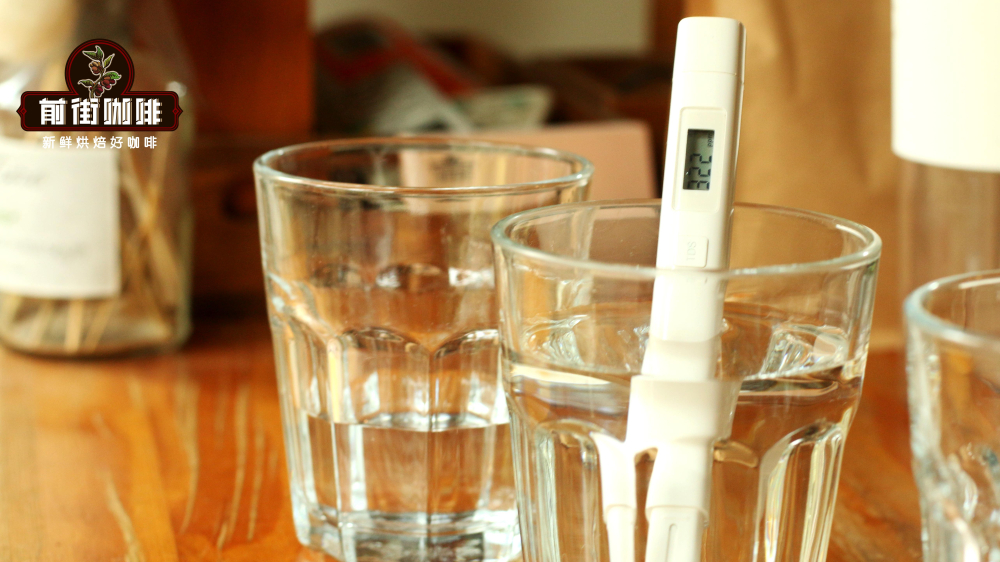
Next, TDS—if the PPM is too high (above 225), it leads to under-extraction, and flavors cannot be released; if TDS is too low (below 75ppm), it easily leads to over-extraction, making the coffee bitter. According to SCAA standards, the ideal TDS range is between 125–175ppm. Every coffee shop uses a different water source, so the TDS naturally varies. So when you hit a bottleneck brewing at home, it's worth paying attention to this parameter, and you can also directly ask your regular coffee shop what water source they use. Front Street uses water treated with a filter that meets drinking standards, with a TDS of 139ppm. We do not recommend using unfiltered tap water to brew coffee directly.
2. Grind Size
This is the real reason behind many brewing problems. The shop may tell you the grind size, or even give you a reference sample, but every grinder is different, and you also need to pay attention to whether your grounds are uniform, how many fines there are, and the shape of the particles. Even with the same model of grinder, the state of the ground coffee can differ—how long it has been used will cause grinding deviations, not to mention that you and the merchant are not even using the same machine. Front Street Coffee uses a BG conical burr grinder, though for home use you don't need to pursue such precise equipment. So how do you choose a home grinder? Front Street recommends two types of burrs suitable for pour-over coffee for your reference.
Conical burr: It crushes coffee beans into particles by grinding and pressing, so the shapes are mostly block-like. This type of burr is mostly used in hand grinders. Because of the "crushing" mechanism, when the coffee beans are fractured, a large amount of dust-like fines are produced. Normal coffee particles are also irregularly block-shaped, but overall tend toward uniformity. Conical burr output tends to be blocky, so the water path is longer and contact time with water is longer. Therefore, less soluble material is released in the early stage, and the concentration doesn't spike immediately; but during extended extraction, the woody parts absorb less water, making it less likely to bring out off-flavors and astringency, making it suitable for pour-over grinding. Of course, the difference in grinding performance between an expensive conical burr and a cheap one is quite significant.
Ghost tooth: It grinds coffee beans into particles by friction, and the shapes are closer to spheres. Precisely because it can grind a single bean into numerous small spherical particles, the resulting by-products (that is, fines) are also more numerous. Overall, however, the variation between large particles is the smallest. It is also suitable for pour-over grinding.
As for the grind size setting, Front Street uses a national standard No. 20 (850 microns) test sieve for screening and calibration. According to SCAA cupping standards, cupping grind requires a 70–75% pass-through rate on a No. 20 standard sieve. When brewing light-roast pour-over coffee, Front Street Coffee generally controls the grind to a 75–80% range, and for medium-dark roasts, a 70–75% range.
3. Water Temperature
The water temperature for pour-over coffee is generally recommended to be between 86 and 93 degrees Celsius. Lighter-roasted beans are suitable for 90 to 93 degrees Celsius; darker-roasted beans (such as Golden Mandheling) are suitable for lower water temperatures, that is, between 86 and 88 degrees Celsius. Front Street Coffee uses a water temperature of 90–91 degrees when brewing light to medium-roast coffee beans, and 88–89 degrees for medium-dark roast coffee beans.
4. Coffee-to-Water Ratio
Front Street Coffee recommends a coffee-to-water ratio between 1:14 and 1:18. The smaller the ratio, the stronger the taste; the larger the ratio, the weaker the taste. Most coffee beans at Front Street Coffee stores are brewed at a 1:15 ratio, typically 15 grams of coffee beans with 225 grams of water.
5. Brewing Technique
Next, let's analyze Front Street's most commonly used three-stage brewing technique. First, do the preparation—warm the dripper and server, grind the coffee beans, prepare water at the appropriate temperature, then add the coffee grounds. Begin the first pour while starting the timer. Pour 30 grams of hot water in the first stage, spiraling from the center outward. The coffee grounds absorb water and slowly expand, forming a puffed-up "coffee bloom."
Stop when you reach 30 grams of water and wait for a 30-second bloom. When the scale shows 31 seconds, begin the second pour, still spiraling from the center outward, keeping the flow steady and vertical. When the stream hits the coffee bed, foam is produced. This stage of brewing releases the coffee foam, which spreads across the entire surface of the coffee bed, and the liquid level rises to the base of the short ribs. The water volume for this stage is 100 grams.
When the liquid level drops to the halfway point, begin the final pour. In this stage, also pour 95 grams in an "aroma-seeking" spiral from the center outward. The originally dark brown foam gradually turns into pale yellow coffee foam, and the liquid level returns to the height it was at during the second pour. After all the coffee liquid has flowed into the server, remove the dripper, and extraction is complete.
Why does Front Street favor three-stage extraction so much? What are its advantages?
Enhanced coffee flavor: It extracts the flavor compounds from the coffee more fully during brewing, enhancing the coffee's complexity.
Strong compatibility: For most coffees from different origins and different roast levels, it can express their flavors well; for the brewer, if you pour too much water at the start and notice the water level rising too quickly, you can use staged pouring to extend the brewing time, waiting for the water level to drop before continuing, avoiding under-extraction caused by water flowing through too quickly.
The above content is compiled by CoffeeHunters, a coffee news website.


