







Why Does Yunnan Baoshan Coffee Focus on the Typica Variety?
Yunnan Baoshan coffee is grown mainly at Front Street's Baoshan estate, where Typica is cultivated instead of the Catimor that dominates the local market. Typica is planted to improve the region's image at the source, on the view that variety, rather than special processing, is what shifts Yunnan coffee's flavor and reputation over the long term.
Most Yunnan coffee on the market is Catimor, and producers often use special processing to mask its less desirable flavors. Front Street treats that as a short-term fix, since consumers are only briefly curious about such methods. Applying traditional processing to Catimor can still yield a pleasant cup, but the comparison of planting yield, estate environment, and brewed flavor points to variety as the decisive factor.
In the Yunnan coffee market, the Catimor variety accounts for the vast majority. To mask some of Catimor's inherent flaws, many producers resort to special processing methods to reshape the flavor, but Front Street Coffee has always believed that relying on processing methods to alter coffee's performance is not a long-term strategy—consumers mostly approach special processing methods with a spirit of curiosity, while traditional processing methods are what they are truly willing to accept over the long term. If traditional processing methods are applied to Catimor, the brewed cup can still present a pleasant taste. So how can the public be left with a good impression when drinking traditionally processed Yunnan coffee? The answer is to start from the source—the variety. At its Baoshan estate in Yunnan, Front Street mainly cultivates Typica, precisely in the hope of leading by example and driving a transformation in Yunnan coffee's image. This article will compare the actual differences between the Typica and Catimor varieties from multiple angles, including planting yield, estate environment, and brewed flavor.
The vast majority of Yunnan coffee currently circulating on the market belongs to the Catimor variety. To eliminate some of the undesirable flavors inherent to Catimor, many industry players choose special processing methods to reshape the taste of the coffee beans. However, Front Street Coffee is reserved about this, believing that relying on processing methods to transform coffee flavor is not a sustainable path. Consumers are often only temporarily curious about special processing methods, while traditional processing methods are what they truly favor over the long term. If traditional processing methods are applied to Catimor, the brewed cup can likewise potentially display a pleasant flavor.
To give the public a positive impression when tasting traditionally processed Yunnan coffee, the key lies in cultivating other coffee varieties. At its estate in Baoshan, Yunnan, Front Street mainly plants Typica coffee. This is done to demonstrate through action that if the public's entrenched perception of Yunnan coffee is to be reversed, one must start from the root—the variety. Why did Front Street choose to plant Typica?
After several years of planting practice, Front Street observed that although the Yunnan coffee market has shown good momentum, the price of coffee beans has not risen correspondingly. Even beans using special processing methods only see a slight price increase. Ultimately, this is closely related to the poor flavor performance of Catimor, which is planted on a large scale across Yunnan. At this point someone might say, "Then just switch to planting Typica!"
Indeed, when coffee was first planted in Yunnan, the Typica variety was chosen. But this variety has low yield and is also susceptible to pest damage, making it difficult for input and output to be proportional. On the other hand, at that time coffee farmers had not yet developed an awareness of specialty coffee, so they naturally avoided Typica and gradually shifted their attention to the hybrid variety of Arabica and Robusta—Catimor.
If Yunnan coffee farmers were now required to cut down all the Catimor and switch to planting Typica, that would be a massive undertaking consuming both money and time. It takes four years from planting to harvest, and during this period the farmers' income cannot support a normal life. Front Street Coffee started from scratch, so from the very beginning it made Typica its main planting target. Typica coffee has a uniquely serene, clean flavor and balanced characteristics, with extremely high cup cleanliness—something special processing methods find hard to achieve. Processing the coffee cherries with traditional methods allows people to genuinely experience the true flavor of Yunnan coffee. Just how big is the yield gap between planting Catimor and planting Typica?
The Catimor coffee tree grows straight in a cylindrical shape and is suitable for dense planting, typically with 330 trees per mu and a yield of about 300 kilograms per mu; the Typica coffee tree's main trunk can reach a vertical height of up to 5 meters, and this height means that the spacing between its branches and the internodal spacing on the same branch are longer than those of other varieties, so only 100 trees are planted per mu, with a yield of about 100 kilograms per mu.
Where is Front Street Coffee's estate located?
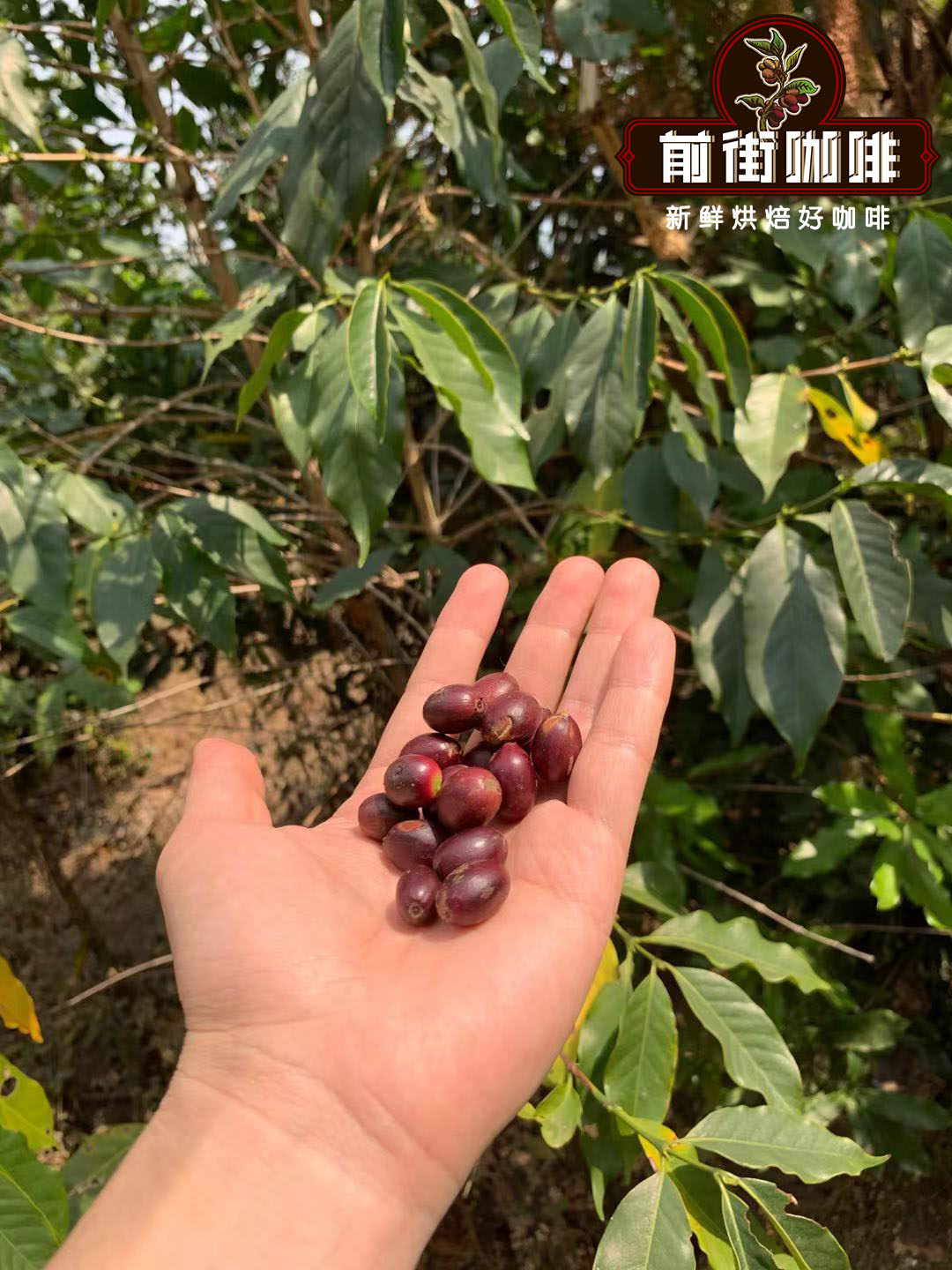
Front Street Coffee's Yunnan plantation is located in Baoshan at an altitude of 1,200 meters, near the Vietnamese border. The Baoshan coffee-producing region of Yunnan has an average temperature of 21.5°C, essentially no frost throughout the year, and abundant rainfall year-round, making it very suitable for coffee tree growth. In early March 2021, Front Street introduced a new member to the estate—the Bourbon variety. What flavor this batch of Yunnan Bourbon coffee will ultimately present, Front Street is also full of anticipation.
For Typica and Catimor that both use washed processing, where are the flavor differences reflected?
This time Front Street selected Catimor and Typica that both come from the Baoshan producing region and both undergo washed processing for a brewing comparison, to observe how the coffee flavors of these two varieties each perform under traditional processing methods.
Front Street Yunnan Catimor small-bean coffee Producing region: Baoshan, Yunnan Altitude: 1,200 meters Variety: Catimor Processing method: Washed processing
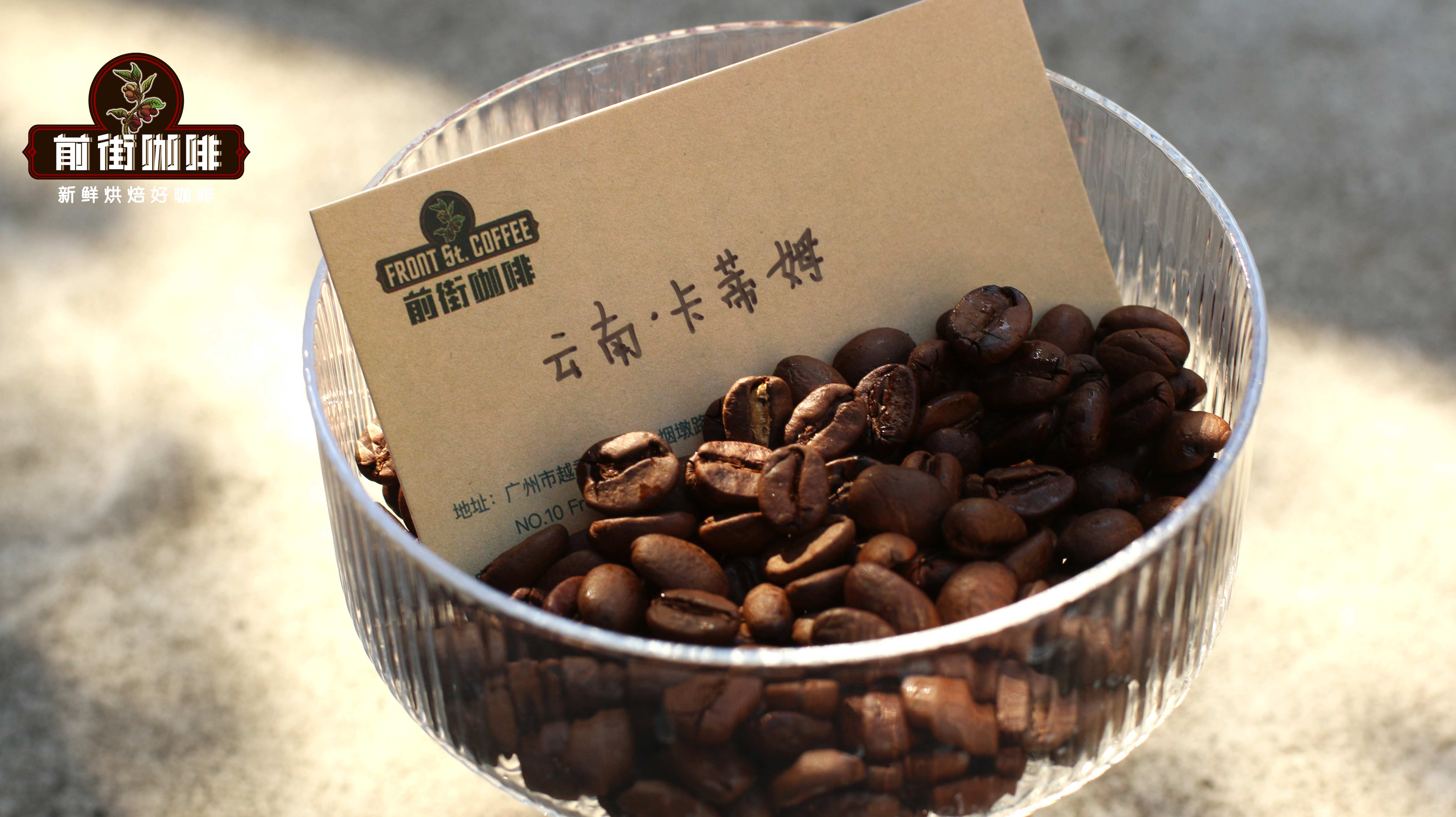
Front Street 2013 Typica coffee
Producing region: Lincang, Yunnan Altitude: 1,200 meters Variety: Typica Processing method: Natural processing
To enhance the body of the two washed Yunnan coffees, Front Street chose the Kono Meimon dripper for brewing. The Kono Meimon dripper's short-rib design can slow the flow rate during coffee extraction, thereby extending the extraction time and playing a role in enhancing body.
Dose: 15g Coffee-to-water ratio: 1:15 Grind size: Medium-fine grind (76% passing rate through a 0.85 aperture sieve) Water temperature: 90°C
Front Street uses staged brewing: first pour 30g of water to bloom for 30 seconds, at which point the coffee bed expands into a hamburger shape. For the second stage, pour 125g of water in small circles from the center, with a pouring height of 4cm, gently, minimizing agitation of the coffee bed, and controlling the flow rate at 4g per second. When the water level drops to 1/2 of the coffee bed, begin the third stage of pouring, likewise gently circling from the center outward, until reaching 225g and finishing. End extraction after all the coffee liquid in the dripper has dripped through; the total time is 2 minutes and 1 second. After extraction is complete, gently swirl the coffee liquid, and wait until it is fully uniform before tasting.
The brewed flavor of Front Street 2013 natural Typica: Rich fruity aroma on the entry, with melon and herbal plant notes; the middle section presents nuts and milk chocolate; the finish has a lively, bright plum acidity. As the temperature goes from hot to warm, one can sense the layered changes in acidity and sweetness—sweet first, then sour—accompanied by apricot and citrus-toned acidity, with a black tea finish and a slight brown sugar sweetness. The brewed flavor of washed Catimor: Pronounced roasted nuts, soft acidity, overall balanced and rich, solid dark chocolate aroma, slight orange peel.
The above content is compiled by CoffeeHunters, a coffee news website.


