








What is the piccolo coffee meaning and ratio?
Piccolo means small in Italian, and the Piccolo Latte is an Australian milk coffee served in a glass of about 100ml. It uses a single shot of espresso topped with a thin layer of milk foam, giving a richer, more coffee-forward taste than a standard latte.
The piccolo coffee ratio of espresso to milk is roughly 1:2, compared with about 1:6 in a latte, while a regular latte cup holds 200ml to 300ml. Flat White also comes from Oceania and differs from both. Because milk takes up less of the cup, the piccolo shows the flavor of the beans more clearly. Making one still demands careful steaming and pouring.
Among the many milk coffees, the latte is the most familiar, and the Australian-style Flat White has also become quite popular in recent years. But have you ever heard of the Piccolo Latte, which also originates from Australia? It is called a "small latte," with an espresso-to-milk ratio of about 1:2, giving it a richer taste than a regular latte, yet served in a cup of only about 100ml. What exactly is the difference between a Piccolo, a latte, and a Flat White? Why does it better highlight the flavor of the coffee beans themselves? Front Street Coffee will give you a detailed analysis of the Piccolo's characteristics and teach you step by step how to make a standard small latte, so you can easily enjoy this perfect balance of espresso and milk at home.

For more specialty coffee knowledge, please follow: Front Street Coffee (Frontsteet Coffee)
When it comes to milk coffee, the latte is probably the one everyone drinks most in daily life, and in recent years Flat White (Australian-style white coffee) has gradually become popular too. Flat White is different from latte—it originated in Oceania. In fact, besides Flat White, there is another milk coffee that also comes from Australia, and today Front Street will introduce it to you!
What is a Piccolo Latte?
The Piccolo Latte originated in Australia and is said to be especially popular in Melbourne. The English name Piccolo comes from Italian, meaning "small." It uses a single shot of espresso, topped with a thin layer of milk foam, and is served in a small transparent glass of about 100ml (a regular latte cup holds 200ml–300ml). Although it is called a "small latte," making a good Piccolo is no less difficult than making a latte.
What is the difference between a Piccolo and a latte?
Although the latte originated in Italy, it became popular starting in Seattle, Washington, in the 1980s in the United States, and spread worldwide with the expansion of an international chain brand. The word Latte comes from Italian, and its original meaning is simply milk.
The difference between a Piccolo and a latte is that in a Piccolo the ratio of espresso to milk is about 1:2, while in a latte it is about 1:6. As a result, the Piccolo Latte tastes richer than a regular latte, yet its volume and calories don't place too much of a burden. For those who don't want to take in too much caffeine and milk, this is practically a blessing.
What is the difference between a Piccolo and an Australian-style Flat White?
The Australian-style white coffee, like the Piccolo, originated in Oceania. As for whether the Flat White specifically originated in Australia or New Zealand, even with written records, both sides each hold to their own account.
So what is the difference between a Piccolo and a Flat White? For those who enjoy milk coffee, the Australian way of making a Flat White lets people sense the taste of coffee within the milk, while also finding the silkiness of milk within the coffee. As for the ratio of milk to milk foam in a Flat White, after the milk settles, the foam should remain at a thickness of 0.5cm.
Front Street has found that, for Australians, a latte is a coffee for people who prefer milk; if you want to "truly taste" the aroma of the coffee beans and their perfect pairing with milk, the Flat White's ratio comes closer to the ideal. Besides the most common Flat White, Australians also invented for heavy coffee lovers the Piccolo Latte, commonly known as the "small latte." The Piccolo is essentially a scaled-down version of a full latte, representing the same flavor and coffee intensity. This can cause some confusion when customers place their orders.
The differences in taste among all milk coffees mostly depend on the amount of espresso extracted—in other words, the espresso content is a crucial factor. In a latte, the espresso component makes up about one-tenth of the entire drink; in a 300ml cup there is roughly 30–40ml of espresso.
This means that if we similarly use a standard 30ml single shot of espresso to make a Piccolo Latte of only 100ml, the flavor of the espresso will be more pronounced and richer.
Therefore, the Piccolo Latte makes it easier to taste the flavor of the coffee beans themselves, and even amplifies the beans' characteristics. If you find a latte has too much milk, but you don't like espresso that is too concentrated and bitter, the Piccolo may be your best choice. It is smooth on the palate, with a moderate temperature—about 55–60°C can bring out the lactose sweetness in the milk. Moreover, precisely because the milk content is low, you can taste the coffee's sweet aroma, richness, and lingering finish, and even after finishing the whole cup you won't feel stuffed.
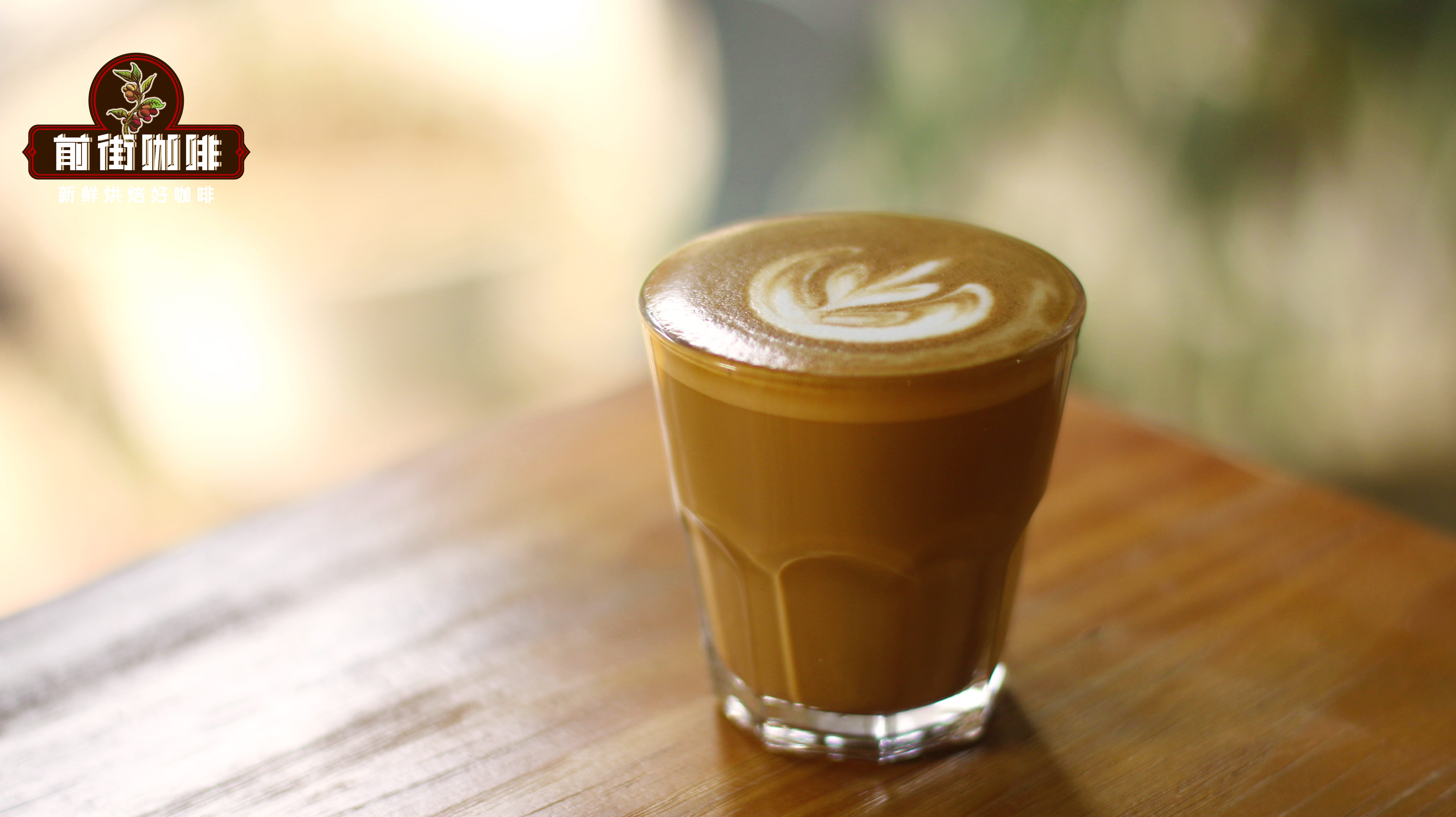
Front Street teaches you to make a standard Piccolo Latte
To give the Piccolo Latte a mellow and substantial mouthfeel, here we use Front Street's classic espresso blend beans, which adopt the classic "Mamba recipe," with Brazil and Mandheling as the main notes, then paired with a small amount of Robusta to form the combination. The purpose is to let everyone extract a rich, deep, caramelized coffee flavor and full-bodied crema at home. Below, Front Street will make a latte and a Piccolo respectively, and you can find the differences between the two for yourself.
[Latte]
Through repeated testing, Front Street determined 20g of coffee grounds, extracting 40g of espresso, in 28 seconds. Front Street Coffee (FrontStreet Coffee) stores serve lattes in 300ml coffee cups, so 220g of milk is poured in and steamed with a steam wand to 55–60°C. The latte's milk foam has a moderate thickness of about 0.5cm; after steaming, the milk surface is glossy, without bubbles, and has a certain fluidity. Finally, simply combine the steamed milk with the espresso and pour latte art.
[Piccolo Latte]
To make a Piccolo, Front Street uses a small cup of about 90–100ml, preheated in advance as much as possible to ensure the coffee's drinking experience. Then a single shot of espresso (15–20ml) is combined with 60ml of steamed milk with thin foam (less than 0.5cm). Apart from the mini cup size, the Piccolo and a regular latte are indeed not so different in structure, but because the vessel it is served in is half the size, the difficulty of making it is undoubtedly much higher than a latte.
Since it is called a "small latte," the latte art that comes standard with a hot latte naturally cannot be left out, but a smaller cup means less space for the barista to draw. As the whole coffee shrinks, the barista must steam just 60ml of milk from the pitcher into silky, dense foam and blend it evenly with the espresso, all without losing the exquisite appearance of a regular hot milk coffee. This is also why the Piccolo we usually see in cafés is almost always simple patterns like tulips, small leaves, and hearts.
Also being a milk coffee, why is the latte more famous than the Australian-style white coffee and the Piccolo Latte?
Front Street speculates that this is related to flavor and the strength of promotion. The latte became widely known because Starbucks gradually expanded its market worldwide. Second, compared with Australian milk coffees, a latte has a larger proportion of milk in the cup, and the overly concentrated and rich flavor of the espresso is diluted to a great extent, making it easier for people to accept. As the Australian-style white coffee and the Piccolo Latte appear on more and more café menus and more people drink them, these milk coffees from Australia can become known to more and more people.
The above content is compiled by CoffeeHunters, a coffee news website.


