







What Is Arabica and How Does It Differ From Robusta?
Arabica (Coffea arabica) originated in Ethiopia and accounts for roughly 80 percent of global coffee production, prized for delicate, varied flavors. Robusta (Coffea canephora) yields more caffeine and resists pests and disease better, which keeps it central to blend and instant coffee markets even though it is often described as the lesser variety.
The two species also diverge in growing altitude and cupping performance. Kew has identified more than 120 Coffea species, yet only Arabica and Robusta are grown on a large commercial scale. Roasted carefully to specialty standards, Robusta can show walnut and chocolate notes, so quality depends on processing, not species alone.
The world of coffee is far richer than we imagine. As the third wave of coffee has led people to pay attention to the story behind every bean, the influence of variety on flavor has become a hot topic. Commercially grown coffee worldwide is mainly divided into two major categories: Arabica and Robusta. The former occupies about 80% of production with its delicate and varied flavors, while the latter holds its ground in blend beans and the instant coffee market thanks to its strong stress resistance and high caffeine content. The two differ significantly in growing altitude, resistance to pests and diseases, and cupping performance, but Robusta is not destined to be low quality—when carefully processed to specialty standards, it can also present surprising walnut and chocolate notes. This article takes you through a systematic understanding of the true nature of these two major coffee varieties.
For more specialty coffee knowledge, please follow: Front Street Coffee (Frontsteet Coffee)
The evolution of coffee has gone through a long period of time, and it was not until the rise of the third wave of coffee that people began eagerly tracing every step of a cup of coffee from seed to cup—how farmers cultivate, how pickers select, how processing methods affect green beans, and how roasters customize curves for specific beans. In this series of steps, the coffee variety is especially key in shaping the final flavor. Today, Front Street will sort out the two main forces in the coffee family and resolve everyone's doubts one by one.
Beauty from a seed
Everything begins with a seed, which comes from a tree that bears white flowers and gives off a jasmine-like fragrance. The fruit produced by this tree looks much like a cherry, and hidden at the center of the pit is exactly the coffee bean.
London's Botanical Kew has undertaken the identification of more than 120 species of Coffea plants, many of which originate from Madagascar, Asia, and Australia. Among the many varieties, Coffea arabica (Arabica) and Coffea canephora (Robusta) are the two major commercial pillars, and they are also the two most commonly consumed in daily life. Although there are other members of the Coffea genus, none has yet been proven capable of large-scale production.
What is Arabica?
Arabica accounts for about 80% of global coffee production. It originated in Ethiopia and is usually grown at altitudes between 1,000 and 2,300 meters, distributed across the "Coffee Belt" between the tropics and subtropics. This region often has fertile volcanic soil, regular rainfall, and ample sunshine, exactly meeting the conditions needed for healthy coffee tree growth.
Arabica requires especially careful attention because its plants are vulnerable to pests and diseases. For example, coffee leaf rust or fungal infections can cause orange spots on the leaves, hinder photosynthesis, and lead to leaf drop or even the death of the entire plant; if not controlled effectively, an entire estate may be destroyed. In addition, pests such as the coffee berry borer also prefer Arabica. They lay eggs inside the coffee cherry, and after hatching, the larvae eat the pulp, causing a significant decline in coffee quality.
Despite these difficulties, Arabica still wins consumers' favor with its smooth mouthfeel. A cup of Arabica coffee is full of aroma and rich in flavor, often described as having floral, fruity, citrus, earthy, creamy, chocolate, caramel, honey, or sugary notes. The flavor range can span from light and sweet to full-bodied, depending on the origin and processing method.
What is Robusta?
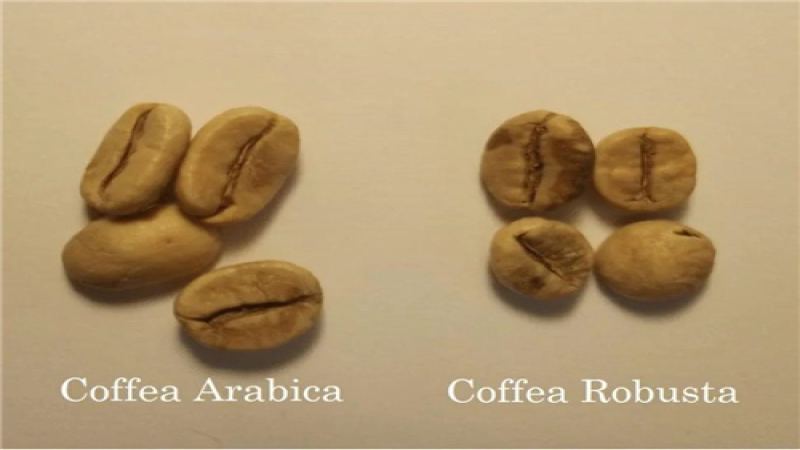
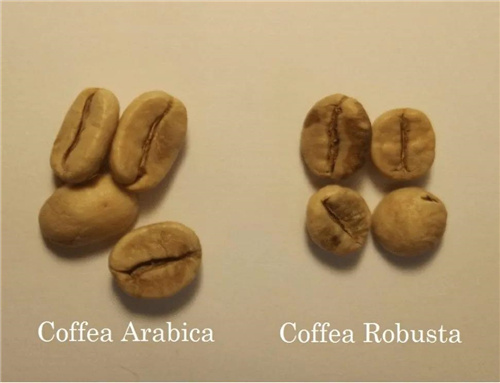
Robusta originated in West Africa and is mostly grown in lower-altitude, hotter regions. Almost all of the rest of the world's coffee production comes from it. Robusta beans are smaller and rounder, and their caffeine content is nearly twice that of Arabica. This high caffeine serves as a natural insect-repellent barrier, helping it resist most pests, so Robusta has lower cultivation costs and a more affordable price. In addition, because it can bring a richer crema during extraction, it is often used in blend beans.
Although Robusta also has quality advantages, it is not very popular with the public. In fact, many coffee lovers stay away from it, mainly because it often appears in instant coffee or low-quality blend beans, corresponding to low price and quality. After roasting and brewing, Robusta is often described as prominently bitter, sharp, and carrying notes of wood and rubber. Despite being disliked by most coffee enthusiasts and not being the first choice for mass consumption, Robusta still has its own supporters.
Without artificial protection, what ultimately survives will be Robusta
Gabe Shohet is the co-founder of Black Sheep Coffee in London and is committed to promoting specialty-grade Robusta. This coffee shop was founded by Shohet and a group of friends who wanted to make coffee that was different from the rest, especially favoring Robusta's rich, thick, high-caffeine characteristics. As the shop's name suggests, they have already left the track of mainstream coffee culture.
However, Shohet's advocacy of Robusta has its reasons. In his article "Fairness and E-Quality: The Case for Robusta," he pointed out that Robusta has a bad reputation, but the responsibility does not lie with the bean itself. Robusta is usually machine-harvested, which means the harvest will be mixed with rotten, unripe beans, as well as impurities such as insects and branches. Such a combination is destined to produce a bad cup of coffee.
So Shohet set out to verify: if Robusta received the same care and attention as Arabica, what would it taste like? After months of repeated trials, Shohet and his team found the world's first specialty-grade Robusta farm. India's Sethuraman Estate hand-sorts, double-washes, and shade-dries Robusta, ultimately presenting flavor characteristics more distinctive than Arabica. This high-caffeine drink can help people stay energized all day while carrying very obvious walnut and chocolate flavors.
Although Arabica may still be consumers' first choice, Robusta has begun to prove its value—people like Shohet are working hard just to give consumers a chance to give it another try.
The above content is compiled by CoffeeHunters, a coffee news website.


