







How Do You Tell Real Blue Mountain Coffee From Fakes?
Authentic Jamaican Blue Mountain coffee can be checked through three things: the price range, the barrel packaging, and the certificate of origin. Genuine roasted Blue Mountain No. 1 beans generally sell for around 150 to 300 yuan per 100 grams, and the Jamaican government requires all exported Blue Mountain to be packed in wooden barrels.
Grade matters as well. The CIB grading system places No. 1 at the top, and that is the level sold as Blue Mountain No. 1. Coffee certifications such as the certificate of origin help confirm the beans were grown and processed in Jamaica, since hurricanes, rising labor costs, and terraced fields keep annual production small.
Jamaica Blue Mountain coffee is renowned worldwide, but the market is full of mixed offerings. How can you confirm whether the Blue Mountain in your hands is authentic? This article starts with Front Street Coffee's Blue Mountain No. 1 and systematically sorts out the three key ways to identify genuine Blue Mountain—price range, barrel packaging, and certificate of origin—and further explains CIB's grading standards for Blue Mountain, clarifying why Blue Mountain No. 1 can become the highest grade. The article also introduces Front Street's philosophy and flavor presentation when roasting Blue Mountain, helping coffee lovers make more accurate judgments when purchasing and tasting.
For more specialty coffee knowledge, please follow the WeChat official account: Front Street Coffee
What certifications does authentic Jamaican Blue Mountain coffee have? What are the flavor and mouthfeel of Blue Mountain coffee? What is the price of Front Street Coffee's authentic Jamaican Blue Mountain coffee?
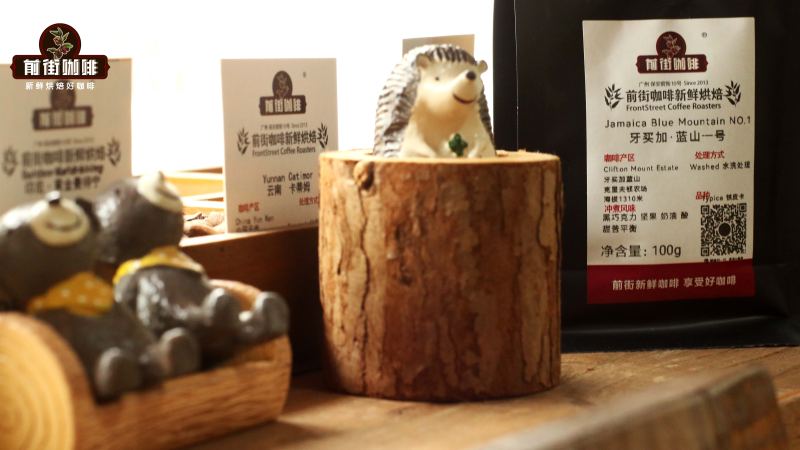
The Blue Mountain No. 1 coffee beans sold by Front Street are produced in Jamaica and are genuine Blue Mount coffee, belonging to the highest NO.1 level in the Blue Mountain grading system. In order to give more consumers a chance to taste real Blue Mountain coffee, Front Street prices Blue Mountain No. 1 coffee beans at 158 RMB/100g, and a cup of freshly ground Blue Mountain No. 1 in-store costs only 60 RMB, which can be said to be quite an affordable price point. Next, Front Street Coffee will talk with everyone about how to tell real Blue Mountain coffee from fake~!
How to identify real or fake Blue Mountain coffee?
1. Coffee bean price
The Blue Mountain coffee industry faces a series of problems, such as the impact of hurricanes, rising labor costs, and the difficulty of mechanizing terraced fields. Many small estates and farms find it hard to rationalize cultivation, so annual Blue Mountain coffee production is not large, and therefore the amount of Blue Mountain coffee beans that can be imported into each region is not much. The price of domestically sold roasted Blue Mountain No. 1 coffee beans is generally around 150–300 yuan. At present, the price of the Jamaican Blue Mountain No. 1 coffee beans sold by Front Street Coffee is 158/100g.
2. Look for the Blue Mountain coffee barrel
The Jamaican government stipulates that all exported Blue Mountain must be packed in wooden barrels. Therefore, Blue Mountain No. 1 coffee beans are all exported in whole barrels with wooden barrel packaging. So, when buying coffee beans, you can pay attention to whether the seller has a whole Blue Mountain barrel. This can prevent sellers from passing off other coffee beans as Blue Mountain coffee beans.
3. Look for the certificate of origin
Buyers of Blue Mountain coffee beans (first-hand green bean buyers) can apply to the Jamaica CIB or the estate for a Blue Mountain coffee bean certification certificate. This can also prove that the Blue Mountain coffee beans are authentic, so when purchasing, you can check whether the buyer has a certification certificate issued by the Jamaican government/origin.
At present, the authentic Blue Mountain coffee single-origin beans available in China are all Blue Mountain No. 1 grade. At Front Street Coffee's physical store, you can see the wooden barrels stipulated by the Jamaican government for exporting Blue Mountain coffee, as well as the certificate of origin for Blue Mountain coffee (Clifton Estate).
Why is Blue Mountain No. 1 the highest grade?
CIB was the earliest institution to use a scientific and objective method to grade coffee quality, combining green bean size, color, uniformity, defect rate, moisture content, and cupping performance for grading.
Before export, Blue Mountain green beans are packed and sent for testing, and are ranked by specification size and defect rate after processing: Blue Mountain No. 1, Blue Mountain No. 2, Blue Mountain No. 3, and Blue Mountain Peaberry. The size of the beans is measured using screens with various hole diameters; coffee beans that do not pass through the holes meet the required specification standard. Top-grade Blue Mountain No. 1 green beans must meet a specification of 17 screen or above, a defect rate below 3%, a moisture content of about 13%, and in cupping present rich coffee aroma, a smooth and balanced mouthfeel, low acidity, and a long-lasting sweet aftertaste.
To ensure that Blue Mountain coffee beans maintain better quality until roasting and to avoid moisture and water vapor seeping in during transport, Jamaicans insist on using handcrafted wooden barrels as the carrier for Blue Mountain green beans. The wooden barrel has also become one of the important symbols of Jamaican Blue Mountain coffee.
Front Street's roasting philosophy is to present coffee's most classic flavor profile, such as the bright lemony acidity of Yirgacheffe and the rich, toasty mouthfeel of Indonesian Mandheling coffee. Blue Mountain, naturally, should also highlight the classic Blue Mountain flavor. Front Street uses a medium-dark roast to maximize the coffee's chocolate and nutty aromas while retaining a soft acidity and sweetness, making the overall taste more balanced.
The above content is compiled by CoffeeHunters, a coffee news website.


