







How Does Yellow Bourbon Coffee Differ From Red Bourbon?
Brazil is the largest coffee producer in the world, and its Cerrado region turns out clean, sweet, full-bodied specialty coffee thanks to high altitude and fertile soil. Red Bourbon serves as a daily staple, while Yellow Bourbon from the Mogiana Queen Estate is positioned as a specialty lot. Both lean low in acidity and are aimed at drinkers who prefer nutty and chocolate notes.
Brazilian coffee began in 1729, when the first trees arrived from French Guiana. Much of the country's coffee production sits at low altitude, where quality can be mediocre, but higher ground supports specialty lots that can place in COE competitions. Bourbon Santos is a well-known representative single origin from Brazil.
Brazil, as the world's largest coffee producer, has its Cerrado region producing clean, sweet, and full-bodied specialty coffee thanks to high altitude and fertile soil. This article starts from Brazilian coffee history, geographical conditions, Bourbon variety characteristics, and the pulped natural process, focusing on analyzing the regional features, green bean analysis, roasting curves, and cupping flavors of Cerrado Red Bourbon and Mogiana Queen Estate Yellow Bourbon. Combined with Front Street Coffee's brewing parameters, it presents the differentiated performance of the two beans in nutty, chocolate, and sweetness notes, suitable for coffee lovers who prefer low-acid, full-bodied flavors.
Brazil firmly holds the top spot in global coffee production, supplying large quantities of commercial blending beans while also offering notable specialty lots. Commercial beans are an irreplaceable base ingredient in espresso blends, while specialty beans reveal more possibilities of regional terroir. Among the beans listed by FrontStreet Coffee, whether the Red Bourbon as a daily staple or the Yellow Bourbon positioned as specialty, both balance origin flavor and value for money. For consumers who dislike acidity, Front Street usually lists Brazilian beans as the first choice. Brazil is vast with many producing regions; coffee grown at low altitudes often has mediocre quality, but once the altitude rises, specialty beans can even place in COE competitions—the gap is striking. Front Street always believes that whether a bean can clearly convey its origin flavor is crucial, as this reflects regional characteristics and helps drinkers understand the logic behind coffee formation. Next, Front Street will take you into Brazilian producing regions; friends who want to learn the story of Brazilian coffee, don't fall behind.
The history of Brazilian coffee can be traced back to 1729, when the first coffee trees were introduced from French Guiana. Although careful cultivation, improved processing methods, and enhanced growing techniques can optimize quality to some extent, Brazil's natural endowments ultimately cannot compete with regions producing top-tier coffee—soil conditions are acceptable, the climate is humid, but the altitude is low. Nevertheless, Brazil has still contributed some world-renowned single origins, with Bourbon Santos being a representative. It has no particularly outstanding merits nor obvious shortcomings; the taste is mild and smooth, with low acidity, moderate body, and a hint of light sweetness. These soft elements intertwine, and distinguishing them one by one is quite a challenge for the palate—which is exactly why many Bourbon Santos fans enjoy it. Because it is gentle and approachable, Bourbon Santos is suitable for medium roasting and for as full an extraction as possible, making it an excellent base for espresso and various fancy coffees.
Brazilian coffee is mostly distributed in flat terrain areas. To adapt to this environment, Brazilian estate owners bred improved Arabica varieties decades ago that do not require high altitudes or shade, and can be planted on plains or grasslands directly exposed to the sun, completely different from traditional high-altitude shade cultivation. Brazilian coffee bean producing regions are mostly only a few hundred meters above sea level, and coffee is even planted on flat land. This sun-exposed cultivation causes the fruit to develop faster, with insufficient flavor development, and the beans are less dense than highland beans, with noticeably low fruit acidity and monotonous flavor. Rio coffee near the coast even has an iodine and salty taste, generally believed to be the result of some microbial action. Front Street points out that even with the same soil, this flavor is not necessarily produced every year; most coffee lovers do not appreciate it, and only a few Middle Eastern countries, accustomed to boiling coffee with sugar, find this Rio flavor suitable.
Brazil is often compared to the "giant" and "monarch" of the coffee world. The country has about 3.97 billion coffee trees, with small farmers contributing 75% of total production. Brazil's coffee workforce is two to three times that of Colombia, the world's second-largest coffee producer. In terms of natural conditions, Brazil is located in the tropics, with the northern part having a year-round hot and humid tropical rainforest climate suitable for tropical crops; coffee trees prefer sunlight, and ample sunshine meets their needs. Historically, Brazil was a Portuguese colony for a long time, and to meet Western European demand, it long pursued single-crop cultivation and developed a tropical plantation economy, with coffee being a pillar industry for a very long period. From a market perspective, coffee and its processed products are rich in caffeine, can invigorate the spirit, and are significant for groups mainly engaged in mental labor, thus having a broad market. Combining these factors, Brazil's coffee production ranks first in the world. Unlike before, Brazil's economy is now less dependent on coffee, with coffee accounting for only 8% to 10% of GDP. Before World War II, Brazil's total coffee production accounted for more than half of the global total; now it is close to 30%, but the country's influence on global coffee, especially on prices, remains pivotal. The two frosts in 1994 once caused global coffee prices to soar.
After coffee trees were introduced from French Guiana in 1720, coffee production gradually evolved into a science. Before 1990, the Brazilian government exercised strict control over the coffee industry, with both severe intervention and price protection, and consistently implemented minimum price guarantees for farmers, leading to overproduction. For a period before World War II, surplus stocks reached as many as 78 million bags, which later had to be burned or dumped into water for destruction.
Since the opening of the free market in 1990, the former "Brazilian Coffee Institute" (IBC) was replaced by the National Economic Association, a non-investment administrative agency, which pursued a non-intervention policy and allowed producers and exporters to negotiate directly. Exporters' business activities are supervised by government legislation, and legal exporters are registered. This largest coffee-producing region, with various grades and types of coffee, accounts for one-third of global consumption and holds a place in the global coffee trading market. Although Brazil faces several times more natural disasters than other regions, its arable land area is sufficient to compensate. There are many coffee types here, but industrial policies favor large quantities and low prices, so there are not many specialty-grade coffees, but it is a good choice for blending with other coffees.
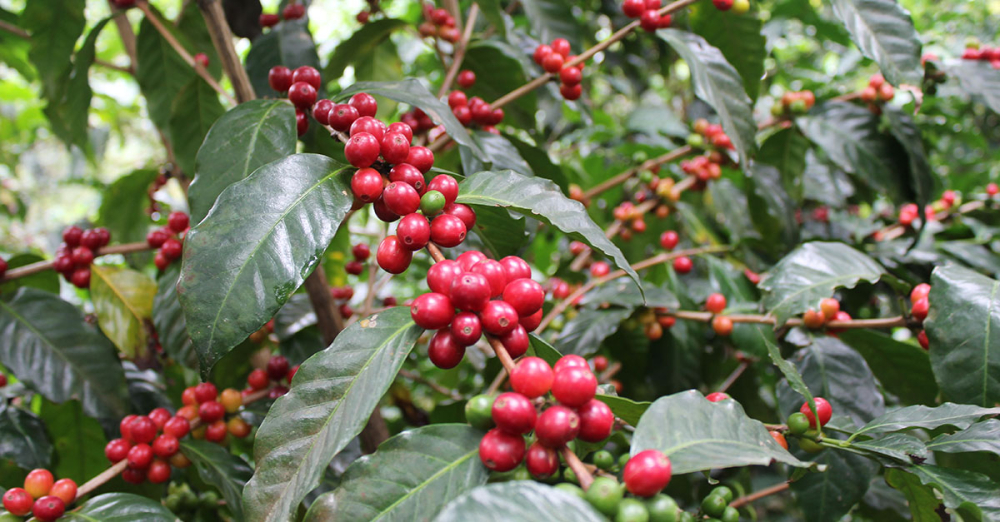
Bourbon coffee was first planted on Réunion Island, which was also called Bourbon Island before 1789. Bourbon is a sub-variety resulting from a mutation of Typica, and together with Typica belongs to the oldest existing coffee varieties. The green fruit turns bright red when ripe. For Red Bourbon, after the coffee tree flowers and fruits, the fruit color changes as follows: green, slightly yellow, slightly orange, ripe red, and darker red when more mature. Therefore some people call it Red Bourbon; in fact, Red Bourbon is what is commonly called Bourbon. Bourbon planted at high altitudes usually has better aroma, brighter acidity, and even a red-wine-like flavor. In simple terms, Bourbon is a branch under the Arabica species, generally bearing red fruit, called Red Bourbon; there are also Yellow Bourbon and Orange Bourbon. Yellow Bourbon has relatively lower yield but better quality.
The semi-washed method is a somewhat outdated green bean processing method in Brazil and is easily confused with the pulping method, but in Front Street's view, the semi-washed method still has its unique merits. Coffee processed by the semi-washed method has an extremely full body and very high sweetness, and places extremely high demands on the grower's skill and experience; once a mistake is made, the coffee becomes undrinkable. Like the pulping method, people first use a pulper to remove the pulp from the fruit, but the difference is that the semi-washed method requires removing as much of the skin, pulp, and mucilage on the surface of the green beans as possible. In Central America, people wash directly with a washing machine after pulping, so this method is also called "mechanical washing." The processed green beans are very clean and can begin drying without fermentation. Semi-washed coffee dries very quickly under constant temperature conditions. Front Street believes that semi-washed coffee has quite good acidity, sweetness, body, and aroma; the only drawback is that the flavor is not as intense as pure natural or washed coffee.
The pulped natural process, also called the peeled sun-dried method, differs from traditional natural processing in that pulped natural removes the skin and pulp of the coffee cherry, allowing control over the fermentation degree of the mucilage-covered beans after pulping. Traditional natural processing dries with the skin and pulp, making it impossible to see the fermentation degree of the mucilage. The pulped natural process lies between natural and washed processing, but without the washed process's "tank fermentation and clean water rinsing," instead going directly into the sun to dry. Although the methods look similar, without the fermentation step, the coffee bean flavor is completely different. During the pulped natural process of removing skin and pulp, fully ripe pulp is easy to remove, while the skin of unripe green fruit is not easy to handle, so a second screening can be performed to filter out unripe fruit and unify coffee fruit maturity. Compared with natural processing, Front Street believes that coffee beans selected and processed this way will have improved cleanliness and maturity, bringing coffee with a more uniform taste.
The main coffee-producing regions of Brazil are Minas Gerais, Sao Paulo, Bahia, and Espirito Santo; these four places account for 90% of national export volume. The Mogiana we commonly see comes from Sao Paulo, and Cerrado and Sul de Minas within Minas Gerais, because these three producing regions are at higher altitudes, mostly produce specialty Brazilian coffee beans.
Sul de Minas: Hilly land at 700m-1200m above sea level, it is the earliest production area of Brazilian coffee. Due to rising labor costs, most is now mechanically harvested, and it is also the earliest commercialized coffee region, where many large exporters can be seen. The Bahia producing region in northern Brazil mainly produces washed Brazilian coffee, and the Espirito Santo producing region near the coast is the main export area for Brazilian Robusta varieties.
Cerrado: The savanna occupying 22% of Brazil's total area, deep in Brazil's interior; the Portuguese word Cerrado means "closed place." The Cerrado savanna begins in Mato Grosso in southwestern Brazil, passes through the central-west of Minas, and reaches western Bahia in the north. The Cerrado coffee producing region referred to by Front Street is not the entire Cerrado savanna, but only the coffee planting area above 1000 meters altitude in the central-west of Minas, which can truly be called the Cerrado coffee producing region. This area is the essence of the Cerrado savanna, with high altitude and fertile soil, making it possible to grow clean, sweet, full-bodied, and highly clean specialty coffee beans. So to drink Brazilian specialty coffee, start tasting with this Front Street Cerrado. It is selected from a well-performing Red Bourbon and uses a medium-dark roast, highlighting a rich creamy nutty aroma, very suitable for friends who fear acidity.
Brazil Cerrado Red Bourbon Country: Brazil Region: Cerrado Altitude: 1000 meters Variety: Red Bourbon Processing Method: Pulped Natural
Mogiana: This area is very close to southern Minas. Coffee is planted among shrubs, grass, and other vegetation. There are many farming families in this area; some use traditional large-farm operating methods, while others adopt small-scale modern operations. Modern technology combined with mountain coffee-growing culture creates the highest-quality green coffee beans. In Brazil, large estates are actually not many. Front Street Queen Estate is not only located at a high altitude, but also uses the Yellow Bourbon variety, and because of refined processing, it carries more delicate aroma and sweetness, suitable for pour-over, espresso machines, drip machines, moka pots, and other extraction methods.
Brazil Queen Estate Yellow Bourbon Country: Brazil Region: Mogiana Altitude: 1400-1950 meters Variety: Yellow Bourbon Processing Method: Pulped Natural
Usually we see information like this on burlap sacks of Brazilian coffee beans: Brazil NY.2 SC ——17/18 FC. This is Brazil's unique three-part grading method, not adopted by other countries, because the producing area is too large and too many beans are produced. To create coffee flavors specifically for export, these coffee beans are often blended, resulting in inconsistent quality that requires "cupping" for grading. This way, consumers can roughly know the coffee's quality just by looking at the green bean information.
1. Grading by defect rate
The evaluation method used for Brazilian coffee is the "deduction method," ranking grades according to how many defective beans are in each 300 grams of primary beans. There are seven levels from No.2 to No.8; a deduction below 4 can be classified as No.2. Of course, having no defective beans at all could be called No.1, but this is rare and cannot maintain a steady supply, so Brazil sets No.2 as the highest grade, not No.1.
2. Grading by bean screen size
Screen size: This is screened using a mesh based on 1/64 inch, usually with screen sizes from 14 to 20. It should also be noted that the size corresponding to the screen number is the short side, i.e., the "width," of the coffee bean. The largest screen size for Brazilian coffee beans is 19, but production is not much, so 17/18 screen is the highest grade.
3. Cupping quality
fine cup|fine|good cup|fair cup|poor cup|bad cup|FC (Fine Cup) and GC (Good Cup) are more common.
Many companies or platforms also add processing method (natural/washed/honey) and estate information.
4. Flavor grade
Brazilian coffee beans are classified into five major categories by flavor grade. They are: Strictly Soft → very smooth, Soft → smooth, Softish → slightly smooth, Hardish → not smooth, Rioy → iodine pungent taste. Brazil-Cerrado coffee beans received a cupping result of Strictly Soft Fine Cup (very smooth) from the local coffee association, which is the best grade. In summary, Brazil NY.2SC – 17/18 FC Cerrado means country Brazil, defect rate grade 2, green bean screen size 17~18, fine cup quality, from Cerrado. This is also the Brazilian formula bean in the blend coffee that FrontStreet Coffee has always used. Next, Front Street will use the two Brazilian coffee beans listed, the Yellow Bourbon from Mogiana Queen Estate and the Red Bourbon from Cerrado, for green bean analysis, roasting, cupping, and brewing comparison.
Front Street Green Bean Analysis
Front Street noticed that the two Brazilian green coffee beans have a solid texture, relatively low density, softer bean quality, thinner thickness from bean surface to core, good flavor performance, with a slight orange peel and spice aroma, and a green bean moisture content of 9.9%. This relatively low moisture content gives the beans strong heat absorption capacity. Therefore, FrontStreet Coffee's roasting plan is to charge beans at 200°C, then use high heat and a small airflow to speed up dehydration. After the dehydration phase ends, open medium airflow and medium heat for the Maillard reaction; do not rush the time, and discharge near the end of first crack.
Front Street Roasting Comparison Brazil Yellow Bourbon Roasting Suggestion: Yangjia 800N, charge amount 550g: preheat to 200°C and charge, adjust heat to 150, open airflow to 3, turning point at 1'30", maintain heat, turn yellow at 5'10", grassy smell disappears, enter dehydration phase, lower heat to 125, open airflow to 3.5. At 8'20" dehydration is complete, bean surface shows wrinkles and dark spots, toast smell turns to coffee aroma, a prelude to first crack; at this time listen carefully for the sound of first crack. At 9'14" first crack begins, open airflow fully to 5. Post-first-crack development time 1'48", when reaching 180°C lower heat to 50, discharge at 197.5°C.
Brazil Red Bourbon Roasting Suggestion: Yangjia 800N, charge amount 550g. Preheat furnace temperature to 200°C and charge, adjust heat to 160, open airflow to 3, turning point at 1'30", maintain heat, turn yellow at 5'00", grassy smell disappears, enter dehydration phase, lower heat to 130, open airflow to 4. When reaching 168°C, lower heat again to 100. At 8'00" dehydration is complete, bean surface shows wrinkles and dark spots, toast smell turns to coffee aroma, a prelude to first crack; at this time listen carefully for the sound of first crack. At 8'50" first crack begins, open airflow fully to 5. Post-first-crack development time 3 minutes 10 seconds, when reaching 190°C lower heat to 50, at 194°C lower again to 30, discharge at about 200°C. Front Street Cupping Comparison
Front Street will conduct cupping within 8-24 hours after roasting the sample coffee beans. The cupping bowls generally used by FrontStreet Coffee baristas are 200ml ceramic bowls, marked with 150ml and 200ml lines. According to SCAA standards, the water TDS is about 150ppm; too low TDS easily causes over-extraction, too high affects taste and easily causes under-extraction. The water temperature used for cupping is 94°C. According to SCAA cupping standards, the grinding degree is controlled so that the pass rate through a No. 20 standard sieve (0.85 mm) is 70%-75%. Ratio: 11 grams of coffee powder plus 200 milliliters of hot water, i.e., 1:18.18, so that the extracted concentration is exactly within the golden cup range of 1.15%-1.35%. Steeping time: 4 minutes.
Brazil Queen Estate Cupping Dry aroma: roasted nuts, cinnamon Wet aroma: roasted nuts, peanuts Flavor: roasted nuts, peanut butter, fermented fruit, cane sugar sweetness
Brazil Red Bourbon Cupping Dry aroma: roasted hazelnut, caramel Wet aroma: nuts, chocolate Flavor: nuts, peanuts, cream, chocolate, caramel
Front Street Coffee Brewing Experience
Brewing Parameters: Use Kono dripper Water temperature: 88°C Coffee dose: 15 grams Coffee-to-water ratio: 1:15 Grind size: medium-fine (70-75% pass rate through China standard No. 20 sieve)
For coffee beans with a darker roast level, to highlight the coffee's full body, Front Street chooses the Kono dripper for brewing. The Kono dripper's feature is its soaking function, which can be used to extract more coffee substances and enhance the full-bodied taste. Because it has few ribs and they are located at the lower end, the filter paper can adhere tightly to the dripper to limit airflow, thereby slowing the water flow and increasing water-coffee contact time.
FrontStreet Coffee uses staged extraction, also called three-stage brewing: use 30 grams of water for blooming for 30 seconds, pour in a small stream in circles until 125 grams for the first stage, and when the water level drops and is about to expose the coffee bed, continue pouring until 225 grams and stop. When the water level drops and is about to expose the coffee bed, remove the dripper. (Timing starts at the beginning of blooming.) Extraction time is 2'05"-2'15". Brazil Queen Estate Coffee Brewing Flavor: fresh sweetness of sugarcane juice, black tea, soft and smooth fruit sweetness, obvious nutty flavor, balanced and smooth acidity, weak and clean bitterness, containing rich chocolate aroma and nutty flavor, bright and refreshing taste, smooth and delicate mouthfeel. Brazil Red Bourbon Brewing Flavor: obvious sweetness on entry, with a faint lemon aroma, containing rich nutty flavor, with an obvious dark chocolate note in the aftertaste, and an overall relatively rounded impression.
The above content is compiled by CoffeeHunters, a coffee news website.


