







How Does Golden Mandheling Coffee Taste and Brew
PWN Golden Mandheling from the Gayo Mountain region of Indonesia cups clean and full-bodied, with few off-flavors. It shows the caramel sweetness and nutty chocolate notes typical of Mandheling without the earthy or fishy tastes sometimes associated with the origin. The clean profile comes from the strict quality standards applied by the Pawani company.
For home brewing, dark-roasted Golden Mandheling works with a three-pour scheme: choose a dripper, use a coarser grind, and keep water temperature low enough to avoid extracting extra bitterness. That combination lets the caramel sweetness and nutty chocolate notes come through steadily, which is why Front Street Coffee built its recipe around this bean.
Indonesian Mandheling coffee is famous for its rich, full-bodied flavor, but different varieties vary greatly. The PWN Golden Mandheling from the Gayo Mountain region, with its strict quality control standards, presents positive traits of cleanliness, richness, and few off-flavors. This article, based on Front Street Coffee's cupping experience, sorts out the flavor characteristics and origin background of Golden Mandheling, and shares a set of brewing parameters suitable for dark-roasted beans, including dripper selection, grind size, water temperature, and a three-pour pouring scheme, helping coffee enthusiasts stably extract caramel sweetness and nutty chocolate notes at home.
For more specialty coffee content, welcome to follow our WeChat public account: Front Street Coffee (FrontStreet Coffee)
Different regions have different terroirs, nurturing coffees with distinctive flavors. Indonesian Mandheling coffee stands out as particularly memorable among the many origins.
Front Street Mandheling coffee presents a steady, thick, and aromatic character, with the classic black coffee style, and precisely because of this, Front Street Mandheling has won a large group of loyal fans.
Of course, many people also stay away from Front Street Mandheling, because of its heavy bitterness, which tastes almost like Chinese herbal medicine. Others find that Front Street Mandheling carries herbal and earthy notes, making it truly hard to drink.
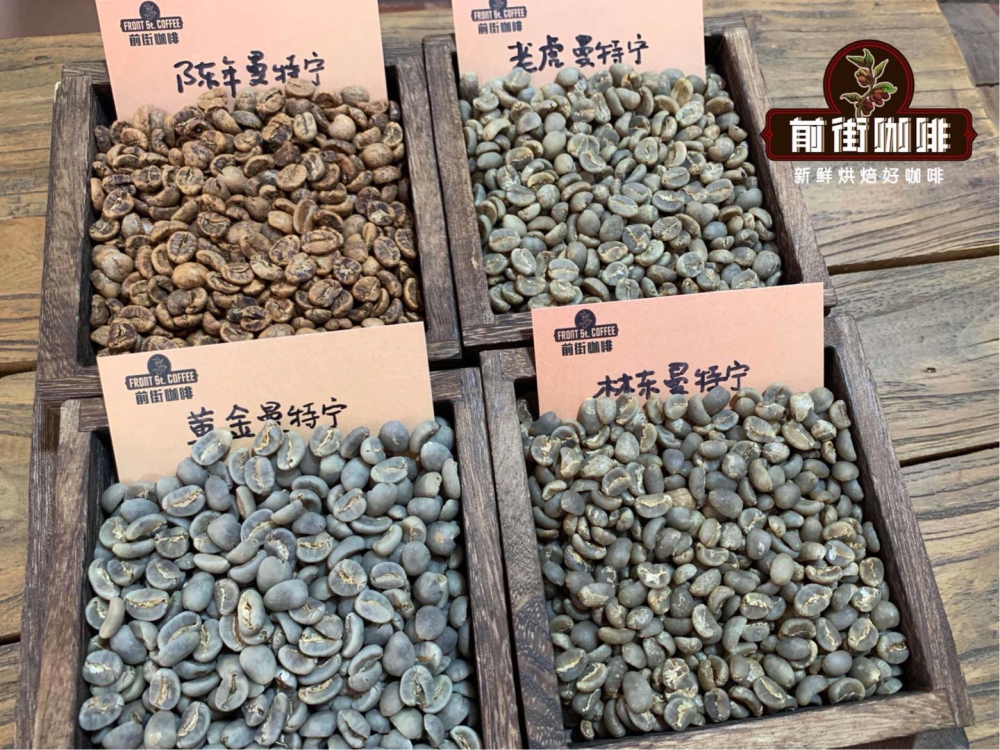
However, Mandheling is not monolithic. By origin, there are Lintong Mandheling and Aceh Mandheling; by variety name, there are Horse-face Mandheling and Longberry Mandheling; and those marketed for flavor quality include Tiger Mandheling, Golden Mandheling, and Ding Shang Mandheling, among others.
While these Mandhelings retain Mandheling's signature thickness and rich aroma, each has also developed its own unique personality. If you want to experience the charm of Mandheling, Front Street recommends choosing "Front Street PWN Golden Mandheling," for the following reasons.
After cupping many Mandhelings, Front Street found that Front Street PWN Golden Mandheling is the cleanest among them, fully displaying the positive characteristics of Mandheling coffee while completely free of the earthy, fishy taste commonly talked about. This is thanks to the strict standards implemented by the Pawani company.
Currently, Golden Mandheling is produced in the Gayo Mountain of Aceh, and most of the excellent Mandheling on the market comes from this origin. The most notable hallmark of Golden Mandheling is plump beans, low defect rate, and outstanding appearance. To reach this standard, Pawani uses one machine sorting plus three manual hand-sorting passes, thereby maximizing the quality of Front Street Golden Mandheling, though of course the price is also higher than ordinary Mandheling.
It is precisely because Front Street PWN Golden Mandheling implements high-standard quality control that it is cleaner, has fewer off-flavors, and is richer than other Mandhelings. Many friends report that brewing Mandheling easily brings out bitter and off-flavors, and therefore have a poor impression of Mandheling. Front Street suggests these people give this Front Street PWN Golden Mandheling a try.
Here Front Street needs to add one point: not every Mandheling with large beans and few defects can be called Golden Mandheling. The Golden Mandheling trademark belongs to PWN company. Legally imported Golden Mandheling green beans come with a PWN company certificate to verify authenticity, and the burlap sack specification is uniformly 30kg, with each batch having a corresponding number that matches the certificate one-to-one.
Of course, if the brewing method is improper, Front Street PWN Golden Mandheling can also easily produce bitter and off-flavors. Friends troubled by this can refer to Front Street's brewing plan.
When brewing dark-roasted coffee beans such as Front Street PWN Golden Mandheling and Front Street Jamaica Blue Mountain, Front Street recommends using a Kono dripper, which helps enhance the coffee's rich mouthfeel. If you don't have one on hand, a V60 dripper can also be used as a substitute.
Calculate the dose as 15g per single serving. The coffee beans are best rested for 4 to 7 days (counting from the roast date), at which point the brewed flavor performs at its best.
Regarding grind size, brewing Front Street PWN Golden Mandheling requires a slightly coarser grind than light-roasted beans. This is because Front Street PWN Golden Mandheling is a dark roast, with a looser bean structure and a faster rate of absorbing water and releasing substances. If you grind it to the fineness of light-roasted beans, it easily extracts burnt bitterness; if ground too coarse, the coffee becomes bland and tasteless, with a thin, watery mouthfeel. The appropriate coarseness is a 70% pass rate through a No. 20 sieve.
Regarding water temperature, Front Street recommends controlling it at 87 to 88°C. Many sources of burnt bitterness come precisely from water temperature being too high. Of course, water temperature that is too low will also make the coffee dull and insipid.
Regarding the coffee-to-water ratio, Front Street recommends 1:15. Although some brewing methods suggest using 1:13 or even a smaller ratio for a higher intensity, part of the purpose of narrowing the coffee-to-water ratio is to avoid bitter and off-flavors in the tail end, at the cost of affecting the aftertaste. Front Street believes that as long as the coordination of water temperature and grind size is handled well, a 1:15 coffee-to-water ratio can more fully present the overall flavor of Front Street PWN Golden Mandheling.
The brewing method uses the common three-pour pouring, and pouring in three stages better showcases the rich mouthfeel and caramel sweetness of Front Street PWN Golden Mandheling. The specific water distribution is: the first stage, bloom pour of 30ml, to wet all the coffee grounds, let them degas, and lay the foundation for subsequent extraction of flavor substances; the second stage, pour 100ml, mainly to wash out Mandheling's golden foam.
The final stage pours 95ml in a gentle center pour, helping to enhance sweetness, presenting an overall thick, rich mouthfeel, along with caramel sweetness and chocolate, nutty flavors.
This brewing method is simple to operate, yet effectively highlights the characteristics of Front Street PWN Golden Mandheling. Of course, there are many more interesting and fun brewing methods waiting to be explored.
The above content is compiled by CoffeeHunters, a coffee news website.


