







What Makes Panamanian Geisha Coffee Stand Out?
Butterfly coffee beans from Front Street Coffee are a Panamanian blend built on roughly 70% Geisha, sold as single-origin coffee at a price far below pure Geisha lots. They come from the Boquete growing region, the area where Hacienda La Esmeralda helped make Panamanian Geisha coffee famous after winning a reliable of Panama competition in 2004.
The Geisha variety was first found in Ethiopia in 1931, studied in Kenya, and reached Panama by the 1960s, where it was initially used as a windbreak tree. Butterfly beans use natural processing to keep costs lower, which changes the cup profile compared with washed Panamanian geisha lots while still showing the variety's characteristic floral and fruity notes.
Geisha coffee has long been famous for its high price and unique flavor, which puts many coffee lovers off. However, on Front Street Coffee's bean list there is a Panamanian coffee bean called "Butterfly," which, with its 70% Geisha blend ratio and affordable price, has become an ideal choice for experiencing Geisha flavor in daily life. This article will walk you through the origin of the name Butterfly coffee beans, their variety composition, the planting advantages of the Boquete producing region, and the flavor changes brought by natural processing. It will also answer why it still counts as single-origin coffee, and include Front Street Coffee's roasting and brewing suggestions, helping you fully understand this high-value, everyday Geisha.
Among today's most sought-after top-tier coffees, the Geisha variety accounts for a considerable share. With its high price and distinctive flavor performance, Geisha coffee beans have attracted many growers to introduce and cultivate it. Today, Geisha coffee trees can be seen in many coffee-producing countries, and Geisha varieties have even taken root in Colombia, Costa Rica, and even Yunnan, China.
Although Geisha coffee is now grown in multiple producing countries, its place of rise was Panama, while its original origin was Ethiopia. In 1931, someone discovered this variety in the Geisha forest of Ethiopia, and samples were later collected and sent to the Kenya Coffee Research Institute for study. In 1936 it was introduced to Uganda and Tanzania, but unfortunately it was not widely promoted due to unsatisfactory flavor performance. In 1953, it was introduced to Costa Rica's CATIE agricultural research institute and labeled T2722. By the 1960s, CATIE distributed T2722 to Panama for cultivation.
At first, people did not pay much attention to the Geisha variety and merely used it as an ordinary windbreak tree. After more than forty years of obscurity, Hacienda La Esmeralda in Panama's Boquete producing region noticed the unique flavor of Geisha coffee and in 2003 sent it to compete in the Best of Panama (BOP), achieving a good ranking. Just one year later, in 2004, it directly won that year's BOP championship and at the same time broke the auction price record for green coffee beans. Since then, Geisha coffee rose to fame. Not long after, in order to prevent Geisha coffee beans from dominating the spotlight, the BOP also divided coffee beans into Geisha and non-Geisha groups.
Because Geisha coffee beans are expensive, even though Geisha coffee is grown in various producing regions, its selling price is generally not cheap. After tasting a large number of Geisha coffees, Front Street Coffee believes that if you want to appreciate Geisha coffee's flavor, Panamanian Geisha is the most classic. But as everyone knows, Panamanian Geisha is costly, and many friends who hope to drink Geisha coffee regularly must think it over repeatedly. For enthusiasts with limited budgets who still want to see what Geisha coffee is like, this is even more of a headache. On Front Street Coffee's bean list there is a Panamanian Geisha coffee bean with extremely high value for money, and it also has a very elegant and pleasant name—Butterfly.
Front Street Coffee Panamanian Natural Butterfly Coffee Beans
Producing region: Boquete, Panama
Altitude: 1,600 meters
Varieties: 70% Geisha, Caturra, Catuai
Processing method: Natural process
Front Street Coffee's Butterfly coffee beans come from Panama's well-known Boquete producing region. Boquete is close to the border between Panama and Costa Rica and very near the famous local Baru volcano. It has very fertile volcanic soil and microclimate conditions, making it an ideal area for growing high-quality specialty coffee. Around Baru volcano are also many renowned estates, such as Hacienda La Esmeralda, Elida Estate, Finca Deborah, and others. It can be seen that this land is extremely favorable for coffee cultivation.
However, most of the above estates are famous for Geisha coffee, so much so that when people mention Panama, their first reaction is often Geisha coffee, while overlooking the existence of other coffee varieties. In fact, Boquete in Panama has exceptional growing conditions, and the coffee beans it produces are likewise outstanding in flavor.
The coffee bean Butterfly was originally named "Butterfly." The reason it has such a beautiful name is that the place where this coffee is grown has beekeeping nearby, and wild butterflies can be seen everywhere on the hillsides, which means the local growing environment is excellent.
This Butterfly coffee bean is made from 70% Geisha coffee beans blended with 30% Caturra and Catuai. With 70% Geisha variety as its backbone, this Panamanian Geisha blend also has a rich Geisha coffee flavor. It can be said to have a touching price and off-the-charts value for money.
Friends who remember Front Street Coffee's bean list should notice that Butterfly has changed from washed to natural. This is because the new-crop Butterfly coffee is only available in the natural process. Compared with the washed process, naturally processed coffee beans have a more intense aroma, more prominent sweetness and acidity, and a fuller mouthfeel. This also does not affect Butterfly's status as an extremely cost-effective and accessible Geisha coffee.
Some friends may worry: since Butterfly is a blend, can it still count as single-origin coffee? There is actually no need to worry. When the estate that produces Butterfly first grew coffee, in pursuit of yield, it planted Geisha, Caturra, and Catuai coffee trees mixed together. Later, for easier harvesting, the farmers also separated these three varieties, and at export they mixed the coffee beans of these varieties in proportions to present this coffee bean's mellow performance.
Although Butterfly is a Geisha blend made from three kinds of coffee beans, all three varieties are produced in the same producing region, which means Butterfly still falls within the category of single-origin coffee beans.
When Front Street Coffee's roaster received this coffee bean, in order to preserve the floral aroma and juicy sweet acidity typical of Geisha coffee flavor, a medium-light roast level was specially adopted, shortening the Maillard reaction time and reducing the loss of small-molecule aromatic substances such as floral notes. Because Butterfly is grown at a higher altitude, its coffee beans are denser and harder, so at the beginning of roasting a high flame is used for dehydration, and near first crack the flame is slightly reduced to lower the rate of temperature rise as it enters first crack.
When brewing this accessible Geisha coffee bean, Front Street Coffee recommends using a V60 dripper, a water temperature of 92 degrees Celsius, and a medium-fine grind.
Dripper: Hario V60
Water temperature: 92 degrees Celsius
Dose: 15 grams
Coffee-to-water ratio: 1:15
Grind level: 80% passing through a Chinese standard No. 20 sieve
After leveling the grounds, pour 30 grams of hot water in a "の" shape to completely wet the coffee grounds and bloom for 30 seconds. From the center point, pour in a small stream and slowly circle to 125 grams for the first pour. When the water level in the dripper drops to the point where the coffee bed is about to be exposed, continue gently circling and pouring to 225 grams. The total extraction time is about 2 minutes.
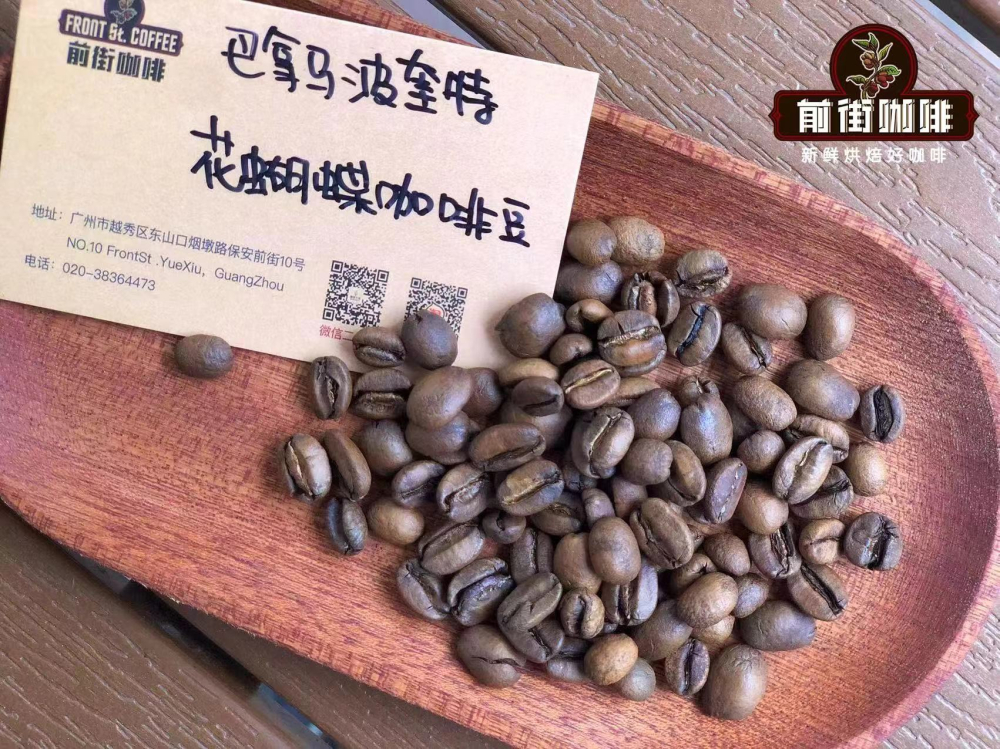
After brewing, Front Street Coffee's naturally processed Butterfly presents a relatively rich white floral aroma, with honey-like sweetness and citrus acidity. Overall, its sweetness is more obvious than the previous washed Butterfly.
For more coffee bean information, please follow Coffee Workshop (WeChat public account: cafe_style) For professional coffee knowledge exchange, please add WeChat ID: kaixinguoguo0925
The above content is compiled by CoffeeHunters, a coffee news website.


