








How does mixing coffee work with an AeroPress?
The AeroPress brews by combining immersion, paper filtration, and pressure, and it extracts fairly quickly, so bean choice matters. Medium and medium-dark lots with sweetness and body tend to hold up well, while very light, delicate coffees can taste thin when pushed through the plunger. Suggested directions include Front Street Strawberry Candy, Front Street Brazil Queen Estate, and Front Street PWN Golden Mandheling.
For a practical starting point, the sweetness-forward Front Street Costa Rica Mozart brews inverted with a set dose, grind, coffee-to-water ratio, and water temperature across six steps, producing floral, berry, and chocolate notes. A finer grind with less water turns the same device toward a concentrated, espresso-style shot instead of a clean, filter-like cup.
The AeroPress combines immersion, paper filtration, and pressure extraction into one device. It has a low barrier to entry and produces a clean cup, making it a very friendly brewing tool for both home and travel. This article first outlines the AeroPress's structure and advantages, then, given its relatively fast extraction pace, suggests suitable coffee bean directions, including Front Street Strawberry Candy, Front Street Brazil Queen Estate, and Front Street PWN Golden Mandheling. Afterwards, using the sweetness-forward Front Street Costa Rica Mozart as an example, it provides a complete demonstration of inverted AeroPress brewing, covering dose, grind, coffee-to-water ratio, water temperature, and a six-step process to help you consistently replicate a rich cup interwoven with floral, berry, and chocolate notes.
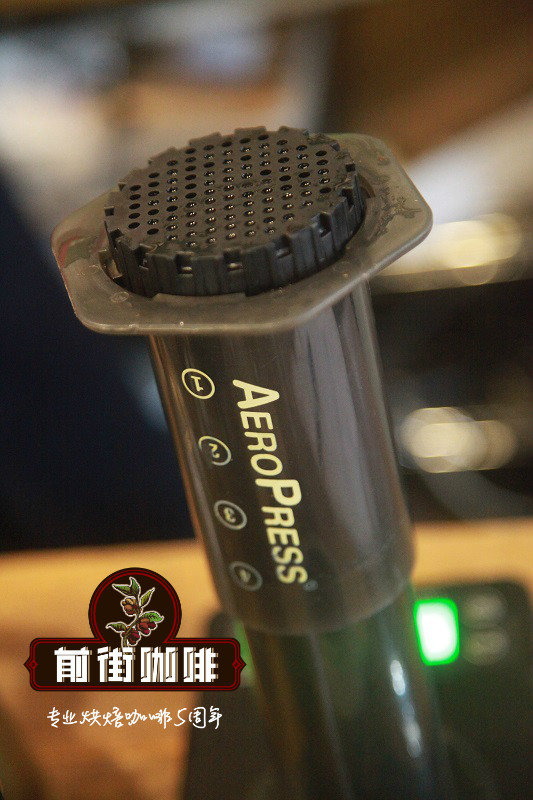
The AeroPress's extraction logic is quite unique: it has the immersion process of a French press, uses the paper filters common in pour-over for filtration, and also adds a pressure step similar to espresso. After mixing coffee grounds and hot water, you push the plunger down to compress the air downward, hot water passes through the filter cap, and you end up with a cup of coffee that is clean in flavor and relatively free of off-flavors. If you grind finer and reduce the water amount, the AeroPress can also make a concentrated espresso-style coffee with considerable strength.
Structurally, it can be broken down into three main parts: the chamber, the filter cap, and the plunger. When using it, you need to pair it with paper filters or a metal filter, and it usually also comes with accessories such as a funnel, scoop, and stirrer. Thanks to this simple yet flexible design, the AeroPress quickly became popular among coffee enthusiasts.
Compared with many other brewing methods, the AeroPress is much easier to learn. A French press is best paired with a burr grinder, otherwise uneven particle size will noticeably disrupt the mouthfeel; pour-over requires repeated practice with pouring technique. The AeroPress has none of these barriers—you just pour in water and press the plunger down. It is lightweight, durable, and its plastic material is shatter-resistant, making it very convenient to bring along when traveling.
In addition, the AeroPress produces coffee very quickly. There is no need for a long immersion, nor for slowly pouring in circles. After the water boils, a cup of coffee can be completed in about 60 seconds. Another key point: it is especially easy to clean. With a French press, you first have to dig out the coffee grounds and then clean up the residue; with the AeroPress, you just unscrew the filter cap and remove an entire puck-like block of coffee grounds, then simply rinse it clean.
Because the AeroPress's extraction time is relatively short, the contact between coffee grounds and water is not as prolonged as with pour-over or a French press, so when choosing beans it is better to pick types with highly recognizable flavors. For example, Front Street Strawberry Candy, with rose floral notes and raisin-like character; if you prefer a non-acidic style, you can choose the creamy, nutty Front Street Brazil Queen Estate; if you care about body and a solid mouthfeel, Front Street PWN Golden Mandheling would be a good choice.
AeroPress Brewing Tutorial
The bean used in this demonstration is Front Street Costa Rica Mozart coffee beans. When brewed as pour-over, it can present aromas of raisin, osmanthus, candied fruit, and white chocolate, with a quite prominent sweetness. Therefore, in addition to the AeroPress introduced in this article, it is also suitable for various extraction methods such as cold brew, pour-over, French press, and ice drip.
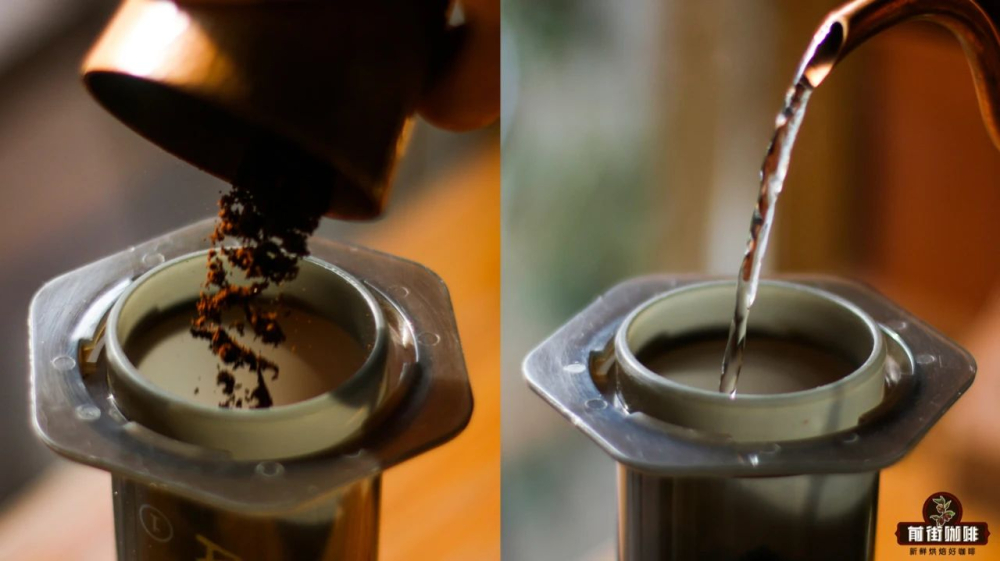
Dose: 18g
Grind setting: 90% pass-through rate on a No. 20 sieve (EK43s setting 7)
Coffee-to-water ratio: 1:11 (about 200ml)
Water temperature: 90°C
Extraction method: inverted
1. Assemble the plunger and chamber, then push the plunger down to around mark ④ and invert it!
2. Add the ground coffee, then pour in an equal amount of hot water and start the timer!
3. Use the stirrer to stir the coffee grounds in the chamber for ten seconds. (Slowly in circles)
4. Attach the filter cap with the fitted paper filter to the chamber.
5. Then place the prepared container on top.
6. At one minute, flip it over, then begin pressing downward to "push out" the coffee.
The Front Street Costa Rica Mozart brewed this way offers a clearly perceptible rich pink floral aroma and ripe berry notes; on the palate, there are flavors of sweet orange, cream, raisin, and candied fruit, with a chocolatey sweetness in the finish. The overall flavor is layered and full-bodied, and after drinking it, it is hard not to be deeply impressed.
The above content is compiled by CoffeeHunters, a coffee news website.


