








Is Iced Pour-Over Coffee Weaker Than the Hot Version?
Iced pour-over tastes weaker because the ice dilutes the brewed liquid while the aromatic compounds that carry most of the perceived flavor stay behind in the hot extraction. In a side-by-side test of four coffees brewed hot and iced, the iced versions lost aroma first, then flavor separation, then body, sometimes reading as little more than water.
The gap is widest with washed medium-light roasts such as Ethiopian Kafa Forest, where jasmine and lemon aromas fade to faint fruit and green tea notes over ice. This is not the same question as whether white coffee is strong or what white coffee is; that drink is roasted differently and served without the dilution step, so its concentration is set at the roaster rather than by melting ice.
Both are pour-over coffees, but just how big is the difference in taste between the hot and iced versions? Many coffee lovers have noticed that some beans are full of aroma and layered when brewed hot, yet turn bland and watery once made as iced pour-over. To get to the bottom of this, Front Street Coffee selected four coffees with distinctly different styles and brewed each one both hot and iced, comparing them across three dimensions: aroma, flavor, and mouthfeel. This article not only presents the detailed comparison results, but also starts from the principles of extraction to explain why iced pour-over tends to lose flavor, and offers advice on choosing beans suitable for making iced pour-over.

During the National Day holiday, many coffee lovers made special trips to the store to "stock up," hoping to easily make a cup of freshly ground coffee at home, and while they were at it, they'd ask Front Street Coffee about all sorts of questions they'd encountered in their daily brewing. One customer shared her confusion:
When she comes across a bean she particularly likes, she tries it both as a hot pour-over and an iced pour-over. She found that some beans perform brilliantly when brewed hot, with aroma and mouthfeel both satisfying, but once she switches to iced pour-over, it's a total "flop"—not only are the individual flavors less distinguishable than in the hot version, but the overall drink tastes especially thin, sometimes even no different from drinking water. Why exactly is that?
Just how big is the difference between hot and iced brews of different coffee beans?
To present the comparison as comprehensively as possible, Front Street Coffee selected four coffees with distinctly different styles, brewed each one as both hot and iced pour-over, and then compared them from the three angles of aroma, flavor, and mouthfeel.
Recommended washed medium-light roast coffee bean: Front Street Coffee Ethiopia Kafa Forest
Hot pour-over: White floral and lemon aromas are very prominent; the flavor shows notes of mandarin, honey, grapefruit, and caramel, with very high clarity and a mouthfeel as clean and translucent as green tea.
Iced pour-over: The aroma is noticeably weakened, retaining only a faint layer of fruity notes; on the palate you can taste the sweet-tart flavors of green grapes, pear juice, and green tea, with low body and an overall refreshing, icy character.

Recommended natural medium-light roast coffee bean: Front Street Coffee Panama Emerald Red Label Geisha
Hot pour-over: It smells of rich fruity notes and red florals; the flavor includes cranberry, grape, pineapple, orange, Da Hong Pao, and a clear fermented note, going down smooth with plenty of juicy character.
Iced pour-over: The aroma is similar to the previous group, generally weak, dominated by a fresh citrus note; the flavor is berries, candied fruit, and pineapple juice, with medium fruit sweetness and a light body.
Recommended dark roast bean for iced pour-over: Front Street Coffee PWN Golden Mandheling
Hot pour-over: The aroma is caramel and chocolate; the flavor shows chocolate, nuts, spices, and caramel, very rich and aromatic; the mouthfeel is full-bodied.
Iced pour-over: Roasted nut aroma, with an overall flavor profile dominated by chocolate, herbs, and nuts—clean but one-dimensional. Mandheling's signature full-bodied mouthfeel barely comes through in the iced pour-over.
Recommended fermented-style bean for iced pour-over: Front Street Coffee Finca La Divisa Big Belly
Hot pour-over: It smells of intense fruity notes of orange and grape with an almond nuance; on the palate there's citrus, blackcurrant juice, black tea, spices, and a fermented wine-like aroma, with various bright, solid fruit acids and very rich layering.
Iced pour-over: The aroma still has a clear fermented note, and on the palate it's fresh blueberry, pineapple, and sweet dried apricot, with a rounded mouthfeel, overall like a glass of iced prune juice, leaving a hint of cinnamon in the finish after swallowing.
Why does coffee taste good brewed hot, but easily loses its flavor when brewed iced?
In fact, many coffees had a hot version first, and only later spawned an iced form. Take the universally known Americano: from its birth it existed as a hot drink for a long time, and only later, following the trend, did an iced version gradually appear. The same goes for pour-over as a representative of drip extraction—hot pour-over has a far longer history than iced pour-over, and the equipment and brewing methods that emerged in that era all evolved gradually around the hot-brew format.
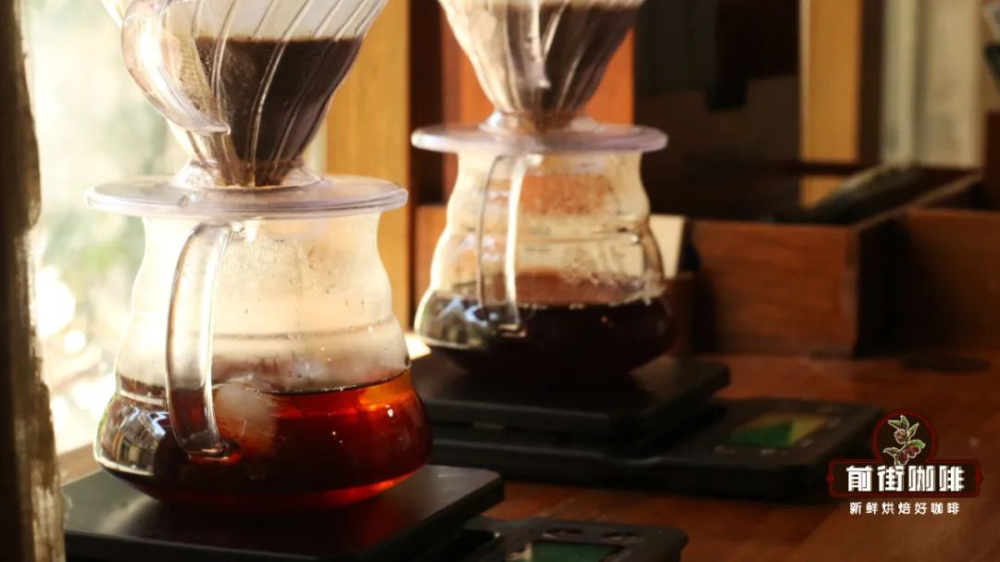
Generally speaking, after getting a coffee bean, one first determines its flavor characteristics through cupping, then builds the hot pour-over brewing parameters accordingly (usually taking roast level and processing method into account), while the iced pour-over recipe is gradually adjusted from the hot-brew basis.
The most common iced brewing method is: on the basis of the hot brew, grind finer, reduce the amount of water poured, and adjust the technique appropriately—first making a high-concentration hot coffee, then rapidly cooling it with plenty of ice, while using the melted ice to lower the concentration, ultimately producing an iced drink with suitable strength and sufficient flavor.
As Front Street Coffee shared at the start of summer with its "universal formula": iced pour-over = coffee grounds (fine grind) + 10x hot water + 5x ice. The ice here is actually split off from the total water amount of the original hot pour-over (1:15 coffee-to-water ratio). In other words, the ice replaces part of the hot water that would have been used to rinse through the coffee bed, and is then separated out on its own, so it doesn't participate in the coffee's extraction process.
Once the amount of poured water is reduced, the coffee's extraction range also shrinks, and the compounds concentrated in the mid-to-late stage may not have had time to be released before the pour is already finished. Yet these compounds are precisely the main source of sweetness, body, and aftertaste, which ultimately leads to the obvious gap between the flavor performance of iced pour-over and hot pour-over.
From the above comparison, it's clear that no matter which group of coffees, hot pour-over is noticeably stronger than iced brew in terms of aroma fullness, flavor complexity, layering, fruit sweetness, and solidity. And those dark roast beans that sell themselves on caramel-type aromas, body, balance, and sweet aftertaste perform even worse in iced brew.
However, iced pour-over also has one irreplaceable advantage: it adds an icy, refreshing mouthfeel on top of the coffee's original flavor, and this is precisely the key reason many people can't give up iced drinks. Imagine, on a hot afternoon, sipping a cold, refreshing drink that's also rich in aroma—how delightful that would be.
For this reason, we can use this characteristic of iced pour-over to select suitable coffee beans. For example, medium-light roasts are mainly floral and fruity, and tend to be on the light side when made into iced coffee; in that case, you can prioritize natural or fermented-style beans, so the final cup has both rich fruity notes or sweet-tart layering while maintaining a clean, light character.
The above content is compiled by CoffeeHunters, a coffee news website.


