







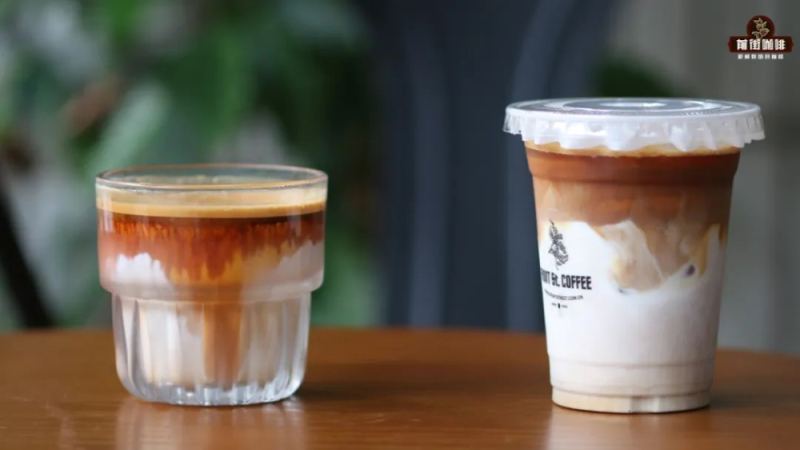
How Is a Dirty Coffee Different From an Iced Latte?
Both drinks show espresso layered over milk, but they are built differently. An iced latte is a chilled latte: espresso plus a larger share of milk, with ice added for coldness and no steamed milk foam on top. The dirty latte skips ice and pours espresso over cold milk for a sharper layer.
Cup size, whether ice is used, how the cup is chilled, and how strictly the layers must hold separate the two. An iced latte is usually stirred before serving, which dulls the contrast, so shops often pour espresso on top instead. Bean choice, including a dark cocoa base blend, affects how clean the layering reads.
Dirty coffee and iced latte look quite similar in appearance, both presenting a layered effect of espresso covering milk, but the two are actually different beverages. This article systematically sorts out the differences between Dirty and iced latte starting from production details such as cup volume ratio, whether ice is added, cup treatment, and layering requirements, and explains in detail the correct way to drink each. The article also combines the flavor characteristics of Front Street Coffee's classic blend, specialty blend, and dark cocoa base blend to explain how to choose beans to achieve the ideal layering effect and taste experience.
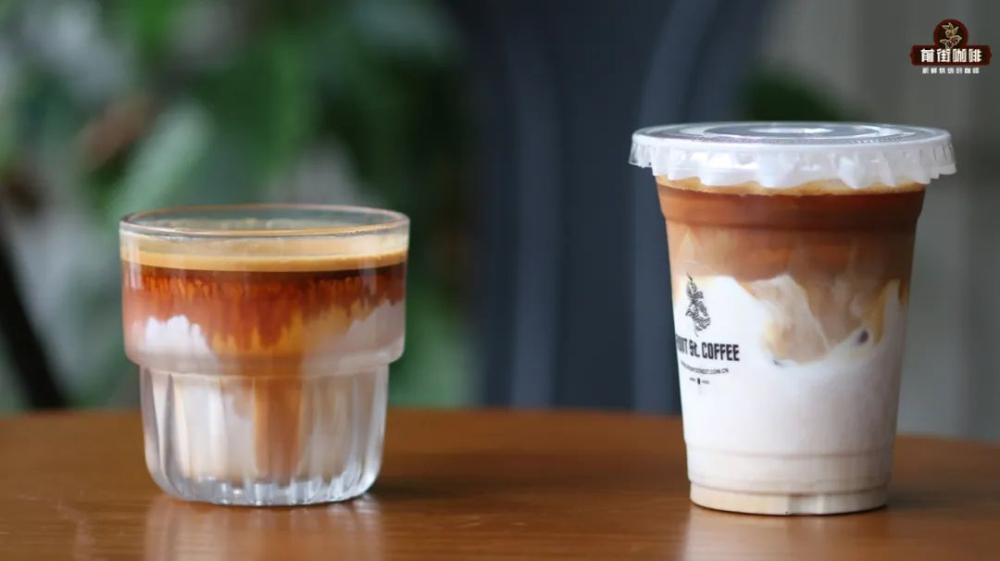
From the appearance of the finished product, Dirty coffee and iced latte are extremely similar. Both have a layered structure with espresso on top and milk below, and at first glance they seem to be the same drink. However, they are actually two different coffees. Although the basic method is similar, differences in several details give these two coffees completely different flavor and mouthfeel experiences.
What is an iced latte?
Iced latte coffee is not complicated to understand. Essentially, it is a chilled version of latte. Its core composition is still espresso plus a larger proportion of milk, and to maintain a cold mouthfeel, ice cubes are also added to keep it chilled. Compared with hot latte, the biggest difference of iced latte is that there is no need to steam and froth milk, so the surface is not covered with a layer of milk foam. According to the standard process, before an iced latte is handed to the customer, the coffee and milk should first be fully stirred together.
However, after stirring, the latte takes on a color similar to milk tea. It is not exactly ugly, but it is indeed less pleasing to the eye than before stirring. Especially nowadays, when everyone takes photos and shares them, whether an iced latte is photogenic has also become an invisible scoring item—being good-looking does not add points, but looking bad may cost points depending on mood. For this reason, iced lattes nowadays are often simply made by pouring espresso over the surface of the milk and then served to the customer.
Dirty coffee (X)
A "special" iced latte (✓)
Dirty coffee also has another name, "dirty coffee." This name comes from the "dirty food" trend that emerged in 2019, in which ingredients are used to create a visually dirty effect. Dirty coffee was one member of this wave. However, the Dirty coffee popular at that time was not the method commonly seen today. Instead, it used milk foam or cream to create an overflowing effect, then sprinkled on cocoa powder, crushed nuts, and so on, thereby presenting a "dirty" look.
Today's popular Dirty coffee has returned to its essence and focuses more on the taste itself. Visually, it appears as espresso poured over pure white milk, with the coffee liquid slowly penetrating downward, as if the pure white milk has been "polluted" by coffee. To achieve the ideal layering effect, Front Street Coffee's classic blend is recommended for making Dirty. This bean is composed of three producing regions and is a medium-dark roast espresso recipe. Its design inspiration comes from the early popular "Mamba" combination, namely Mandheling plus Brazil. To enhance aroma and crema, Front Street Coffee's classic blend also adds a small amount of Robusta, further raising the flavor intensity, so that the espresso has golden crema and forms a striking black-and-white contrast with the milk.

If you prefer complex nutty aromas such as almond, apricot kernel, and walnut, you can try Front Street Coffee's specialty blend and Front Street Coffee's dark cocoa base blend. Both contain a high proportion of Brazilian coffee beans, thus bringing a comfortable bittersweet taste and an extremely smooth entry.
Among them, Front Street Coffee's specialty blend carries the nutty, chocolate, and caramel aromas characteristic of Colombian coffee, along with moderate acidity. When paired with milk, it is as fragrant and smooth as Ovaltine; Front Street Coffee's dark cocoa base blend combines the ripe plum acidity of Yunnan small-bean coffee with the sweetness of Brazilian beans. After being ground into powder, it gives off the aroma of sunflower seeds and caramel, with a balanced taste. Used to make a latte or Dirty, it can present a creamy chocolate-like mouthfeel.

From a visual perspective, today's iced latte can also be called "Dirty"; and in essence, Dirty coffee can also be classified within the category of latte coffee.
Differences between Dirty and iced latte in production details
Although the main body of both is espresso plus milk, and both involve pouring espresso over milk, there are still many differences in the specific operation.
First, the milk ratio and cup volume are different
The cup volume of Dirty coffee is smaller than that of iced latte. Usually Dirty is between 180 and 220 milliliters, while iced latte is between 280 and 320 milliliters. The amount of milk added also differs. Generally speaking, Dirty uses less milk than iced latte.
Second, Dirty cannot have ice added
This is also one of the more obvious differences between Dirty and iced latte. No ice cubes are added when making Dirty coffee. Under normal circumstances, iced latte needs an appropriate amount of ice cubes to maintain a low temperature. Of course, some customers will ask for an iced latte without ice.
Third, Dirty uses a chilled cup
If produced strictly, Dirty coffee is only suitable for dine-in, because a chilled cup is needed to keep the temperature as low as possible without adding ice.
Fourth, Dirty has stricter layering requirements
Indeed, one of the selling points of Dirty coffee is the "dirty" look brought by layering, so it is more particular in this respect. Iced latte has no such rigid requirement. Whether layered or not, it does not affect its being an iced latte.

Differences between Dirty and iced latte in drinking method
What Dirty coffee emphasizes is the sensation of distinct layers, so after it is made, there is no need to stir it, nor should you use a straw. Instead, drink it directly from the surface.
The first sip is rich, warm espresso (with a small amount of milk), allowing you to feel a strong coffee flavor; the second sip enters the transition zone between coffee and milk, where the coffee and milk partially blend, allowing you to taste a rich milk chocolate flavor; the third sip is chilled milk with a faint lingering coffee aroma. Without dilution by ice cubes, the overall mouthfeel is quite full, shifting from bitter to sweet and from hot to cold, bringing a very rich multi-layered experience.
Although iced latte coffee is also clearly layered when served, it needs to be stirred evenly before drinking so that you can experience the balanced flavor and mouthfeel formed after the two are blended.
The above content is compiled by CoffeeHunters, a coffee news website.


