








Why Does a Moka Pot Coffee Splatter Happen?
Moka pot coffee splatters when pressure in the lower chamber climbs too high. Heated water turns to steam, the steam squeezes the available space, and that force pushes hot water up through the coffee bed. When pressure passes what the pot handles, the liquid erupts instead of flowing steadily, so the fix is keeping pressure in a normal range.
Four factors drive the problem: too much water above the pressure relief valve line, grind size that is too fine, a very dark roast, and excessive flame intensity. Adjusting each one lets the flow run smooth and even. Espresso blend beans also suit moka pots, producing crema and a fuller body in the cup.
When a moka pot is heated and the coffee liquid refuses to come out, or suddenly erupts violently, it is a problem many enthusiasts have encountered. Behind this phenomenon is actually a close relationship with the pressure in the lower chamber: rising water temperature produces steam, and the steam compresses the space to create a pushing force that drives hot water through the coffee bed and turns it into coffee liquid. The stronger the pressure, the faster the liquid flows out, and when it exceeds what the pot body can withstand, it will spatter. So which operations cause abnormal pressure? And how should you adjust to make the flow smooth and steady? This article analyzes the causes one by one from four angles—water amount, coffee grind size, bean roast level, and flame intensity—and gives specific, actionable ways to improve. It will also recommend espresso blend beans suitable for moka pots, to help you make coffee with rich crema and a full-bodied taste.

Many moka pot users have encountered this situation: after lighting the fire, the coffee liquid does not come out no matter how long you wait, and then suddenly it sprays upward violently, leaving no time to react at all. What exactly causes this, and how should you deal with it?
Reasons for moka pot coffee liquid spattering
The water in the lower chamber vaporizes after being heated, forming steam. The steam occupies the space originally in the lower chamber, thereby creating pressure. This pressure pushes the hot water upward, through the coffee bed, converting it into coffee liquid, which finally gushes out from the upper outlet. The greater the pressure, the faster the liquid flows out. Once the pressure exceeds a certain threshold, spattering occurs.
From this it can be seen that the key to avoiding spattering is to keep the pressure from getting too high. In daily moka pot operation, the following factors directly affect the amount of pressure:
1. Too much water
There is a pressure relief valve on the inner wall of the moka pot's lower chamber, and it also serves as a reference for the maximum water level. This line represents the maximum amount of water that can be added. If the water added is above this line, the usable space in the lower chamber is further squeezed, and when the water is heated and vaporizes there is not enough buffer room, so the steam can only rush upward desperately. Therefore, if too much water is added, the pressure will become even stronger.
However, it should be understood that a moka pot is not an espresso machine after all; its delicate construction determines that it cannot withstand too much pressure. Once it exceeds its own limit, in mild cases two arc-shaped streams of water appear, and in severe cases the pot body may directly burst because it cannot bear the pressure! So this point must be taken very seriously!
2. Coffee grounds too coarse
When Front Street previously introduced the grind for moka pots, it mentioned that the suitable particle size is between espresso grind and pour-over grind, leaning more toward the flour-like fineness of espresso. Only when it is fine enough can the density of the coffee bed be increased, narrowing the gaps through which water can pass, allowing for fuller extraction!
On the contrary, if the grind is too coarse (close to the fine-sugar-like particles of single-origin pour-over), the resistance will be clearly insufficient, and the coffee liquid will shoot out in a jet. Moreover, because the hot water passes through the coffee bed too quickly, the flavor substances in the coffee grounds do not have time to be fully extracted, so the final cup also tastes very thin.
3. Using light-roast beans
In addition to grind size, choosing coffee beans with a lighter roast level will also increase the chance of spattering. Light-roast beans have a shorter heating time, harder bean texture, and lower internal gas content, so hot water easily penetrates directly through the coffee bed and then gushes out. For moka pots, baristas usually recommend purchasing medium-dark roast espresso beans.
If you prefer a rich crema, you can try Front Street. Front Street Classic Blend. This bean combines Brazil, Indonesian Mandheling, and Robusta, and is a formula specially designed for espresso extraction. It is suitable for both home use and opening a coffee shop. During extraction, the crema is thick, the body is full, and it has the aroma of roasted hazelnut, butter, dark chocolate, and caramel.
4. Flame too high
Once the coffee liquid begins to flow out, it means the water in the lower chamber has reached a boiling state, and boiling water vaporizes more easily. If the heat source is still kept on high after the liquid starts flowing, then the amount of steam will rise sharply, and the pressure will increase exponentially, which will also cause the liquid to spray out violently in the form of a water column.
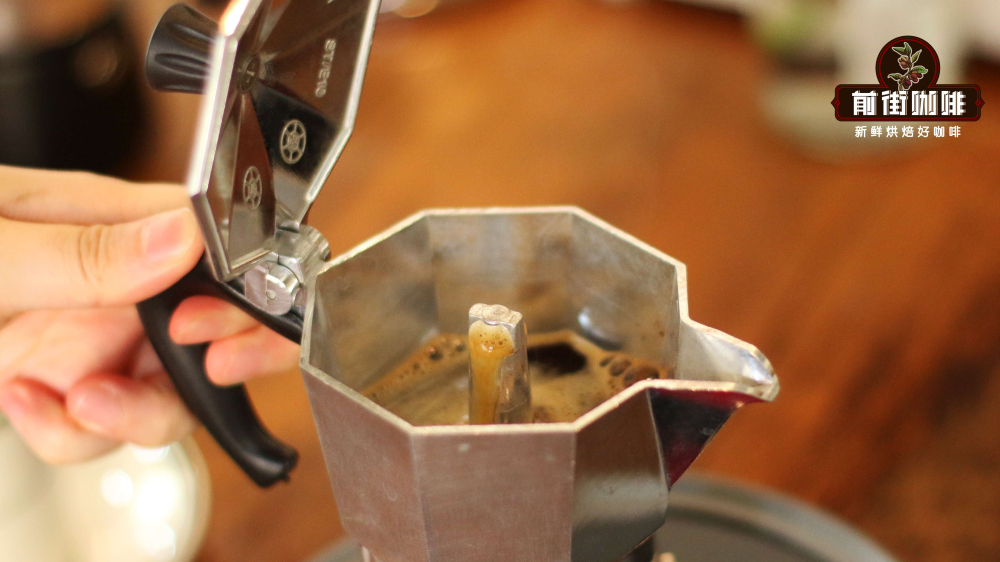
Therefore, when you see the coffee liquid begin to flow out (as shown in the picture below), Front Street suggests lowering the heat appropriately, or simply removing the moka pot from the heat source. In this way, the amount of steam produced will decrease, and the coffee liquid will not spray out so easily.
The above content is compiled by CoffeeHunters, a coffee news website.


