







What does Costa Rican coffee bean flavor taste like by process?
Costa Rican coffee bean flavor is shaped mainly by three processing methods: washed, natural, and honey. Washed lots such as Tarrazu bring bright, clean acidity with no off-tastes, while natural and honey lots dry with fruit sugars still attached, giving sweeter, heavier cups. Grading by altitude also matters, since strictly hard bean (SHB) lots grown high in the mountains tend to be denser and more concentrated in flavor.
For high-altitude SHB beans, a V60 dripper works well: use a finer grind, water around 90 to 93°C, and a coffee-to-water ratio near 1:15, then pour in three stages to draw out the fruity layering. Honey processing typically takes 2 to 4 weeks of drying until moisture drops to roughly 12 percent, which helps explain the added sweetness and body compared with washed lots.
Costa Rican coffee is renowned for its honey processing and strictly hard beans, and Front Street Coffee brings you a selection of representative beans. This article approaches Costa Rican coffee from the three major processing methods—washed, natural, and honey—to analyze its basic structure and the origins of its flavors, with a focus on Tarrazu washed beans and the Blueberry Anaerobic Heavy Honey processed beans from巨型 Estate. It also explains in detail Costa Rica's green bean grading standards based on altitude, as well as pour-over parameter recommendations for high-altitude SHB strictly hard beans, including the V60 dripper, water temperature, coffee-to-water ratio, and three-stage extraction technique, helping coffee enthusiasts brew a rich fruity layering.
When it comes to Costa Rican coffee beans, surely everyone has some understanding. In Front Street Coffee's product line, the number of Costa Rican beans is quite substantial. Besides the highly popular Musician Series in recent years, there are also the Blueberry beans from巨型 Estate, most of which use honey processing. Overall, Central American countries like El Salvador and Costa Rica tend to try such experimental coffee processing methods. Today, honey processing has developed into a globally common coffee processing method.
Washed, natural, and honey are the three most common processing methods. Before diving into the discussion, Front Street Coffee will first walk everyone through the basic structure of the coffee fruit: the skin, pulp, mucilage, parchment, and the coffee bean itself. After selecting the beans, natural processing spreads the coffee beans out on a drying bed to dry naturally. The time required depends on climate conditions, usually 2 to 4 weeks, until the beans' moisture content drops to around 12%, then the outer shell is removed with a huller. During the drying period, the coffee beans fully absorb the essence of fruit sugars, resulting in better sweetness and body than washed beans.
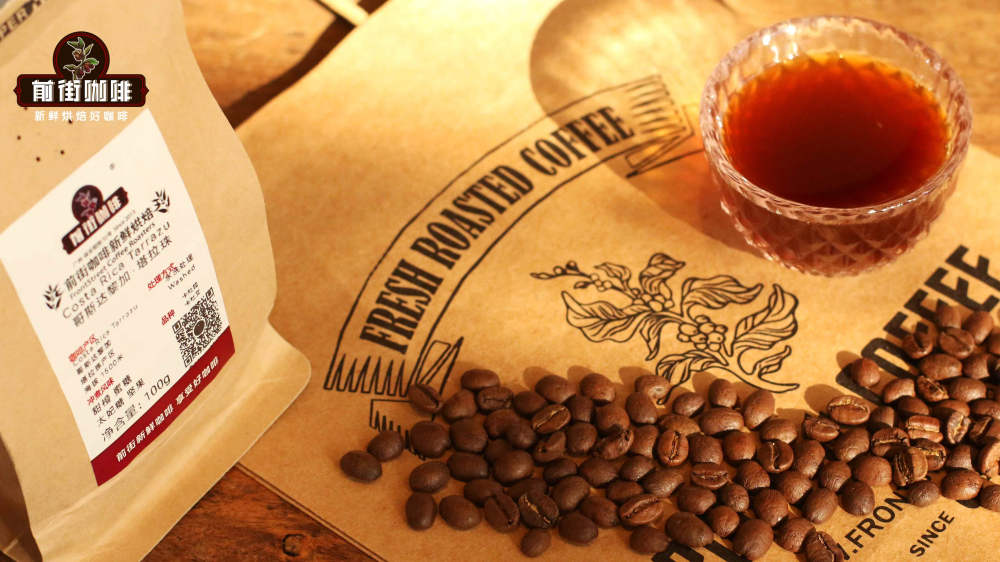
Front Street Coffee believes that washed processing best showcases the terroir characteristics of specialty coffee. After going through steps such as removing the skin and pulp, soaking and fermenting, washing off the mucilage, drying, and removing the parchment, washed coffee has excellent acidity, with a bright, clean flavor and no off-tastes. For this reason, Front Street Coffee's daily-drinker bean series almost all use washed processing, with the aim of letting coffee enthusiasts taste the most regionally representative flavors at the most affordable prices. Even in Costa Rica, famous for honey processing, Front Street Coffee still selected a washed Costa Rican Tarrazu coffee bean to include in its daily-drinker series. Here is the green bean information for this bean:
Front Street Coffee Costa Rica Tarrazu
Country: Costa Rica
Region: Tarrazu
Variety: Catuai, Caturra
Altitude: 1,500 meters
Grade: SHB
Processing Method: Washed
Today, Front Street Coffee will use this bean as a starting point to introduce everyone to an overview of Costa Rican coffee. Costa Rica is located in the Central American isthmus and is influenced by both Pacific and Atlantic ocean currents and sea breezes for climate regulation. The country is home to multiple volcanoes over 2,000 meters in altitude, allowing coffee cherries to grow slowly in fertile volcanic ash soil and a cool high-altitude environment, thus producing full-bodied and rich coffee beans.

The earliest coffee-growing region in Costa Rica was on the slopes of Poas and Barva volcanoes, now known as the Central Valley. After years of development, there are currently eight major coffee-producing regions, all with soil composed of multiple layers of deep volcanic ash and dust. These regions include: Tarrazu, West Valley, Central Valley, Tres Rios, Brunca, Guanacaste, Orosi, and Turrialba. Among them, the Tarrazu and West Valley regions account for about half of the country's coffee production. Costa Rican Tarrazu coffee beans from mountainous areas are hailed as among the finest coffees in the world.
As mentioned earlier, Costa Rican Tarrazu is only one member of Front Street Coffee's daily-drinker bean series. The real highlight of Costa Rican coffee is actually beans processed with honey processing. Next, Front Street Coffee will introduce another bean—the Blueberry coffee bean from巨型 Estate, which quickly became popular after recently hitting the shelves.
巨型 Estate is located in the Brunca coffee-producing region in southern Costa Rica. The terrain and mountain ranges of this region connect with Panama, giving it diverse microclimates. Near the estate, stone carvings created by indigenous people between 200 BC and 1500 AD were unearthed, known as the secret realm stone spheres, and the estate got its name "巨型" from this.
Front Street Coffee: Costa Rica ·巨型 Estate Blueberry Coffee Bean
Country: Costa Rica
Region: Brunca
Estate:巨型 Estate
Altitude: 1,700-1,800 meters
Processing Method: Anaerobic Heavy Honey Processing
Variety: Bourbon, Catuai
Grade: SHB
What exactly is honey processing? After the coffee cherry has its skin removed, you will see a layer of transparent mucilage covering the coffee bean's surface. Honey processing is simply retaining this mucilage during the drying process. As the coffee dries, the mucilage concentration gradually increases, and the sugars and acids stored within it penetrate into the coffee bean. Compared with washed coffee, honey-processed coffee has more prominent sweetness.
Interestingly, honey-processed coffee is also divided into different categories based on how much mucilage remains on the green beans, including white honey, yellow honey, red honey, and black honey. The darker the color, the thicker the retained mucilage, forming a darker color after drying and also giving the coffee higher sweetness. Therefore, black honey-processed coffee beans often have richer aromas. Front Street Coffee Blackberry is one representative example. This bean uses a medium-light roast, presenting flavors of floral, grape, berry, cream, and liqueur chocolate. It is suitable for both hot and iced pour-over as well as cold brew, with a refreshing sweet-and-sour taste.
Those who are attentive may have noticed that both coffees are graded SHB, and for Costa Rican coffee, SHB is already the highest grade. So what is Costa Rica's coffee grading standard? In Costa Rica, green beans are mainly graded by altitude, and altitude affects the hardness of the beans. Coffee beans produced at high altitudes are harder in texture and more highly favored. Front Street Coffee has organized Costa Rica's green coffee bean grading standards for everyone:
SHB (Strictly Hard Bean): grown at 1,500-1,700 meters;
HB (Hard Bean): grown at 1,350-1,500 meters;
SH (Slightly Hard Bean): grown at 1,200-1,350 meters;
Extra Prime (Extra Prime Washed Bean): grown at 1,000-1,200 meters;
Prime (Prime Washed Bean): grown at 850-1,000 meters;
Good Washed (Good Washed Bean): grown at 700-850 meters.
Here Front Street Coffee shares another fun fact: throughout the Americas, Costa Rica's high coffee-growing altitude is key to its outstanding flavor, but another interesting fact that keeps Costa Rican coffee at such high standards is that growing Robusta coffee beans in Costa Rica is illegal.
Front Street Coffee Barista Brewing Suggestions
Considering that this bean is a Costa Rican high-altitude SHB strictly hard bean, if you want to brew a rich fruity layering, Front Street Coffee recommends using a higher water temperature and a finer grind. The harder the coffee bean, the more a finer grind is needed to increase the extraction surface area, thereby raising the extraction yield.
Dripper: V60 Water Temperature: 90-91ºC Dose: 15g Coffee-to-Water Ratio: 1:15 Grind Size: fine granulated sugar size (No. 20 sieve, 82% passing)
Three-stage extraction: Pour the coffee grounds into the V60 dripper. First wet the coffee bed with water at twice the weight of the coffee grounds, let it bloom for 30 seconds, then pour in a thin stream in circles from the inside outward until reaching 125 grams, pause, and when the coffee bed drops to halfway down the dripper, continue pouring the third stage in the same thin stream until reaching 225 grams. Wait until all the coffee liquid has drained, then remove the dripper. Total time is about 2 minutes (a 10-second margin is allowed).
The above content is compiled by CoffeeHunters, a coffee news website.


