







What Defines Traditional Coffee Flavor in Mandheling and Its Types?
Mandheling coffee is known for a rich, full body and herbal character, and the name is a transliteration of the Indonesian Mandheling ethnic group, not a region, port or variety. Much of what reaches the market is dark roasted, partly to mask green-bean defects and partly to suit a tradition that values mouthfeel and body.
Front Street selected four lots after repeated roasting, cupping and pour-over tests: Golden Mandheling, Lintong Mandheling, Tiger Mandheling and Aged Mandheling. The article compares their green bean traits, roast curves and cupping flavors, and also covers Indonesia's wet-hulling method and a sun-dried Mandheling.
Mandheling coffee occupies a unique position in the specialty coffee world with its rich, full-bodied herbal flavor, yet the historical origins and varietal differences behind this name are little known. Drawing on the sourcing and cupping experience of FrontStreet Coffee, this article systematically sorts out the naming origin, producing regions, and common categories of Mandheling, and offers a detailed comparison of the green bean characteristics, roasting curves, and cupping flavors of four beans: Lintong Mandheling, Golden Mandheling, Tiger Mandheling, and Aged Mandheling. It also provides an in-depth analysis of Indonesia's unique wet-hulling process and introduces the sun-dried Mandheling brought in by FrontStreet Coffee, offering coffee lovers a complete Mandheling tasting guide.
For more specialty coffee knowledge, please follow our WeChat public account: FrontStreet Coffee
Friends familiar with Front Street articles may know that every time we bring in a coffee bean, we go through a series of testing steps including roasting, cupping, and pour-over. That is why FrontStreet Coffee often needs to conduct a horizontal comparison of at least three or more coffees from a given region before finally putting a bean from that region on the shelf.
The Mandheling commonly found on the market is mostly dark-roasted for two main reasons: first, Mandheling's processing methods and varietal composition are relatively complex, resulting in a higher defect rate in green beans, and dark roasting can effectively mask these shortcomings; second, Mandheling was first discovered and promoted by the Japanese, and Japan's coffee appreciation tradition emphasizes mouthfeel and body. Therefore, it is not surprising that Mandheling chooses dark roasting. In recent years, Mandheling has attracted more and more enthusiasts with its unique herbal, full-bodied flavor, but there are many producing regions and quality varies greatly. After extensive sampling and evaluation, FrontStreet Coffee finally selected four Mandheling coffees: Golden Mandheling, Lintong Mandheling, Tiger Mandheling, and Aged Mandheling.
I. The Origin of Mandheling
Mandheling is neither a producing region name, a place name, nor the name of a port or coffee variety; it is actually a transliteration of the Indonesian Mandheling ethnic group.
During World War II, when Japan occupied Indonesia, Japanese soldiers tasted delicious coffee locally and could not forget it after returning home. So through trade channels, they asked locals to help collect high-quality coffee beans, including this Mandheling. The Japanese loved this bean very much and asked for its name. Because the commercial source could not be disclosed, the locals casually said "Mandheling," and thus the name Mandheling became the code name for a coffee bean by accident.
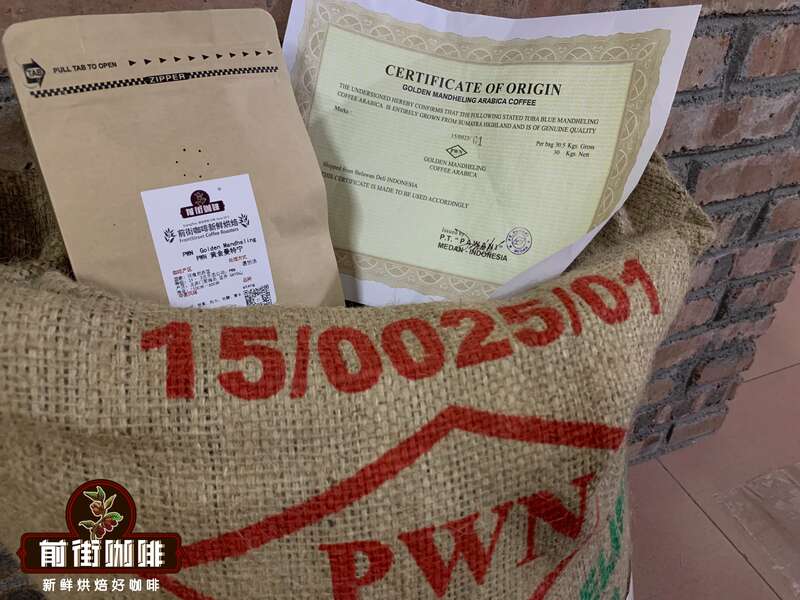
The locals mentioned earlier were precisely the owners of the Indonesian PWN company (Pawani Coffee Company), from which FrontStreet Coffee purchases Golden Mandheling.
II. What Is Mandheling Coffee?
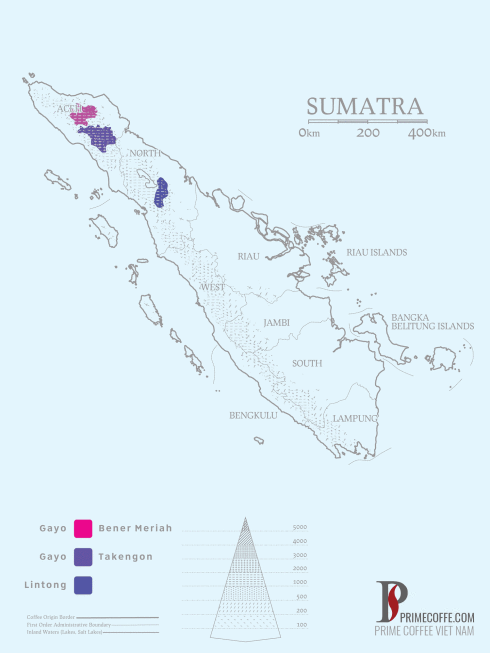
The main coffee-producing regions of Indonesia include Sumatra, Java, and Sulawesi, among which "Mandheling" produced on Sumatra is the most famous. Mandheling is also called "Sumatra coffee." The Lake Tawar producing area in the north can be called Aceh coffee or Lake Tawar coffee, while coffee produced around Lintong and Lake Toba can be classified within the Mandheling category. In the traditional strict sense, only coffee beans produced in the Lake Toba area (located in northwestern Sumatra) are called "Mandheling."
Mandheling has a strong, heavy flavor, full body, and lively dynamism, without astringency or acidity, with body and bitterness expressed to the fullest. Mandheling coffee beans may be considered the ugliest in appearance, but coffee lovers often say that the worse Sumatra beans look, the more full-bodied and smooth they taste.
III. What Common Mandheling Coffees Are There?
The following shows four Mandheling coffees from FrontStreet Coffee: Lintong Mandheling, Golden Mandheling, Tiger Mandheling, and Aged Mandheling.
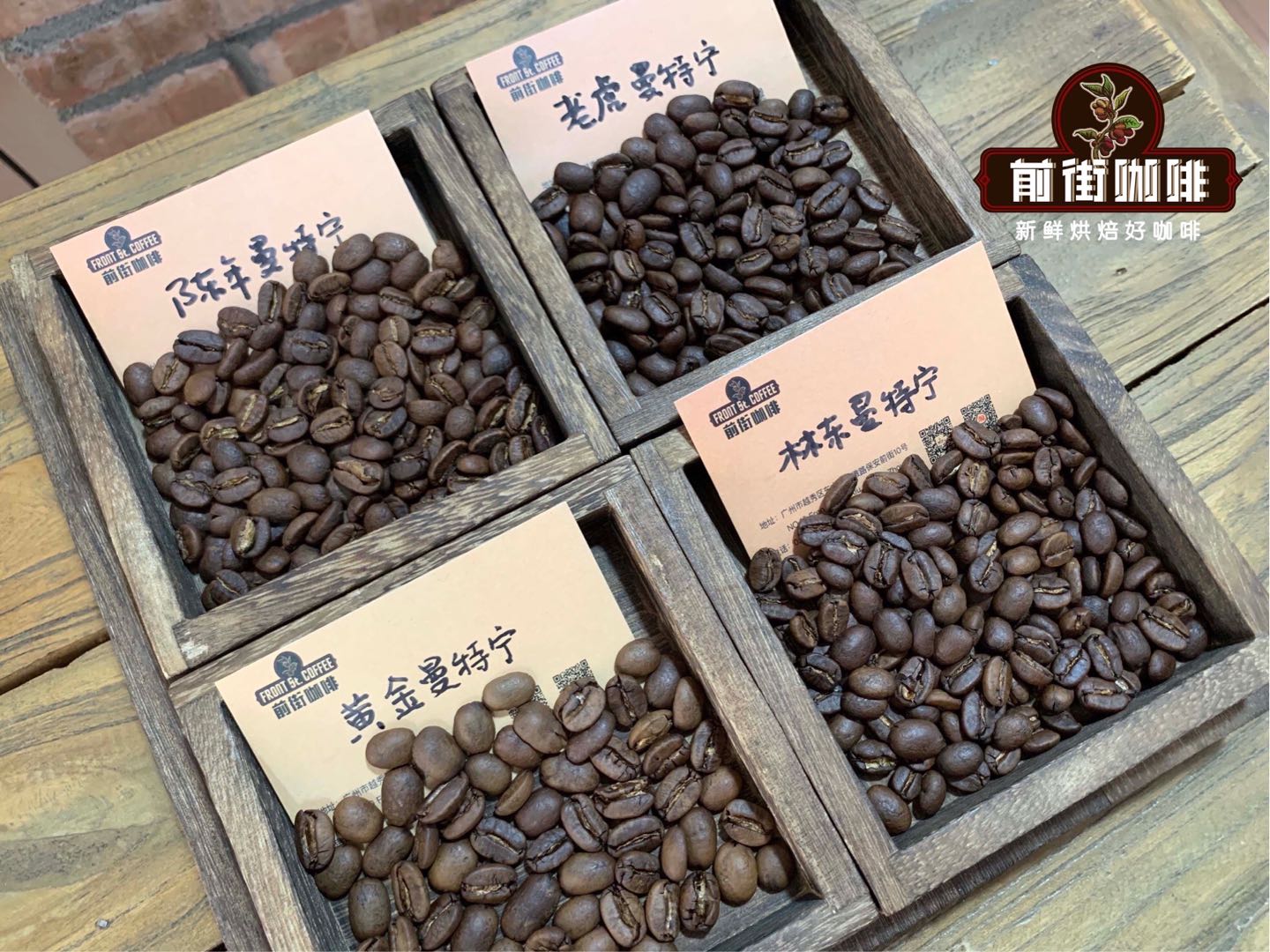
1. Lintong Mandheling
A specialty Mandheling from the Lintong region, with larger beans and a hard bean texture.
Indonesian coffee has rich quality tiers. What is usually called Mandheling refers to Typica or its variants grown in the mountains around Lake Toba. Coffee gourmets from many countries have commented: Sumatra Mandheling is the coffee with the finest texture in the world. Mandheling beans are relatively large and hard, and because there are many defects, strict screening is required during processing.
Mandheling is an indispensable variety in coffee blends, with a rich flavor—sweet, purely bitter, and full-bodied, with faint sweetness and acidity.
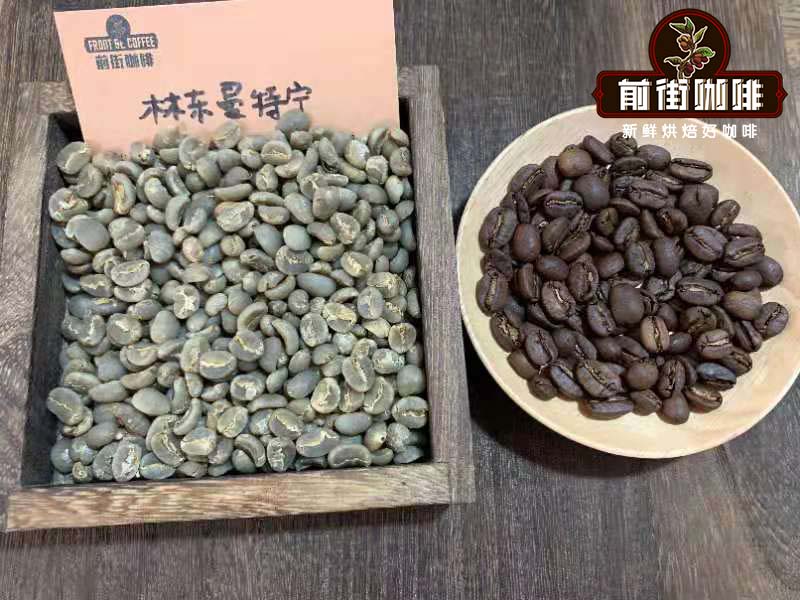
FrontStreet Coffee Indonesian Lintong Mandheling coffee beans
2. Golden Mandheling
Golden Mandheling has been registered as a trademark by the Indonesian PWN company and has become the company's exclusive product. Golden Mandheling is produced in the Gayo Mountains of Aceh, North Sumatra, and the variety is Ateng. Ateng is a hybrid of Arabica and Robusta, widely planted in Sumatra and other small Indonesian islands. It is essentially a branch of Catimor, and Ateng is the local name. Golden Mandheling must reach 19 screen size and undergo four rounds of manual selection, with stricter quality standards.
FrontStreet Coffee Indonesian Golden Mandheling coffee beans
3. Tiger Mandheling
Only Mandheling above 17 screen size with a defect rate below 4% can be called Tiger Mandheling. Its main varieties are Caturra and Typica. Caturra brings citrus- and lemon-like acidity, while Typica gives a lasting sweet aftertaste, making Tiger Mandheling balanced in taste and high in cleanliness.
FrontStreet Coffee Indonesian Tiger Mandheling coffee beans
4. Aged Mandheling
Aged coffee beans are not simply green beans left sitting for a long time—green beans will also spoil if stored too long, changing from fresh blue-green to white and then yellow, eventually becoming bland or even infested with insects. Like aged alcoholic beverages, green beans must undergo proper processing and long-term storage before they can be called true aged coffee.
So-called aged beans refer to:
Green beans allowed to naturally age by extending storage time (usually 2 to 3 years), during which acidity weakens, color changes, and bean texture thickens. The storage environment must remain cool and ventilated. Because the storage environment is dark and the time is long, aged coffee often carries complex notes resembling mustiness or what is commonly described as burlap and leather.
FrontStreet Coffee Indonesian Aged Mandheling coffee beans
IV. Mandheling Coffee Processing Method
Mandheling's unique wet-hulling method, also called wet hulling, is known locally as Giling Basah and is Indonesia's traditional coffee processing method. From the name, wet hulling seems quite similar to the washed method, but the cup flavors of the two are completely different—coffee processed by wet hulling is usually full-bodied and intense, with a very distinct character.
In the 17th century, Dutch colonists introduced coffee to Indonesia, and they pursued faster and greater economic returns. Wet-hulling greatly shortened the time required at the farm stage and also significantly reduced labor costs. FrontStreet Coffee believes that the birth of wet hulling was highly consistent with investors' mentality of pursuing quick profits and cutting costs, which was also an important reason driving the spread of this processing method.
Steps of the Wet-Hulling Process
① Remove the skin and pulp, keeping the parchment and mucilage
② Ferment in a water tank
③ Wash off the mucilage
④ Dry in the sun with parchment for 2-3 days, to a moisture content of 20-24%
⑤ Remove the parchment
⑥ Dry the green beans to a moisture content of 12-13%
⑦ Prepare for export
Wet hulling creates Mandheling's special flavor. FrontStreet Coffee believes there is a bound relationship between Mandheling and wet hulling, but today's coffee market no longer settles for staying unchanged. Even though wet hulling is Mandheling's characteristic, experiments with other processing methods are also underway. A Mandheling recently introduced by FrontStreet Coffee uses the sun-dried processing method. The flavor of this sun-dried Mandheling differs significantly from traditional Mandheling, leaning more toward fruit notes, with a sweeter taste and soft fruit acidity.
FrontStreet Coffee: Sumatra Wahana Estate Sun-Dried Mandheling
Coffee region: Lake Toba
Altitude: 1000 to 1700 meters
Soil: Volcanic soil
Coffee varieties: Bourbon, Typica
Processing method: Sun-dried
Harvest year: 2020
Grade: G1
Coffee-Producing Region
Wahana Estate was established in 2005 and is located near LeaMungkur village in the Sidikalang district of North Sumatra, Indonesia. Sidikalang has been one of Indonesia's famous coffee-producing regions since ancient times. The area where Wahana Estate is located is at an altitude of 1200 to 1500 meters, with annual rainfall of 2000 to 3000 millimeters, a cool climate, and a day-night temperature difference of more than 10°C. Based on these conditions, the red cherries produced by Wahana all have a sugar content above 13%.
Wahana Estate is still a relatively young estate that develops year by year, covering about 500 hectares. The estate owner plans to expand the coffee planting area as much as possible in the coming years. A large part of the estate is protected forest coverage, within which are distributed many native plant and tree species around valleys and rivers. Afterward, coffee seedlings are planted in divided plots and carefully marked for future variety identification.
The local seedling varieties currently planted include: Long Berry from Aceh, Toraja from Sulawesi, Rasuna from Sumatra, and S795 and dong Sari from Java. International nursery varieties include Villa Sachi from Costa Rica, Caturra, Cattuai, and Typica from Colombia.
To produce high-quality North Sumatra coffee, Wahana Estate uses shade trees on the farm and organic fertilizer (compost), practicing sustainable agriculture. The estate isolates different coffee varieties by plot division and harvests them separately to fully unlock the potential of each variety. In addition, only red cherries are harvested and then processed separately.
Processing Method
This bean does not use Indonesia's unique wet-hulling method, but instead chooses the more difficult sun-dried processing. Sun-dried processing first requires manual selection of defective beans as well as unripe or overripe cherries, after which the coffee cherries are evenly spread on drying beds and turned several times each day.
The drying process usually lasts 2 to 3 weeks, depending on the local climate, and Indonesia's humid, rainy climate can make it take even longer. When the internal moisture content of the coffee beans drops to 11-13%, the sun-drying step is complete. After drying, the outer shell of the coffee cherry has become dry and hard, and it only needs to be removed with a huller.
Brewing Suggestions
Wahana Estate Sun-Dried Mandheling uses a light roast. It is recommended to use a V60 dripper, with a water temperature of about 90°C, a water-to-coffee ratio of 1:15, 15g of coffee, and a finer grind than Lintong Mandheling, about the coarseness of granulated sugar (80% passing through a Chinese standard No. 20 sieve), in order to extract more coffee flavor.
FrontStreet Coffee uses staged extraction. Generally, the amount of water for blooming is twice the coffee grounds, that is, 30 grams of water for a 30-second bloom. Pour in a small stream in circles until 125 grams, then pause. When the water level drops and is about to expose the coffee bed, continue pouring until 225 grams and stop. The total extraction time is 2 minutes. Flavor description: Tropical fruit sweetness and acidity on entry, obvious fermented aroma, smooth mouthfeel, tropical fruit, moderate acidity, and noticeable sweetness.
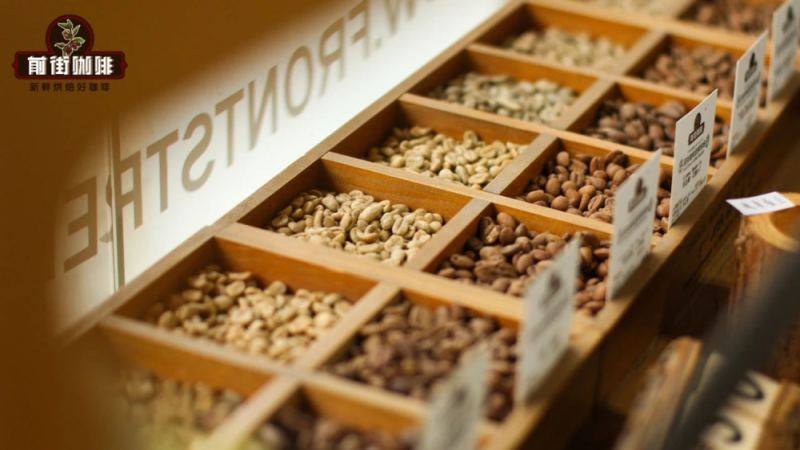
V. Green Bean Comparison
A careful observation of the green beans reveals that Mandheling has a relatively high proportion of peaberry-like split beans, which is caused by hulling the beans while their moisture content is still high and the bean texture is still soft.
Golden Mandheling: screen size 19+, noticeably larger than other Mandheling beans, and because of higher moisture content, the green beans are darker green;
Tiger Mandheling: the green beans are plump, slightly yellow with green, and have better uniformity;
Lintong Mandheling: the green beans are grayish-green, uneven in size, and relatively poor in uniformity;
Aged Mandheling: due to the special processing method, the green beans are orange with a hint of black, have wrinkled surfaces, and are relatively uniform in size.
VI. Roasting Comparison
FrontStreet Coffee's roasting goal is to present the flavor of the coffee's producing region. Each bean can certainly be roasted in various ways, but FrontStreet Coffee believes that the roasted flavor should reflect the characteristics of that region—for example, Yirgacheffe should taste like Yirgacheffe—and then explore other possibilities on that basis. This is FrontStreet Coffee's only criterion for determining a roasting plan.
1. Lintong Mandheling
For this bean, FrontStreet Coffee's roasting goal is medium-dark, aimed at removing excess acidity and enhancing body and balance. Lintong Mandheling is at a medium altitude and has a very soft bean texture. In order to remove excess moisture and avoid astringency caused by insufficient dehydration, a roasting approach of extending dehydration time and reducing heat for a gliding phase is used.
Charge temperature 200°C, turning point 5'18", first crack begins at 9 minutes at 186°C, first crack development 4 minutes, drop at 202°C.
2. Golden Mandheling
FrontStreet Coffee believes that Golden Mandheling is a green bean with relatively high moisture, showing a large moisture deviation from sun-dried beans, so special attention is needed during dehydration. For green beans with high moisture content, the damper can be closed immediately after charging, then opened to 3 after a 30-second soak. When the green bean color turns light green or white, open the damper to 4, and after first crack open it to 5 (maximum).
Charge temperature 200°C, turning point 5'40", first crack begins at 9'54'' at 191.2°C, first crack development 3'30'', drop at 204.5°C.
3. Tiger Mandheling
Tiger Mandheling beans are plump, green with yellow, good in uniformity, and relatively high in moisture. For this bean, FrontStreet Coffee's roasting goal is medium-dark, aimed at removing excess acidity and enhancing body and balance.
During roasting, because this bean is at a medium altitude and has a very soft bean texture, in order to remove excess moisture and avoid astringency caused by insufficient dehydration, the approach of extending dehydration time and reducing heat for a gliding phase is used. The flame is reduced separately at the turning point, after dehydration is complete, and before first crack, to avoid scorching the bean surface. It is dropped 4 minutes after the end of first crack and 20 seconds before second crack, extending the caramelization reaction time and expressing its excellent cleanliness and sweetness.
Charge temperature 200°C, turning point 5'18", first crack begins at 9 minutes at 186.2°C, first crack development 4 minutes, drop at 203°C.
4. Aged Mandheling
Mandheling green beans have high density, while aged beans have less moisture, so heat adjustments at each stage must be especially cautious to avoid scorching the oils on the surface of the original beans.
Charge temperature 200°C, turning point 5'35", first crack begins at 9'30'' at 186.8°C, first crack development 3'20'', drop at 197.5°C.
VII. Cupping Comparison
Lintong Mandheling: herbs, chocolate, caramel, overall balanced;
Golden Mandheling: nuts, spices, herbs, licorice, chocolate, caramel, with a clean and soft flavor;
Tiger Mandheling: nuts, cream, dark chocolate, caramel, traditional Chinese medicine, with noticeable sweetness and a clean, clear flavor;
Aged Mandheling: ripe Pu'er, caramel, herbs, chocolate, with relatively low acidity.
VIII. How to Pour Over Four Mandheling Coffee Beans with a KONO Dripper
FrontStreet Coffee uses the pour-over method, keeping brewing parameters consistent, to compare the flavors of the four Mandheling coffees.
When brewing Mandheling daily, FrontStreet Coffee recommends using a KONO dripper because it can bring a rounder, fuller mouthfeel and a more direct flavor expression. The only exhaust area of the KONO dripper is that one-quarter of the ribs. When the water level crosses the ribs, the amount of water in the dripper keeps rising, increasing pressure through the weight of the water, and the outlet is relatively small, which can extend the contact time between coffee particles and water and, as the water flow drives extraction, more effectively extract soluble substances. FrontStreet Coffee uses this brewing method and can usually achieve the high body that customers expect.
FrontStreet Coffee uses staged extraction, using 30 grams of water for a 30-second bloom. Pour in a small stream in circles until 125 grams, then pause. When the water level drops and is about to expose the coffee bed, continue pouring until 225 grams and stop. When the water level drops and is about to expose the coffee bed, remove the dripper. The extraction time (starting from the beginning of the bloom) is 2'00".
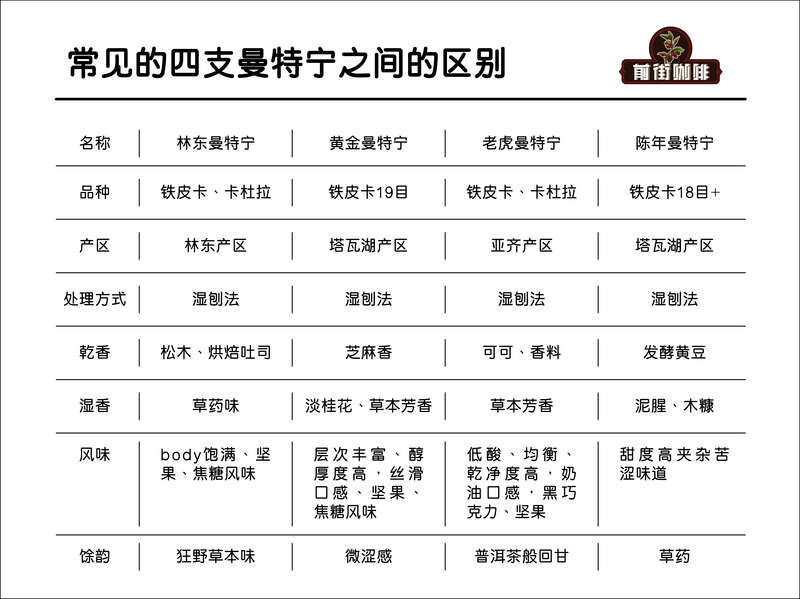
Brewing Flavors of the Four Mandheling Coffee Beans
Lintong Mandheling: herbs, chocolate, nuts, baked toast
Golden Mandheling: spices, nuts, pine wood, chocolate, caramel
Aged Mandheling: ripe Pu'er, chocolate, caramel, herbs
Tiger Mandheling: nuts, cream, dark chocolate, black sugar, caramel
The above content is compiled by CoffeeHunters, a coffee news website.


