







Why Golden Mandheling Stands Out Among Indonesian Coffees
Indonesian supermarket shelves are dominated by two-in-one and three-in-one instant mixes, so pure black coffee takes some searching. The clearest starting point is Mandheling, and specifically Golden Mandheling, the trademarked label of Pwani Coffee Company (PWN). Only beans from PWN carry that name, and buyers can verify them through the PWN logo on the raw bean jute bag and a certificate of origin signed by PWN.
Processing matters as much as the label. Indonesia's year-round humidity of 70 to 90 percent and unpredictable typhoons pushed growers toward wet hulling, a method that shapes the heavy body and low acidity associated with Mandheling. Side-by-side cupping of Lintong Mandheling and Golden Mandheling shows how origin and handling separate the two, and brewing parameters can be adjusted to match each profile.
Indonesia is an important coffee-producing country globally, but most products on supermarket shelves are three-in-one instant mixes, leaving limited options for pure black coffee. For coffee enthusiasts pursuing quality, understanding Indonesian coffee brands and processing methods is essential. This article will focus on Indonesia's most representative Mandheling coffee, highlighting the Golden Mandheling produced by PWN, explaining how to identify its exclusive trademark, and delving into how Indonesia's unique wet-hulling process affects coffee flavor. Additionally, we will present Front Street Coffee's cupping comparison of Lintong Mandheling and Golden Mandheling, along with practical brewing parameters, to help you make an informed choice among the myriad Indonesian coffees.
For more specialty coffee knowledge, welcome to follow: Front Street Coffee (Frontsteet Coffee)
Walk into any supermarket in Indonesia, and the shelves are almost entirely filled with coffee products, which shows just how much Indonesians love coffee. However, upon closer inspection, you'll find that the vast majority are two-in-one or three-in-one mixed coffees, and pure black coffee options are actually quite limited. Initially, because there was no grinder, Front Street could only choose from ready-made coffee grounds, but after buying coffee grounds of poor quality, they never dared to take the risk again. Later, Front Street found a local Indonesian specialty coffee brand—Front Street PWN Mandheling.
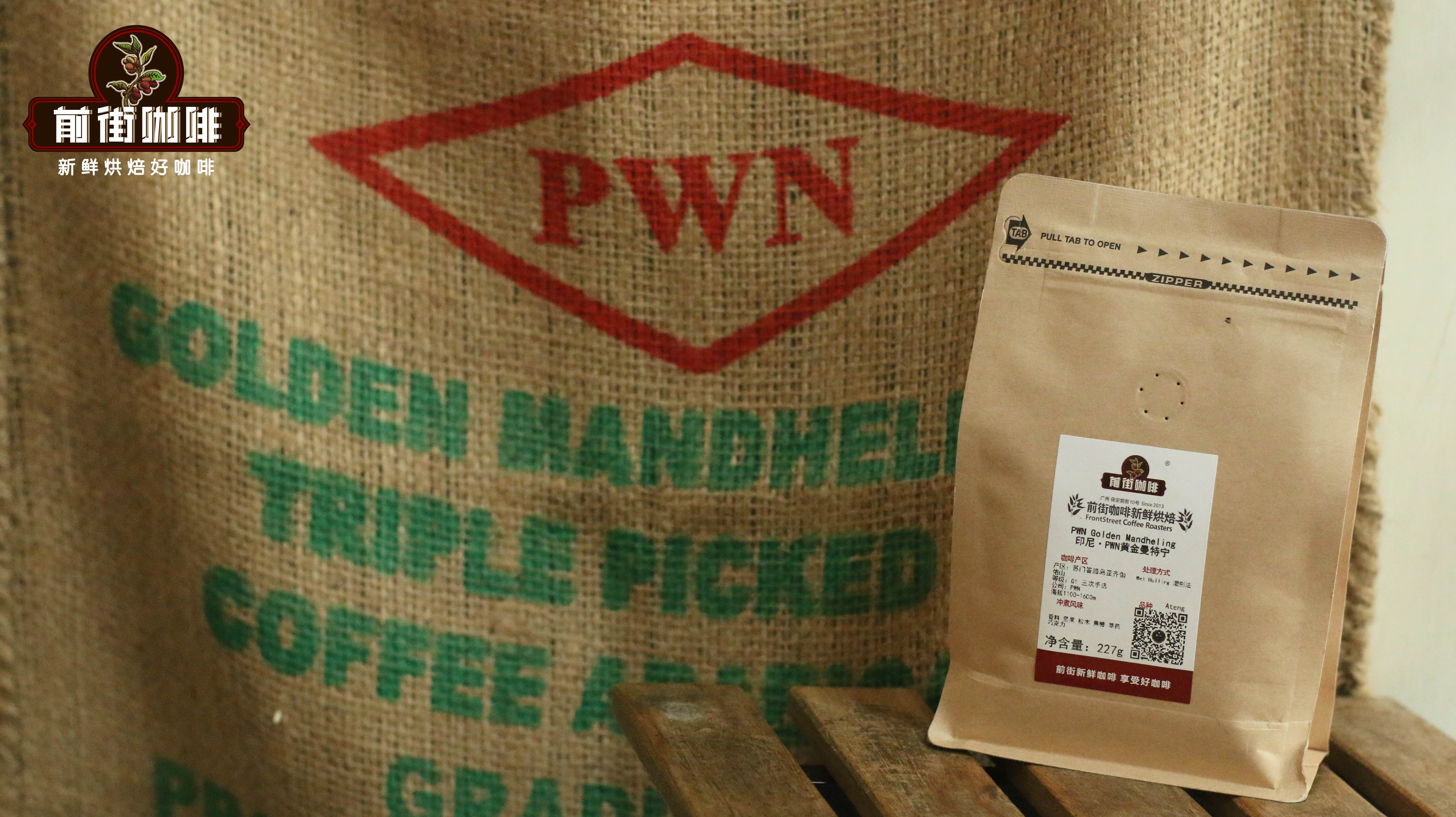
"Golden Mandheling" is an exclusive brand under Indonesia's Pwani Coffee Company (PWN). There are many types of Mandheling products on the market, but since PWN has registered the English name "Golden Mandheling" as its own trademark, only the Golden Mandheling produced by PWN can be considered truly authentic Golden Mandheling. There are two ways to identify genuine Golden Mandheling: first, check whether the raw bean jute bag bears the PWN logo; second, check whether it comes with a certificate of origin signed by PWN. Front Street has displayed both of these identifiers at its Dongshankou store for easy comparison.
Wet hulling is one of the most common raw bean processing methods in Indonesia, and its emergence can be said to have been "forced" by the local climate. Indonesia's humidity remains between 70 and 90% year-round, typhoons can come at any time, and annual rainfall even exceeds 2000mm. Under such harsh weather conditions, it is simply impossible to carry out the 2-3 week sun-drying used in Africa; and washed processing is not only time-consuming but also consumes more labor and water resources, which Indonesia's coffee industry, aimed at mass production, cannot afford. Thus, the locals developed a unique semi-washed method—wet hulling.
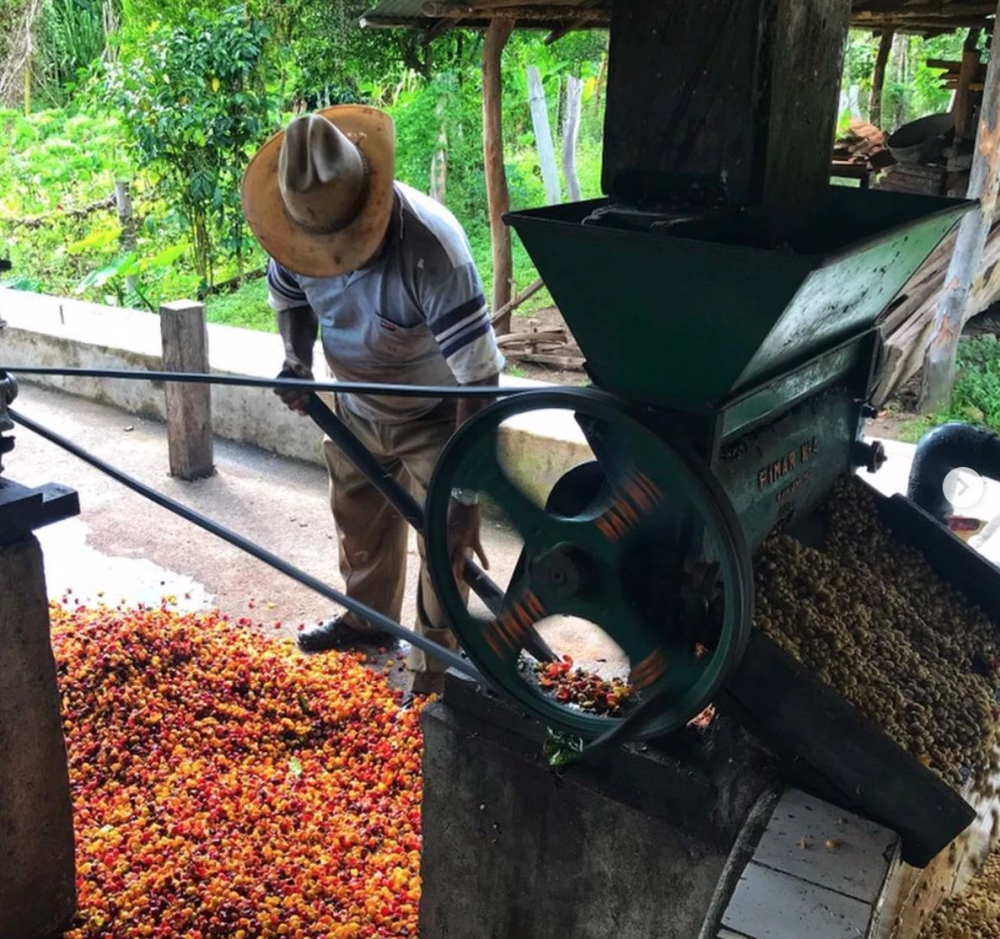
The coffee cherries with skin and pulp removed are poured directly into a pool and briefly fermented for a few hours. At this point, a small amount of mucilage still remains on the surface of the parchment. The mucilage is removed by scrubbing. Then the parchment beans are taken for drying. The first drying only needs to reduce the moisture content to 30-40%, taking about 2-3 days, after which the coffee farmers sell the raw beans to collectors. After receiving these semi-dry parchment beans, the collectors directly hull them by machine to extract the innermost raw beans.
Because the huller has strong friction, it tears open the parchment layer closely attached to the raw beans. At this stage, white or green viscous liquid often flows out. Through prolonged soaking in mucilage and the effect of the humid environment, the raw beans ultimately become soft, whitish and swollen, presenting a grayish-green color. Under the stirring of friction, the raw beans are also more likely to be crushed or bruised, especially at both ends, forming small notches, the so-called goat-foot beans. After the parchment layer is removed, the "naked beans" dry extremely quickly, and once the moisture content drops to 12-13%, they can be bagged.
The increased processing speed also brings a higher defect rate, so hand sorting must be carried out before export to remove defects in order to reach Indonesia's G1 grade (fewer than 11 defects per 300 grams of raw beans). We usually see labels such as DP (double-picked) and TP (triple-picked); the more times of fine sorting, the higher the quality of the coffee beans.
The grading of Indonesian raw coffee beans is mainly based on the number of defective beans, with screen size as a supplementary standard. General quality requirements include: no live insects, no moldy or rotten-smelling beans, maximum moisture content of 12.5%, and impurity rate below 0.5%. According to the defect rate, they are divided into six grades, among which the highest grade G1 requires fewer than 11 defective beans in a 300g sample. The daily-drinking Mandheling coffee beans mentioned above by Front Street are precisely G1 grade, using the wet-hulling method, representing the conventional version of Indonesian Mandheling flavor.
PWN, which pursues the utmost in screening, purchases Mandheling raw beans of 18 screen size and above, with fewer than 3 defective beans in a 300g sample at G1 grade, which is the highest level of Indonesian raw beans. Afterwards, it strictly follows standards by carrying out one mechanical sorting plus three manual pickings of defective beans to ensure that the Mandheling coffee beans are uniform in shape and size. In addition, before packaging, PWN also sends the raw beans into a machine for density and color sorting, making Front Street Golden Mandheling uniform and translucent in color.
As the specialty Mandheling coffee market continues to expand, PWN also realized the importance of trademarks, and thus registered the English name "Golden Mandheling" as an exclusive trademark one step earlier than the Japanese. Therefore, only the Golden Mandheling produced by PWN can be considered truly "Golden Mandheling," while the Japanese-produced one can only be renamed "Ding Shang Mandheling." The Front Street Golden Mandheling obtained by Front Street is naturally a genuine product from PWN. You can identify authentic Golden Mandheling by the raw bean jute bag bearing the PWN logo and a certificate of origin signed by PWN. Front Street has displayed these two identifiers at its Dongshankou store.
In terms of roasting, in order to present the typical Mandheling flavor while retaining more herbal spice notes, Front Street's roasters use a medium-dark roast. Before launching each coffee bean, Front Street conducts at least one cupping evaluation. Under the same standards, cupping allows us to more objectively perceive the strengths and weaknesses of the coffee.
Front Street conducted a simultaneous cupping comparison between Front Street Lintong Mandheling and Front Street Golden Mandheling on the bean list. Front Street Lintong Mandheling showed rich chocolate, dark sugar, and nutty flavors, with an aftertaste carrying herbal notes.
Front Street Golden Mandheling in the dry aroma stage reveals scents of pine, nuts, spices, and herbs. As hot water is poured, notes of licorice and caramel emerge. On the palate, there are flavors of dark chocolate, nuts, and spices, with an overall clean profile, obvious sweet aftertaste, and high body.
Front Street Coffee (FrontStreet Coffee) barista's Front Street Golden Mandheling brewing formula
Brewing water temperature: 87-88°C
Coffee grounds: 15g
Coffee-to-water ratio: 1:15
Dripper: KONO dripper
Grind size: medium-coarse grind (70% passing through China standard No. 20 sieve)
The brewing method uses three-stage pouring. Dividing into three stages better showcases Golden Mandheling's full body and caramel sweetness.
First stage: bloom with 30ml of water. This pour completely wets the coffee grounds, allowing them to degas and preparing for better extraction of flavor compounds in the subsequent brewing.
Second stage: pour 100ml. This stage mainly flushes out Mandheling's golden foam while raising the coffee bed.
Final stage: gently pour 95ml in the center. This enhances the coffee's sweetness.
The above content is compiled by CoffeeHunters, a coffee news website.


