







How Do Coffee Grades Shape Jamaica Blue Mountain Coffee?
Jamaica Blue Mountain coffee is graded by growing area and altitude. Beans grown between roughly 1,000 and 1,700 meters in the Blue Mountains earn the Blue Mountain name, while lower-grown lots fall into High Mountain or Jamaican Prime categories. That altitude split, combined with volcanic soil and steady rainfall, drives the balanced, mild cup the region is known for.
The grading system also explains the price gap and the counterfeits. Because true Blue Mountain output is small, imitation products are common, so grade labels matter when buying. A close look at the coffee grading system, plus a sample like Front Street's Blue Mountain No. 1, shows how grade, roast, and brewing parameters connect to what ends up in the cup.
Jamaican Blue Mountain coffee has long enjoyed an excellent reputation in the global coffee scene, but few people truly understand it. The unique microclimate of the Blue Mountains at an altitude of about 1,000 to 1,700 meters, combined with volcanic soil and abundant water sources, creates the balanced and elegant flavor of Blue Mountain coffee. However, limited production and high prices have led to the appearance of many counterfeit products on the market. This article will start from the historical origins of Blue Mountain coffee, sort out Jamaica's coffee grading system, teach you how to identify authentic Blue Mountain coffee, and use Front Street Coffee's Blue Mountain No. 1 as an example to share specific brewing parameters and flavor performance, taking you through a comprehensive understanding of this legendary coffee.
Authentic Blue Mountain coffee has always occupied a special position in the international coffee market, and it is produced in Jamaica's Blue Mountain region. This coffee has strict requirements for growing altitude, typically needing to be planted between 1,000 and 1,700 meters, and combined with the inherently limited production of the Blue Mountain region itself, its price has remained high for a long time. Because of this, a large number of coffee products imitating the Blue Mountain flavor have emerged on the market to satisfy consumers' pursuit of this classic taste.
The Historical Development of Jamaican Blue Mountain No. 1 Coffee
Jamaica's coffee cultivation history is quite long, dating back to the 18th century. According to information from Front Street Coffee, in 1717 King Louis XV of France ordered the introduction of coffee cultivation to Jamaica. By the mid-1720s, Jamaican Governor Sir Nicholas Lawes brought Arabica coffee seeds from Martinique and gradually promoted cultivation in the St. Andrew area.
Coffee trees thus took root in Jamaica and flourished in the superior environment of the Blue Mountains, and Blue Mountain coffee was born. Later, based on production area and altitude, Jamaican coffee was divided into different grades, including high-altitude Blue Mountain coffee, High Mountain coffee, and ordinary Jamaican Prime coffee. These grades directly determine coffee quality and market price, and also provide coffee lovers with a variety of choices.
The Production Conditions of Jamaican Blue Mountain No. 1 Coffee
Blue Mountain coffee is produced in Jamaica, an island country located in the Caribbean, which is home to the famous Blue Mountain range.
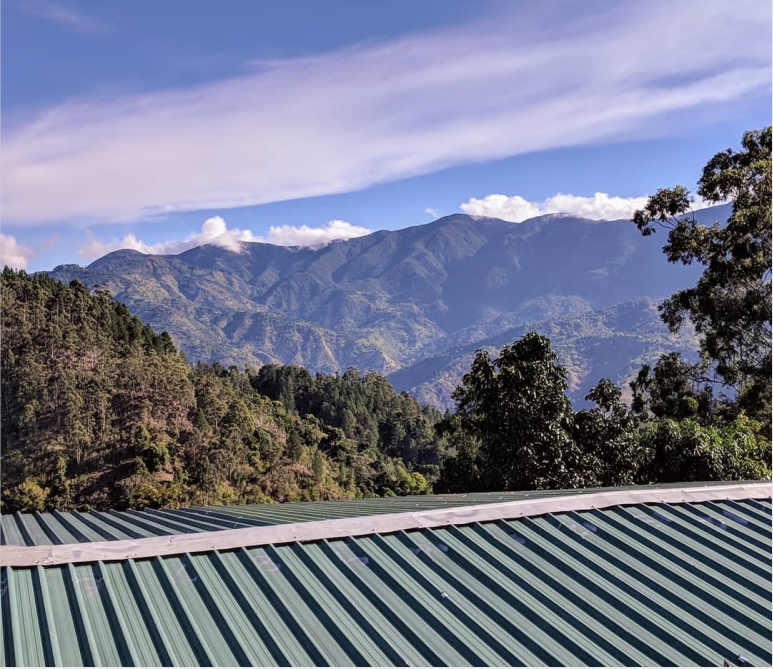
The Blue Mountain range is located on an island, and its special geographical position gives it a unique microclimate. Local volcanic activity is frequent, and the soil is rich in various minerals, providing ample nutrients to the coffee trees. High altitude, abundant water sources, and mild climate conditions work together to create an ideal growing environment for coffee trees. Because of this, Blue Mountain coffee performs outstandingly in aroma and mouthfeel, with acidity, sweetness, and bitterness in harmonious balance, and a full, solid body, making it deeply favored by coffee lovers.
The Grading System for Jamaican Coffee Beans
I. Jamaican Blue Mountain Coffee
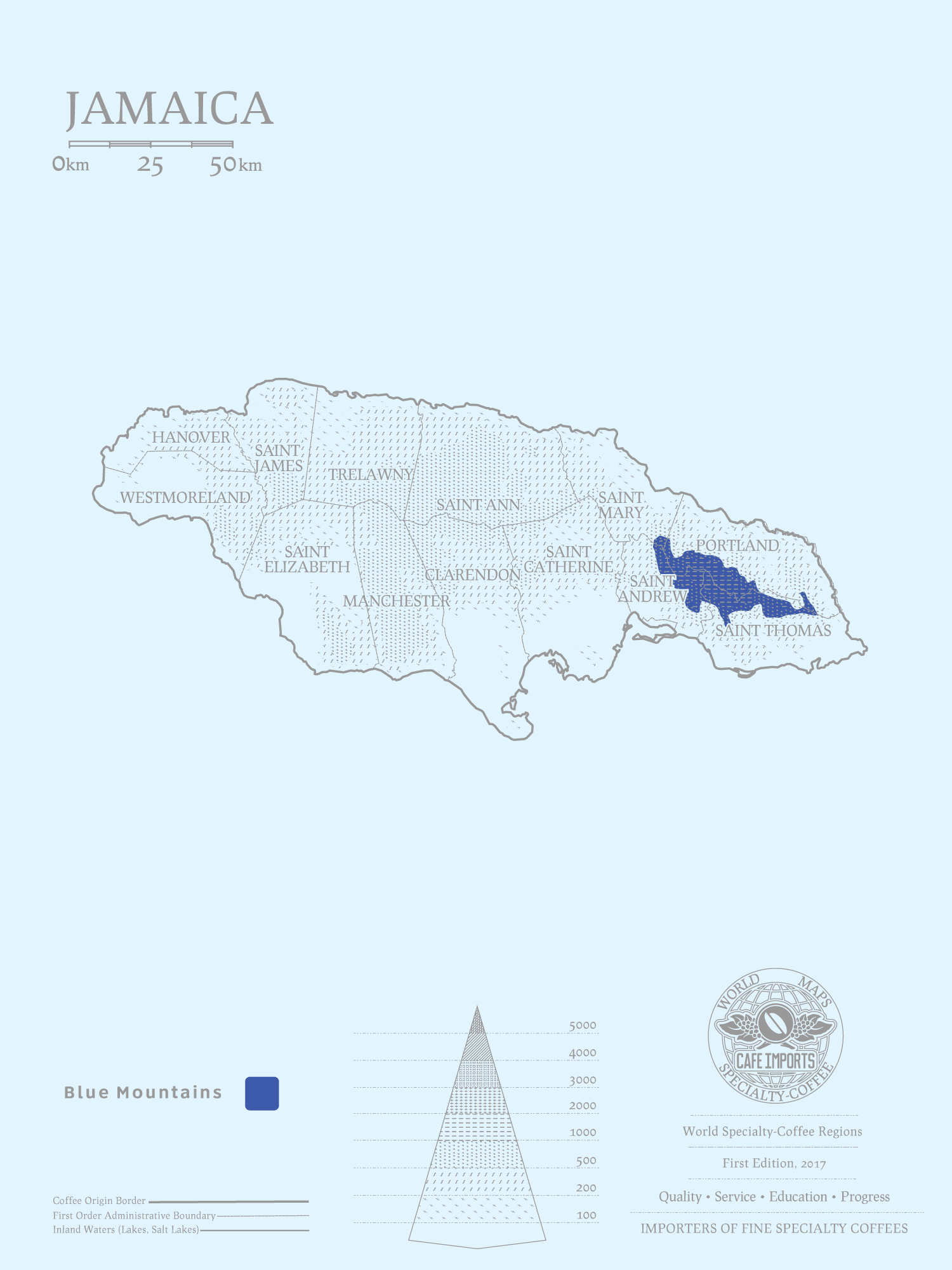
In order to distinguish Blue Mountain coffee from ordinary Jamaican coffee, the Jamaican government established a special grading system. According to the certification standards of the Coffee Industry Board of Jamaica (JCIB), only Typica-variety coffee produced between approximately 910 and 1,700 meters above sea level in the Blue Mountain range can be called "Jamaican Blue Mountain Coffee." The certified cultivation area is only 6,000 hectares, about one-third of the entire Blue Mountain region. Of all coffee produced in Jamaica, only about 15% can be labeled as Blue Mountain coffee. The higher the altitude, the more difficult the harvesting, and the higher the labor management costs. At the same time, green beans must also undergo strict quality grading, classified by defect rate and screen size into NO.1, NO.2, NO.3, and Peaberry (PB).
· No.1 - 17/18 screen, defect bean ratio no more than 2%.
· No.2 - 16/17 screen, defect bean ratio no more than 2%.
· No.3 - 15/16 screen, defect bean ratio no more than 2%.
· Peaberry - 10MS, defect bean ratio no more than 2%.
II. Jamaican High Mountain Coffee
Coffee produced between 500 and 910 meters above sea level in Jamaica's Blue Mountain region is called High Mountain coffee, second only to Blue Mountain coffee in quality, and industry insiders often call it the brother variety of Blue Mountain coffee. Since authentic Jamaican Blue Mountain coffee has extremely limited production, High Mountain coffee is a very good alternative if you want to experience Jamaican flavor.
III. Jamaican Prime Coffee
Coffee grown outside the Blue Mountain range is collectively called Jamaican Prime coffee, with cultivation at altitudes below 500 meters.
On the other hand, it is worth noting that there are currently no strict international detailed rules or industry standards for distinguishing coffee grades, and ordinary consumers often face many difficulties when identifying whether coffee is authentic. Domestically, most consumers have relatively limited knowledge of coffee, so accurately distinguishing real from fake Blue Mountain coffee is not easy.
Front Street Coffee shares a little tip: authentic Blue Mountain coffee does not use burlap sack packaging, but rather distinctive special packaging (Blue Mountain barrels). This can serve as a reference indicator for judging whether Blue Mountain coffee is real. In addition, the barrel is also printed with the symbol of the tropical tree frog, which is the certification mark of the Rainforest Alliance, meaning that this batch of coffee beans was grown as organic coffee in a pollution-free environment throughout the process.
In addition, distributors producing Blue Mountain coffee must obtain permission from the Jamaican government and authorization from the Jamaica Coffee Board. All exported Blue Mountain batches must undergo quality inspection and certification by the Coffee Board and come with relevant labels.
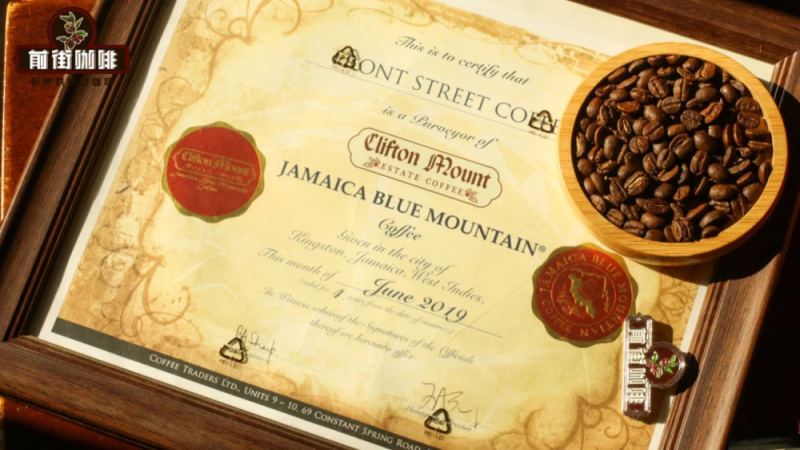
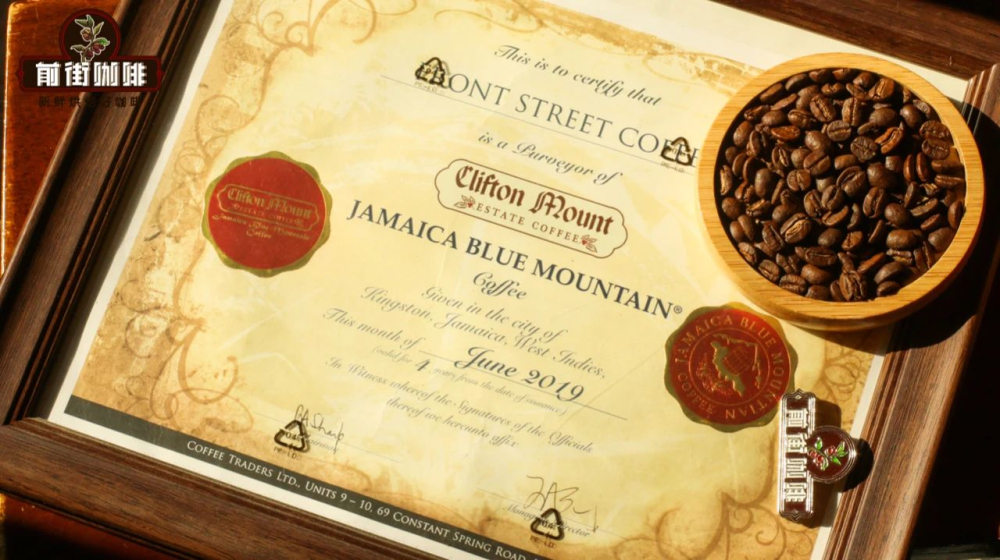
Therefore, when purchasing Blue Mountain coffee, you can ask the seller to present relevant supporting documents. Front Street Coffee's Blue Mountain No. 1 coffee is produced by Clifton Estate and comes with a quality certificate issued by the Jamaica Coffee Board, an authorized sales certificate issued by the Blue Mountain coffee producer, and a certificate of origin for Jamaican Blue Mountain coffee.
The Flavor Characteristics of Blue Mountain No. 1 Coffee
After buying a bag of excellent-quality Blue Mountain coffee beans, the first thing to consider, of course, is how to brew it just right. Below, Front Street uses the Jamaican Blue Mountain No. 1 coffee on its bean shelf as an example to discuss specific brewing ideas.
Front Street Coffee recommends using coffee beans within their optimal flavor period. If the roast date is already more than a month past, some of the aroma may already have dissipated, and it may even develop a woody taste. The coffee beans shipped by Front Street are all roasted within 5 days, so that when everyone receives them, they are just at the stage of fullest aroma.
The classic Blue Mountain flavor profile shows rich chocolate, roasted nut, and other aromas, accompanied by soft acidity and a full body. To reproduce the classic taste, Front Street Coffee's roaster chose a medium-dark roast, which both highlights the roasted aroma and retains some of the acidity. In Front Street's cupping of Blue Mountain No. 1 coffee beans, it was found that acidity, sweetness, aroma, bitterness, and body were balanced and harmonious, so Front Street Coffee's baristas also formulated the corresponding brewing plan according to this flavor direction.
Front Street's Parameters for Brewing Jamaican Blue Mountain No. 1 Coffee:
Dripper: KONO
Water temperature: 88-90 degrees
Coffee-to-water ratio: 1:15
Grind size: medium grind (75% passing through a Chinese No. 20 standard sieve)
The brewing method uses three-pour extraction. First, bloom with twice the amount of water as the coffee grounds, that is, 30 grams of water for a 30-second bloom, then pour in a small stream in circles until 125 grams, at which point pause, and when the water level is about to expose the coffee bed, continue pouring until 225 grams and stop. (Timing starts from the beginning of the bloom.) The extraction time is 2 minutes 10 seconds.
During the brewing process of Blue Mountain coffee, you can already smell rich roasted nut and caramel aromas. On the palate, you can taste dark chocolate and nut-like sweetness; the various flavors interweave and blend, the body is full, the finish is bright, and temperature changes also bring rich layers of aroma.
The above content is compiled by CoffeeHunters, a coffee news website.


