







What Makes Sumatran Arabica Beans Mandheling Coffee?
Mandheling is not a single variety but a general name for Arabica coffee beans grown on the Indonesian island of Sumatra. Not every Sumatran coffee qualifies. The island mainly cultivates two varieties, TimTim and Ateng, and specialty Mandheling is concentrated in the Gayo Mountain area of Aceh Province, typically planted between 600 and 1,200 meters.
Because Sumatra's elevations are modest and the climate stays hot and humid, the cup often lacks delicate top notes but gains a heavy, herbal and resinous character with spice. TimTim is a Timor arabica variety carrying Robusta lineage, while Ateng is Catimor, a cross involving Caturra. Each has its own varietal name, yet all are sold under the Mandheling arabica variety label.
Arabica coffee beans produced on the island of Sumatra are collectively known as Mandheling coffee, but not every coffee from the island can claim this name. Mandheling is not a single variety, but a general term for Sumatran Arabica beans. The island mainly cultivates two varieties, TimTim and Ateng, and specialty Mandheling is mostly concentrated in the Gayo Mountain area of Aceh Province. Front Street Coffee's PWN Golden Mandheling is a representative example, undergoing strict screening and medium-dark roasting to present the mellow flavors of nuts, caramel, and chocolate. This article will walk you through Mandheling's varietal origins, production area distribution, grade standards, and brewing suggestions, helping you gain a more comprehensive understanding of this uniquely characterful coffee.
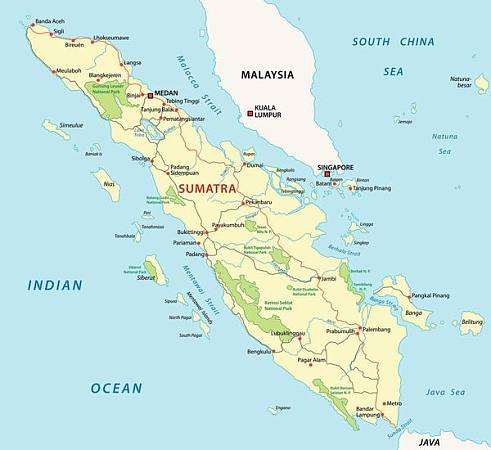
"Can all coffee produced on the Indonesian island of Sumatra be called Mandheling?" The answer is no. The term Mandheling is in fact a general designation for Arabica coffee beans from the island of Sumatra. The vast majority of Indonesia's specialty Arabica beans come from this area, which is why Sumatran Mandheling enjoys such high recognition. In this region, Arabica is planted at higher elevations, while Robusta is mostly grown at lower elevations, so not all coffee beans grown in Sumatra are qualified to bear the name Mandheling.
The overall elevation of Sumatra is not particularly high, and Arabica coffee is usually distributed across mountainous areas between 600 and 1,200 meters. The local climate is hot and humid year-round, and the low elevation makes it difficult to form a pronounced diurnal temperature difference, which means coffee produced here often lacks a refined and delicate flavor profile. But it is precisely this low-elevation environment that gives the beans an unforgettable, uniquely subdued tonality. Mandheling's most distinctive hallmark is its herbal and woody, resinous aroma, along with spice-like flavors.
As mentioned earlier, Mandheling represents Sumatran Arabica coffee beans, so "Mandheling" itself is not a coffee variety. Sumatra mainly cultivates two varieties: TIMTIM and Ateng, both of which are local-language names for the varieties. In fact, timtim is Timor, an Arabica variety with Robusta lineage; Ateng is Catimor, a cross between Caturra and Catimor.
Since each coffee has its own varietal name, why are they all collectively called Mandheling? It is said that during the Japanese colonial period in Indonesia, the Japanese drank a mellow coffee locally and asked the indigenous people what this coffee was called. The indigenous people did not understand the question and thought they were being asked which ethnic group they belonged to, so they answered "Mandheling." From then on, the Japanese referred to all coffee beans produced in the region as Mandheling coffee.
Although all Arabica coffee on Sumatra can be called Mandheling, true specialty Mandheling usually comes only from the Gayo Mountain area. The Gayo mountain range is located in Aceh Province in northern Sumatra, with coffee planted in Takegon town and on the slopes around Lake Tawar. The average elevation of the producing area ranges from 1,110 to 1,600 meters. The coffee is grown by smallholders under shade trees and processed using the wet-hulling method, displaying a peculiar flavor that combines both deep and lively full-bodied richness.
Front Street Coffee's PWN Golden Mandheling coffee beans, widely renowned in the specialty coffee circle, come precisely from the Gayo Mountains of Aceh. Unlike ordinary Mandheling, Golden Mandheling represents specialty Mandheling coffee beans, and it is also a trademark registered by PWN (Pwani Coffee Company of Indonesia), so only Golden Mandheling produced by PWN can truly count as authentic Golden Mandheling coffee beans.
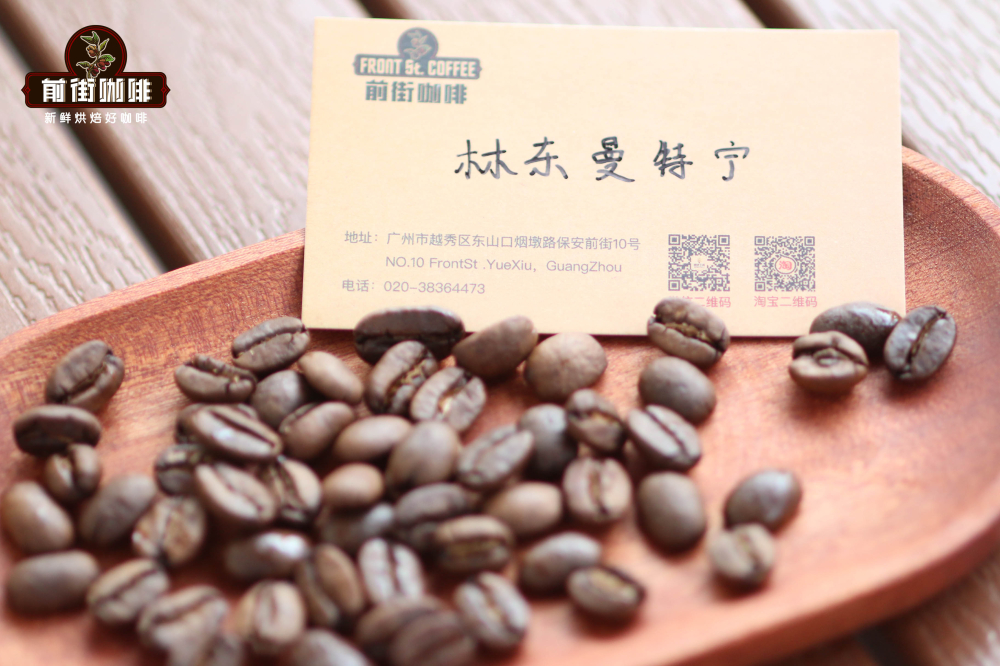
Golden Mandheling sold externally by PWN has strict screening standards. The company only selects beans of screen size 18 and above, and among a 300-gram green bean sample no more than 3 defective beans are allowed. It belongs to the highest grade, G1, with a darker green color and a neat, flat bean shape. After processing, the green beans undergo density and color sorting, followed by hand sorting, for a total of four rounds of meticulous selection. Front Street Coffee's PWN Golden Mandheling coffee beans therefore have a uniform color and consistent bean shape. It is said that during green bean processing, Mandheling green beans under sunlight give off a golden sheen, which is how Golden Mandheling got its name.
As Golden Mandheling's fame continued to rise, many beans appeared on the market that were not produced by PWN but still carried the Golden Mandheling name. Strictly speaking, these can only be called specialty Mandheling. The Front Street PWN Golden Mandheling sold by Front Street Coffee is certified by a certificate issued by PWN. The certification certificate issued by PWN, as well as the jute sacks of Golden Mandheling green coffee beans bearing the PWN logo, can all be seen at Front Street Coffee stores.
In order to bring out the mellow flavor of Front Street PWN Golden Mandheling coffee beans, Front Street Coffee roasts the beans to a medium-dark level, which ensures the coffee's body while also preserving a clean sense of layering. You can purchase authentic Front Street PWN Golden Mandheling coffee beans at Front Street Coffee's Taobao store. All orders are shipped within 5 days of the roast date, ensuring that all coffee beans are freshly roasted.
Since Front Street PWN Golden Mandheling is a medium-dark roasted coffee, a large amount of carbon dioxide accumulates inside the beans, and brewing directly may affect extraction evenness. Therefore, after receiving the coffee beans, it is best to keep them sealed in the original packaging and let them rest until 5 to 6 days after the roast date, allowing the beans to release some carbon dioxide on their own. This not only stabilizes extraction evenness but also drives off the roasty harshness produced during roasting, making the coffee's flavor expression more rounded.
For brewing medium-dark roasted coffee beans, Front Street Coffee recommends using a KONO dripper. The brewing parameters are: 88°C water temperature, 1:15 coffee-to-water ratio, 15 grams of coffee grounds ground to coarse sugar size (70% passing through a Chinese No. 20 standard sieve). The specific method: first pour 30 grams of water and bloom for 30 seconds; for the second stage, pour in a small stream in a circular motion up to 125 grams, and after the water level in the coffee bed drops by half, continue pouring in a small stream in a circular motion up to 225 grams. Wait until dripping is complete; total extraction time is about 2 minutes 10 seconds.
Flavor profile of Front Street PWN Golden Mandheling coffee beans: the overall layering is complex, mellow and clean. Rich nutty and caramel aromas with chocolate notes, a long finish, and high balance.
For professional coffee knowledge exchange and more coffee bean information, please follow Coffee Workshop (WeChat public account: cafe_style)
For more specialty coffee beans, please add the private WeChat of Front Street Coffee (FrontStreet Coffee), WeChat ID: kaixinguoguo0925
The above content is compiled by CoffeeHunters, a coffee news website.


