







How Is an Espresso Martini Made as a Liqueur Coffee?
Coffee and alcohol can be combined, and the Espresso Martini is the classic example. Bartender Dick Bradsell created it in 1980s London at the Soho Brasserie, mixing espresso with vodka, coffee liqueur and syrup. Espresso makes up roughly one third of the drink, so the quality of the shot directly shapes the balance and body of the finished cocktail.
Because the coffee carries so much of the flavor, the shot needs a concentrated, sweet-leaning profile that still cuts through the liqueur. Recipes differ, but the usual build is roughly equal parts vodka and espresso with smaller amounts of liqueur and syrup, shaken hard with ice so a foam cap forms. Serve it immediately, before the crema and the chill fade.
Can coffee and alcohol be paired? The answer is yes, and the most iconic example is the Espresso Martini. This cocktail was born in 1980s London, created by bartender Dick Bradsell, blending espresso with vodka, coffee liqueur, and syrup to deliver both a pick-me-up and a gentle buzz. Since espresso makes up as much as one-third of the drink, its quality directly determines the balance and flavor of the final product. This article will introduce the origins of the Espresso Martini, the challenges of making it, and share a recipe and extraction plan developed through a collaboration between Front Street Coffee and the neighboring bar, giving you an inside look at this classic specialty drink that is both simple and refined.
Front Street has recently received quite a few questions: Can coffee and alcohol really be mixed? I heard there's a specialty drink that combines the two perfectly—can I recreate it at home? Today Front Street is here to talk about this special beverage—cocktails!!
However, it should be noted that the cocktail we're talking about here is not an ordinary one, because it includes espresso. And espresso accounts for a fairly large proportion of this drink, so the quality of the espresso will directly determine the performance of the entire cocktail. For this very reason, this drink is both easy and difficult to make—easy because the ingredients are readily available, difficult because it really tests a bartender's cross-disciplinary mastery.
So next, let's get just a little tipsy in the winter! Meet the world's most invigorating cocktail—the "Espresso Martini."
Espresso Martini
The Espresso Martini, also called the espresso martini, is a new-generation cocktail derived from the Martini. It originated in the 1980s at a bar in London, England called Soho Brasserie (which is still in operation today), and was created by the famous bartender Dick Bradsell.
According to his daughter Bea, the opportunity for Dick to invent the Espresso Martini came one night in the 1980s when a supermodel walked into the bar and ordered a cocktail from him as the bartender. But her request was very particular: she wanted to stay awake while also getting intoxicated (her exact words were: wake me up, then fxxk me up.). To put it simply, it was something like "a colorful black."
It just so happened that the bar had recently installed an espresso machine, and it also happened that the espresso machine was right next to the bar counter. So Dick had a flash of inspiration, combined espresso with vodka, then added coffee liqueur and syrup to balance the flavor, and a cocktail that could both keep you awake and give you a gentle buzz was born!
After that, the Espresso Martini became famous. Every year, countless tourists make special trips to visit this bar just to taste this cocktail with its peculiar character. Interestingly, although the Espresso Martini was born in London, because many bars in Australia evolved from coffee shops, it instead became the most popular cocktail there.
The ingredients for this cocktail seem simple, but in reality they pose a considerable challenge for bartenders. Because espresso accounts for a full one-third of the glass, the quality of the espresso will largely determine the taste of the entire cocktail.
Therefore, a bartender must not only understand mixology, but also know how to make a high-quality espresso. However, most bars are not equipped with espresso machines, and even if they are, bartenders rarely receive proper training and cannot extract a delicious espresso. So although this drink has simple ingredients, for most bartenders it is not easy to make.
And after a bartender extracts a high-quality espresso, they then need to adjust the ingredients based on the taste of the espresso. Suppose we use dark-roasted coffee beans, and the espresso is full of roasty aroma and chocolate-like bitterness; then the bartender has to reduce the bitterness by adding sugar, because a qualified Espresso Martini needs to achieve the highest balance among vodka, espresso, and sweet coffee liqueur. It's clear that this is by no means a simple matter.
How do you make an Espresso Martini?
Although mixology is not Front Street's specialty, there's a bar right next door!!! So Front Street only needs to extract the espresso and bring it to the neighboring bar, and that solves the professional shortcomings on both sides.
Originally, the espresso Mr. Dick used was a 25ml Ristretto, so this time Front Street also chose a short-extraction Ristretto. Regarding the key points of Ristretto extraction, Front Street also mentioned them in yesterday's article, so interested friends can look back at it. The extraction plan is 20g of grounds, extracting 30ml of coffee liquid in 28s.
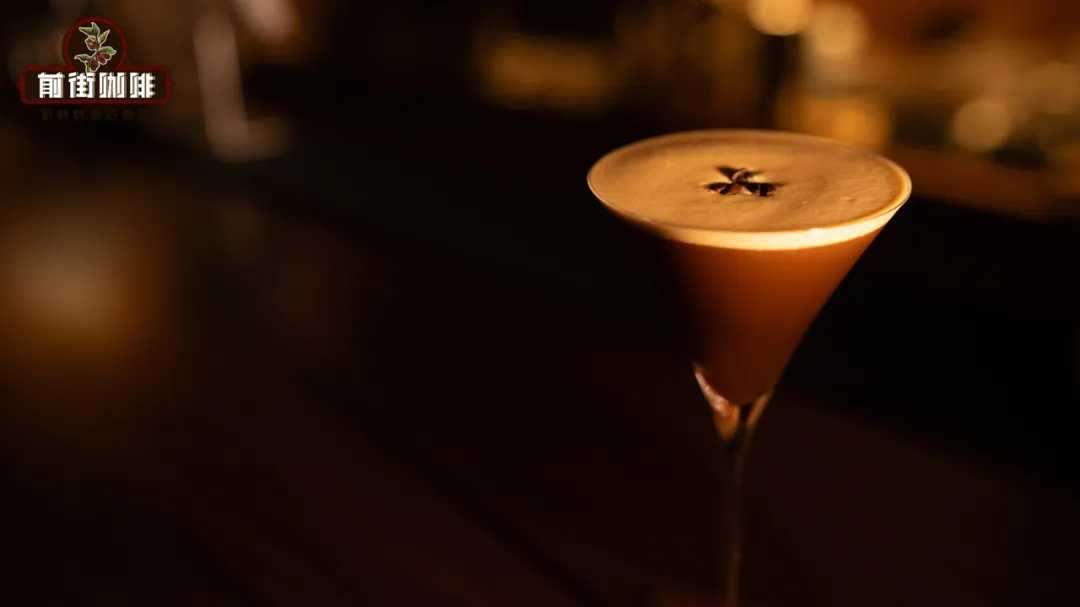
Because Front Street's espresso blend is the medium-dark roasted Warm Sun blend, and it is also a short-extraction espresso, the bitterness is low and the sweetness is extremely high. The bartender made some adjustments to the sugar usage, and the ingredients are as follows: 50ml vodka, 30ml coffee liqueur, 5ml syrup, and 25ml espresso. The procedure is: first pour in all the ingredients, then stir evenly, and then pour into a shaker filled with ice cubes and shake. Once these ingredients form a rich foam in the shaker, you can pour it into a cocktail glass!
Finally, garnish the dense foam with three coffee beans, use a torch to roast out the aroma, and it's ready to enjoy.
Take a sip, and the first thing you feel is the dense texture brought by the foam, followed immediately by the flavor expression of the cocktail. As Front Street said earlier, the taste of the entire cocktail is a state in which the three reach balance, none masking the others, none standing out abruptly, very harmonious. Thanks to the whiskey aroma and berry flavors naturally present in the Warm Sun blend, the entire cocktail's expression becomes richer and more varied, and the mouthfeel is not as heavy as imagined—very smooth. Overall, very good!! Delicious, and also recommended to give it a try!
The above content is compiled by CoffeeHunters, a coffee news website.


