








How Does the French Press Brew Coffee?
A French press uses full-immersion extraction with a metal filter, so coffee oils stay in the cup and the body is thick and full. Choose coarse ground beans, keep the water temperature and steeping time steady, then press the plunger slowly to separate the grounds. Medium and medium-dark roasts generally suit this method better than light roasts.
Because grounds stay in contact with hot water longer, light-roasted beans can pull out sharp acidity that flattens their floral and fruity notes. Sweeteners are a separate choice; what sugar goes in coffee is a matter of taste, and a coarse grind with a longer steep will already round off much of the bite before anything is added.
The French press, with its simple operation and rich mouthfeel, has become the daily go-to for many coffee enthusiasts. It uses full-immersion extraction, and the metal filter allows coffee oils to be retained, delivering a full, substantial taste experience. However, to brew a good pot of French press coffee, every step—from bean selection to grind size, water temperature control, and steeping time—has its own considerations. This article will systematically sort out the types of coffee beans suitable for the French press, explain in detail the specific standards for coarse grinding and the coffee-to-water ratio, and provide a complete brewing process, along with reference on how to use a Starbucks French press, helping you easily recreate a cup of outstanding immersion-style coffee at home.
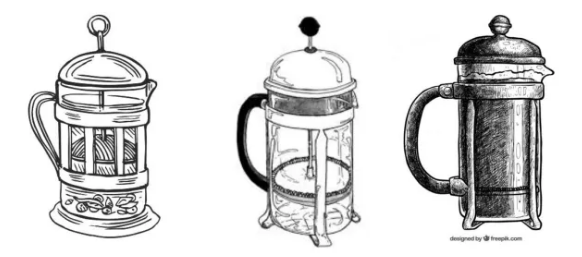
If you are looking for a coffee brewing tool that is easy to learn and does not require too many professional skills, the French press is definitely worth prioritizing. Its logic of use is quite similar to brewing tea: add grounds, pour water, stir, and finally press down the plunger to complete the separation and obtain a clean cup of coffee.
The French press is a typical full-immersion extraction device, equipped with a metal filter inside. Because hot water and coffee grounds come into direct and full contact throughout the process, the finished coffee has a relatively higher oil content, and the texture on the palate is thicker and fuller. But if you are sensitive to fine sediment or a gritty mouthfeel in coffee, the French press may not be the ideal choice.
In practice, the French press leaves several adjustable variables, including water temperature, grind size, and steeping time, which you can gradually fine-tune according to your personal taste preferences. The key is to master the correct brewing method so that you can fully release the aroma and flavor potential of every coffee bean.
What are the specific steps for brewing coffee with a French press?
Before officially pouring water, you need to clarify a few key variables and also choose the right coffee beans to match the French press.
The French press mainly extracts by immersion, and the coffee grounds stay in contact with hot water for a longer time. If light-roasted beans are used, it is easy to extract relatively high acidity, which instead suppresses the original floral and fruity aromas and light layers. Therefore, compared with light roasts, medium-dark roasted single-origin coffees can better leverage the advantages of the French press, and sweetness and caramel-like flavors will be expressed more fully.
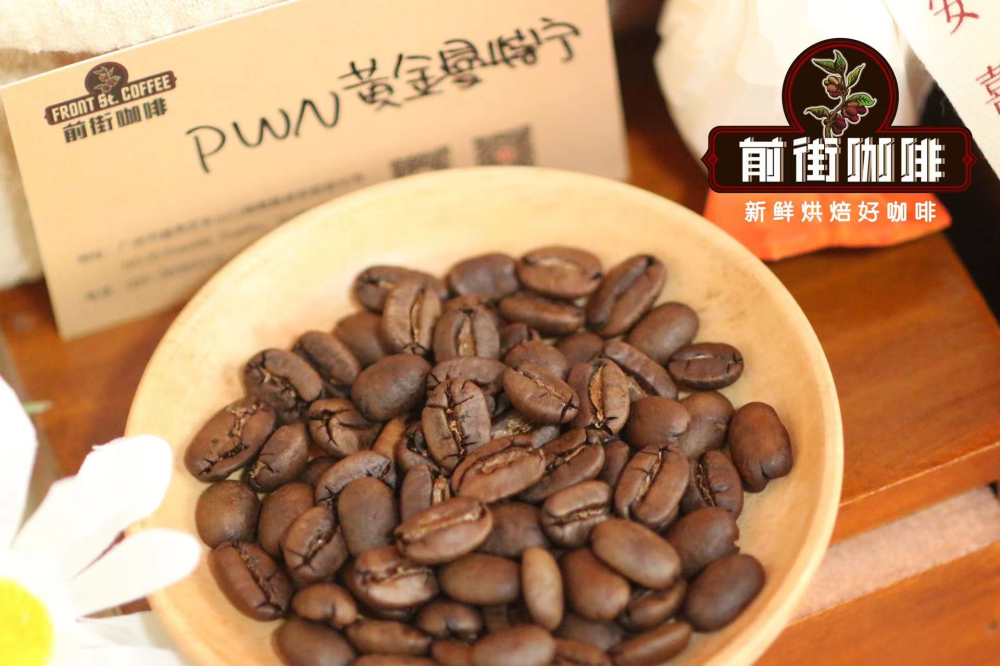
For beginners just getting into the French press, Front Street Coffee PWN Golden Mandheling is a choice worth trying first. As one of the representatives of Asian specialty coffee, Front Street Coffee PWN Golden Mandheling SOE undergoes three rounds of manual hand sorting plus one round of machine screening during the green bean processing stage, resulting in uniform beans and a bright appearance. After medium-dark roasting, Front Street Coffee PWN Golden Mandheling beans are plump and large, giving off intense aromas of spices, caramel, cedar, and dark chocolate. Extracted with a French press, the mouthfeel is mellow and the oil performance is good, making it especially suitable for people who do not prefer acidic coffee.
If you prefer a more fragrant-style coffee, you can try Front Street Coffee Strawberry Candy. This bean is designed specifically for consumers who love floral and fruity profiles. It is a Geisha blend, combining Costa Rican honey-processed coffee with Panamanian washed Geisha. In the cup you can perceive the aromas of roses, citrus, and raisins, and after adding milk it also presents a sweetness like strawberry gummy candy.
1. Grind size
No matter which grind setting you ultimately choose, you should be equipped with a high-quality flat burr or conical burr grinder; blade grinders are not recommended. In addition, the French press brewing method itself carries a relatively high risk of over-extraction. So how exactly should the correct grind size be judged?
A coarser grind setting is recommended, with particles resembling small gravel rather than fine sand. Grinding too fine will cause water to pass through the coffee bed too quickly. For other immersion devices, this may not be a big problem, but if the French press is paired with too fine a grind, fine particles can easily pass through the filter into the coffee liquid, and in the end a large amount of sediment and grit will appear in the cup.
If you look up common French press tutorials, they will basically all recommend coarse grinding. Front Street Coffee's suggestion is to refer to the Chinese No. 20 standard sieve and choose a grind with a 70% pass-through rate, roughly equivalent to the particle size of coarse granulated sugar. Coarse grinding not only increases the margin for error in the extraction process, but also effectively reduces the ultra-fine particles produced during grinding. The pore size of a French press metal filter is usually between 80 and 300 microns, and the pores visible to the naked eye make it very easy for fine particles to pass through; once mixed into the coffee liquid, the whole cup becomes cloudy. Of course, if you pursue richer layers, you can also try a finer grind, but be sure to shorten the steeping time accordingly to avoid over-extraction.
2. Coffee dose and coffee-to-water ratio
The coffee-to-water ratio is an intuitive conversion relationship, that is, how much water corresponds to a certain amount of coffee grounds. A commonly used starting ratio is 1:15, for example 15 grams of coffee grounds with 225 grams of water. You can start from this baseline and, in subsequent brews, increase or decrease the amount of grounds or water according to taste until you find the most satisfactory balance point. Coffee extracted at this ratio has a concentration of roughly 1.1% to 1.2%. If, like Front Street Coffee, you prefer a bold style, you might as well directly use a 1:15 coffee-to-water ratio, and the resulting coffee will taste thicker and fuller.
3. Water temperature
Water temperature is another variable that can be flexibly adjusted to change the flavor direction. If you do not have a thermometer on hand, you can boil water and let it sit for about 45 seconds (adjust flexibly depending on air temperature); at this point the water temperature is roughly around 90°C. If you want more precise control over the finished flavor, it is recommended to get a temperature-controlled pour-over kettle, or use it together with a thermometer.
Because the French press uses a one-time pour and there is no additional stirring action during steeping to increase the extraction rate, it is sometimes necessary to raise the water temperature slightly to compensate. Just 1 to 2°C higher than the usual pour-over temperature is enough. For medium-light roasted coffee beans, a water temperature of 92 to 94°C is recommended; for medium-dark roasted coffee beans, it is recommended to keep it at 89 to 90°C.
4. Brewing time
Without manual stirring, to fully release the flavor substances in the coffee, you need to improve extraction efficiency in other steps, and steeping time is the key among them. Generally speaking, the brewing time is controlled between 3 and 5 minutes. If the beans are darker roasted, 5 minutes may be too long and can easily bring bitterness and astringency; if they are light-roasted beans, 3 minutes may be too short and the flavor will not be fully released. Front Street Coffee's suggestion is, when trying it for the first time, start with a 4-minute steeping time.
5. Brewing process
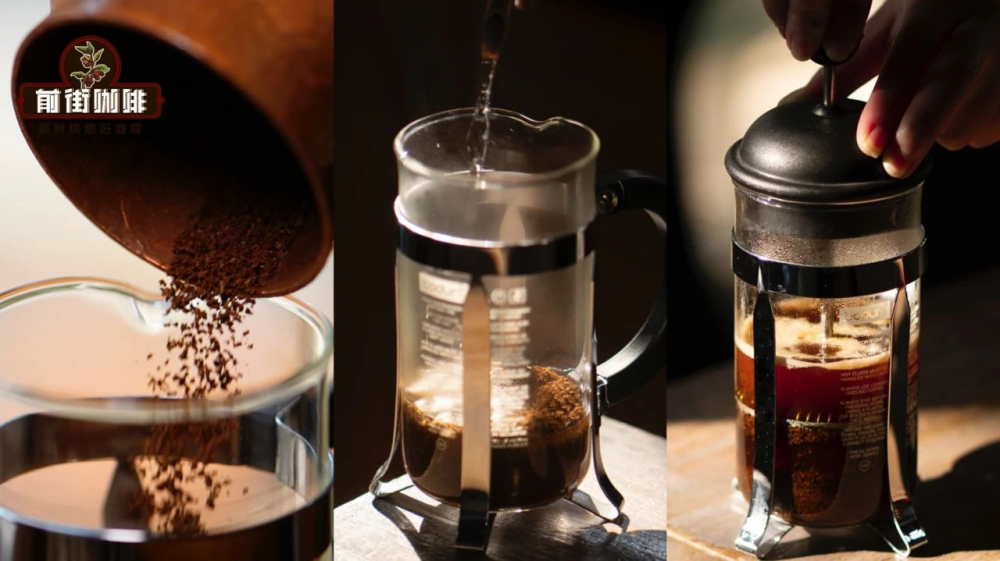
Pour the ground coffee into a preheated French press, then slowly pour in hot water, making sure all the coffee grounds are saturated by the water. In the first step, use about twice the weight of the grounds in hot water for pre-infusion and blooming, for example 15 grams of coffee grounds with 30 grams of water.
At 30 seconds, stir gently a few times, then pour in the remaining hot water, place the plunger on top but do not press down yet. When the coffee grounds have steeped to 4 minutes, slowly push the plunger all the way to the bottom, then carefully pour out the coffee liquid, being careful to avoid disturbing the coffee grounds at the bottom of the pot.
If you feel obvious resistance when pressing down the plunger, it means the coffee was ground too fine; if the coffee grounds have already sunk and there is almost no resistance when pressing down, it means the grind is too coarse.
The above content is compiled by CoffeeHunters, a coffee news website.


