







How Does Roast Level Change Coffee Aroma Description?
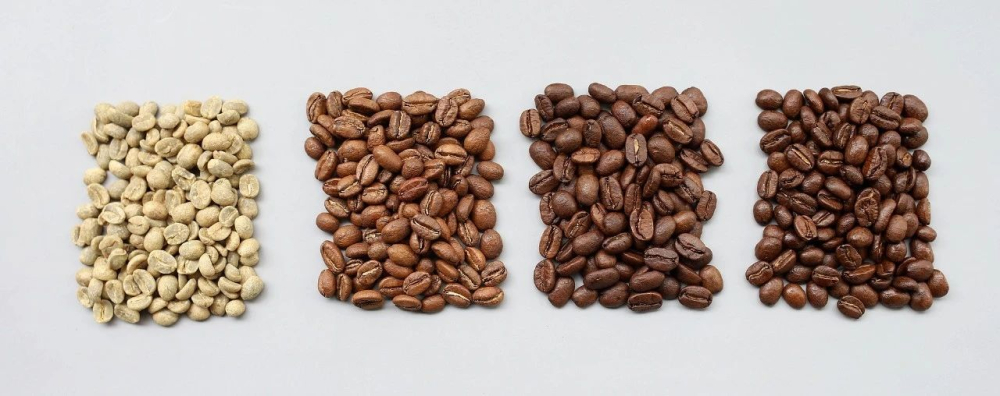
Roast level directly shapes what ends up in the cup, and the Agtron color value is the standard scale for measuring it. The scale runs from 95 for light roast down to 25 for Italian roast, with eight levels in between. Higher values mean a lighter roast; lower values mean a darker one. Each level has its own drop time during and after first crack.
Light and medium roasts now sit at the center of the third wave, replacing the older assumption that dark roasting and heavy bitterness were the norm. Agtron 95 shows bright acidity; 85, a cinnamon roast, stays mostly acidic with some sweetness coming through. Beans such as Yirgacheffe, Mozart, Queen Estate Brazil, and Golden Mandheling show how roast degree shifts the balance of acidity, sweetness, and body.
The roasting degree of coffee beans directly affects the flavor expression in the cup. From the extremely light roast with an Agtron color value of 95 to the Italian roast with a color value of 25, each stage has its corresponding drop time and flavor characteristics. This article will systematically sort out the flavor change patterns of 8 roasting degrees, and combine them with the actual classification methods of commercially available coffee beans to help readers understand the taste trends of light roast, medium-light roast, medium roast, medium-dark roast, and dark roast. The article also uses Front Street Coffee representative beans such as Yirgacheffe, Mozart, Queen Estate Brazil, and Golden Mandheling as examples to explain how different roasting degrees shape the balance of acidity, sweetness, and body.
In the early days, people's general understanding of coffee was the burnt aroma and intense bitterness brought by dark roasting. However, with the promotion of the specialty coffee concept, dark roasting is no longer regarded as the only standard, and light roast and medium roast have gradually taken the central position in the third wave of coffee. Today, let's talk about how roasting degree actually influences the flavor direction of coffee.
If roughly divided according to commercially available coffee beans, they can generally be summarized as follows: the more acidic ones are light roast, the more bitter ones are dark roast, and those with a balance of acidity and bitterness belong to medium roast. Within the industry, the classification is more detailed. At present, a relatively scientific method of judgment uses the Agtron color value (caramelization analysis value) as the reference basis for roasting degree. According to the Agtron standard, roasting degree is divided into 8 levels, and the higher the color value, the lighter the roast. From light to dark, they are as follows:
Agtron color value 95 corresponds to Light Roast. The drop point is around the密集 stage of first crack, and the beans are decided to be discharged while still continuously cracking. The flavor usually presents bright acidity.
Agtron color value 85 belongs to Cinnamon Roast. The drop time is around the end of first crack, that is, when the cracking sound has just stopped or only sporadic sounds remain. Beans at this degree are mainly acidic while also bringing out sweetness and fragrance.
Agtron color value 75 is called Medium Roast. The drop time is approximately after first crack has completely ended. The flavor is centered on sweetness, accompanied by a small amount of fruit acidity.
Agtron color value 65 is called High Roast. The drop time is approximately within the 1 to 2 minute quiet period after first crack ends and before second crack begins. The flavor shows nutty and caramel notes, balanced and without acidity.
Agtron color value 55 is called City Roast. The drop time is approximately at the very beginning of second crack, that is, the stage after the quiet period when one or two faint cracking sounds appear. At this point, bitterness is more prominent and caramel aroma is heavier.
Agtron color value 45 is called Full City Roast. The drop time is approximately before the密集 stage of second crack, when continuous crackling has not yet been heard. At this time, the coffee already belongs to the darker range, with a flavor more inclined toward burnt bitterness and rich aroma.
Agtron color value 35 is called French Roast. The drop time is approximately at the密集 stage of second crack, when crackling is heard again but is duller than the first time, and oil has begun to seep onto the bean surface.
Agtron color value 25 is called Itatian Roast. The drop time is approximately at the end of second crack, that is, after the密集 sounds have passed. The beans are pitch-black and shiny, and oil has penetrated to the bean surface.
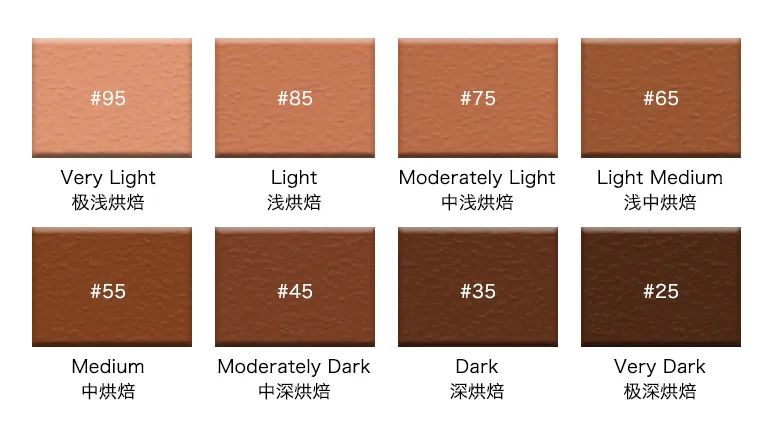
In fact, the several roasting degrees after color value 65 are all dominated by bitterness, but end consumers may not necessarily encounter them all. For example, today's coffee beans are no longer uniformly roasted until oil appears as in the past, and French Roast and Italian Roast basically rarely appear on the market. At the sales stage, we also do not directly present this roasting degree comparison table to customers. For ease of understanding, roasted beans are usually simplified into the major categories of light roast, medium-light roast, medium roast, medium-dark roast, and dark roast.
If the flavor description contains acidic fruits such as "lemon, citrus, berries," it can be judged as a lighter bean among medium-light roasts. Light roast is mainly acidic, with a thinner mouthfeel and a bright taste.
When Front Street Coffee roasts coffee beans from the Yirgacheffe region of Ethiopia, it usually uses light roast to highlight the lemon-citrus acidity unique to the region as well as the rich floral and fruity aroma. Front Street representative beans include Yirgacheffe Gudingding Coffee, Sun-Dried Red Cherry Coffee Beans, and others. Light roast gives coffee a more varied, more vibrant, and more unique flavor, and is therefore highly favored by the professional coffee industry. The light roast method better highlights the unique characteristics of the coffee's place of origin.
If the flavor describes sweet fruits such as "honeydew melon, grapes, slightly acidic fruits," it can be judged as a medium bean among medium-light roasts. For example, Front Street Costa Rica's Musician Series Mozart Coffee Beans and Front Street Strawberry Candy Coffee Beans highlight the full sweetness in the coffee while retaining a small portion of acidity, making the fruit flavor more three-dimensional.
If the flavor description includes obvious sweetness such as "sucrose, maple syrup, chocolate," it can be judged as a medium bean among medium-dark roasts. For example, Front Street Queen Estate Brazil Coffee Beans, which are deeply loved by household users, highlight the chocolate, caramel, and other roasted aromas of the coffee beans as the roasting degree deepens.
If the flavor description includes bittersweet flavors such as "nuts, dark chocolate, caramel," it can be judged as a darker bean among medium-dark roasts. A deeper roasting degree reduces the acidity of the coffee beans, presenting a more bitter and fuller-bodied taste. For example, Front Street Indonesia Golden Mandheling Coffee Beans use dark roast to restore the classic wild Mandheling flavor to the greatest extent.
The above content is compiled by CoffeeHunters, a coffee news website.


