







How do panama geisha and Blue Mountain coffee differ?
Panama geisha and Jamaican Blue Mountain both sit at the top of the price range, but they differ in origin, grading and cup profile. Geisha is grown in Panama, notably around Boquete, and is known for floral and fruity notes with bright acidity, while Blue Mountain No. 1 comes from Jamaica and drinks fuller, softer and lower in acidity.
Blue Mountain carries a strict grading system, so packaging labeled Blue Mountain Flavor or Blue Mountain Blend may contain beans from other origins darkened by roasting rather than genuine Jamaican coffee. Geisha coffee has no equivalent protected grading, so buyers judge it by estate, lot and cupping score instead of the label alone.
In the world of specialty coffee, Geisha and Blue Mountain are often compared. Younger coffee enthusiasts tend to swear by Panama Geisha, while veteran coffee drinkers have a particular fondness for Jamaican Blue Mountain. Both are crowned with the title of "top-tier coffee," and both command high prices, but what exactly sets them apart? If you want to enjoy an authentic cup of Blue Mountain or Geisha coffee, how much will it cost you? This article takes a deep dive into the origins, grading systems, and flavor profiles of these two legendary coffee beans, and brings you Front Street Coffee's Blue Mountain No. 1 recommendation, along with tips on how to properly savor an authentic cup of Blue Mountain.
If you asked young coffee enthusiasts which coffees are top-tier, they would most likely put Panama Geisha at the top of the list. But in the minds of the older generation of coffee lovers, Blue Mountain coffee is the irreplaceable classic. So what exactly are the differences between these two coffees? Since both belong to the top tier, their prices are inevitably high — so how much does it actually cost to enjoy a cup of Blue Mountain or Geisha?
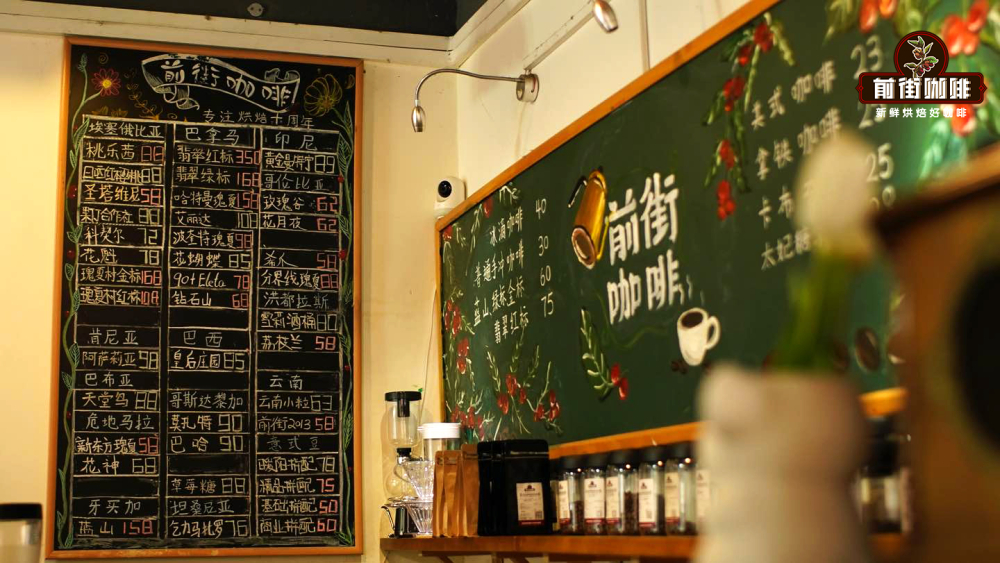
Unlike the past, today you can walk into any café and find menus filled with floral and fruity notes, bright acidity, and clean, transparent choices — and the crown jewel on the bean list is often Panama Geisha. Those who have visited a FrontStreet Coffee shop will notice that on Front Street's blackboard listing nearly fifty coffee beans, beans from various origins with different flavor profiles each occupy their own place. As top-tier representatives, Blue Mountain coffee beans and Geisha coffee beans are certainly no exception.
Many friends who are used to shopping online will wonder after seeing the price of Front Street Blue Mountain coffee at a Front Street shop: Blue Mountain coffee beans sold by different vendors vary widely in price — how can you tell which ones are genuine and which are imitations?
Blue Mountain No. 1 coffee beans As a member of the top-tier coffee beans, Blue Mountain No. 1 also displays a top-tier price. Some merchants, in pursuit of higher profits, play word games on their packaging, boldly printing labels like "Blue Mountain Flavor" or "Blue Mountain Blend."
Because Blue Mountain coffee has a rich, full-bodied taste, some merchants use coffee beans from other origins and, through darker roasting, try to bring the flavor and mouthfeel as close as possible to real Blue Mountain coffee. This means the product may not contain a single bean from Jamaica's Blue Mountains.
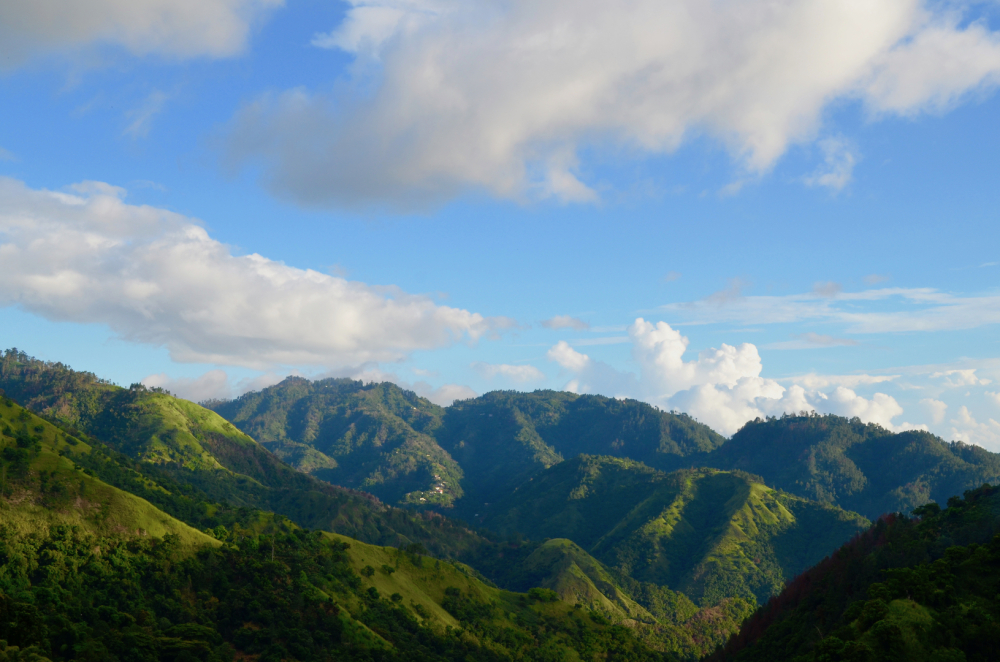
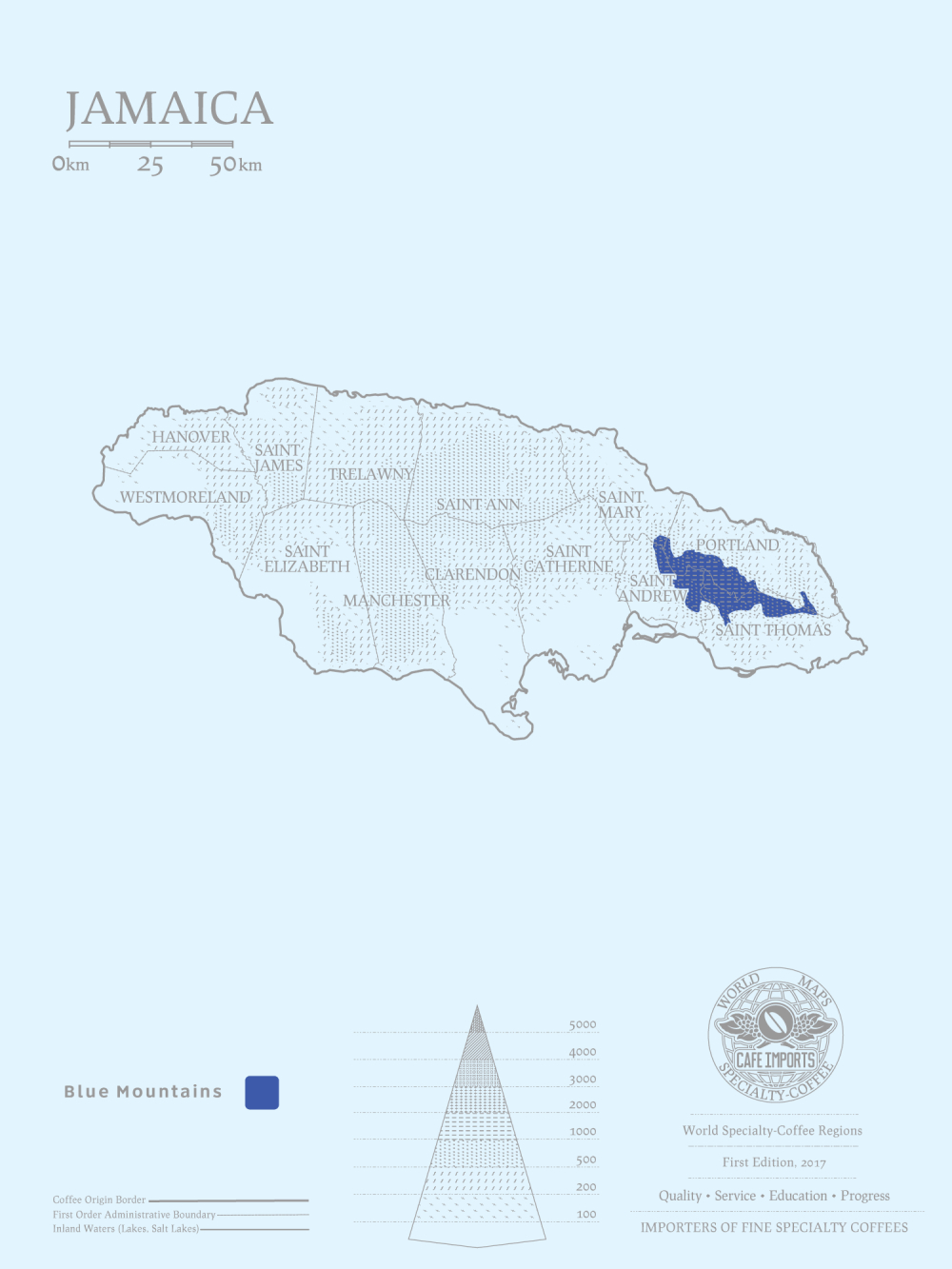
The reason Blue Mountain coffee beans bear the name "Blue Mountain" is that they are grown around the Blue Mountain range in Jamaica. The Blue Mountains are located in eastern Jamaica, surrounded by the Caribbean Sea. On clear, sunny days, sunlight strikes the azure sea, and the peaks refract the brilliant blue glow of the ocean — hence the name. The highest peak of the Blue Mountains exceeds 2,100 meters. The local climate is cool, shrouded in mist, with abundant rainfall. This fertile land, harmonized with plentiful rain, gives birth to the world-renowned Blue Mountain coffee.
Many coffee beans with delicate flavors are typically grown at elevations above 1,500 meters. Interestingly, although the Blue Mountains rise over 2,000 meters, not the entire area is suitable for growing coffee. On one hand, to protect the environment, the Jamaican government has closed off areas above 1,700 meters, prohibiting coffee cultivation. On the other hand, as altitude increases, temperatures gradually drop, and beyond a certain height, frost may occur during colder periods. Frost can "burn" coffee trees or even kill them.
Therefore, Blue Mountain coffee is generally grown at elevations not exceeding 1,700 meters. But not all coffee beans grown within the Blue Mountain region can be called Blue Mountain coffee beans. Jamaica roughly classifies its domestically grown coffee into three grades: Jamaica Blue Mountain Coffee, Jamaica High Mountain Coffee, and Jamaica Prime Coffee.
Among these, Jamaica Blue Mountain coffee beans must be grown at elevations above 1,000 meters and must be located within Jamaica's Blue Mountain region. The Blue Mountain coffee production area spans four Jamaican administrative districts: Saint Thomas, Saint Andrew, Saint Mary, and Portland.
In addition to specific requirements for growing region and elevation, Jamaican authorities have established a more detailed grading system for Jamaica Blue Mountain coffee. Under the premise that the defect rate of green beans is below 3%, based on the bean size of Blue Mountain green coffee beans, they are classified into: Jamaica Blue Mountain No. 1 Coffee, Jamaica Blue Mountain No. 2 Coffee, Jamaica Blue Mountain No. 3 Coffee, and Jamaica Blue Mountain Peaberry Coffee.
To qualify as Jamaica Blue Mountain No. 1 coffee beans, the green bean size must reach approximately 17/18 screen. Under such rigorous层层 screening by the Jamaica Coffee Board, genuine Jamaica Blue Mountain No. 1 coffee beans are of outstanding quality, and their production is quite limited. This is one of the reasons why the price of Blue Mountain No. 1 coffee beans remains high.
However, as a representative of traditional top-tier coffee, Blue Mountain coffee's flavor is a childhood memory for many coffee lovers. While pursuing more exquisite flavors, FrontStreet Coffee has also always been searching for the traditional taste of coffee.
Front Street Blue Mountain No. 1 coffee beans come from Clifton Farm, which is situated near Catherine's Peak, where the forest is dense and species-rich. Clifton Farm emphasizes environmental protection in coffee cultivation, avoiding pesticides, chemical fertilizers, and other substances harmful to the environment, and is committed to maintaining the local ecological balance.
At FrontStreet Coffee shops, there are wooden barrels used to hold Blue Mountain No. 1 green coffee beans. The barrels bear a striking green frog logo — the Rainforest Alliance certification mark — representing that the plantation's growing environment is excellent and very friendly to surrounding flora and fauna.
In addition, when genuine Blue Mountain coffee beans are exported, besides the wooden barrels of Blue Mountain green beans, they also come with a certificate of origin for Jamaican Blue Mountain coffee beans issued by the coffee estate. Both of these credentials can be found at FrontStreet Coffee shops. If you want to confirm whether the Blue Mountain coffee beans a merchant sells are authentic, you can ask the merchant to produce the relevant certificates.
Compared to dark-roasted coffee beans, people today prefer medium-light roasts. However, the classic Blue Mountain coffee flavor emphasizes a balance of acidity, sweetness, and bitterness with a rich, full body. When roasting this bean, Front Street uses a medium-dark roast to recreate the classic Blue Mountain flavor. For first-timers, Front Street recommends enjoying it as a hot pour-over — a cup for 60 yuan can take us back to that elegant coffee era.
So what makes Geisha coffee so expensive?
After Blue Mountain, Geisha became the new byword for "luxury" in the coffee world. At the annual BOP auction, Geisha's winning bids repeatedly hit new highs. Even outside auction channels, in regular sales, Geisha sells for 6 to 10 times more than ordinary varieties. I'm sure many friends are curious: what makes Geisha so expensive? Is it just because it tastes good that it commands such a high price? Of course not! Geisha's preciousness lies not only in its flavor expression but is also closely tied to its varietal characteristics. From Geisha's rise to fame, it's clear that it was precisely these characteristics that kept Geisha in obscurity for over seventy years.
Why can Geisha be so expensive? Although Geisha shot to fame at the 2004 Panama BOP competition, its discovery can be traced back to 1931. Front Street has shared this many times, but here's a brief recap: In 1931, a British botanist ventured deep into Ethiopia's Kafa forest, seeking to collect varieties with high disease resistance to combat the leaf rust that had ravaged crops for years. Geisha was one of several varieties he collected after searching to Geisha Mountain (located southwest of the Kafa forest).
These collected varieties were sent to a laboratory in Kenya for cultivation and selection, and in 1936 were sent to Uganda and Tanzania respectively. In 1953, Costa Rica's Tropical Agricultural Research and Higher Education Center introduced the Geisha experimental variety grown in Tanzania into the country and assigned it the number "T2722" for archival management. In the 1960s, Mr. Don Pachi of Panama's Don Pachi estate, to resist leaf rust, introduced this variety from Costa Rica and subsequently distributed it to surrounding estates. It wasn't until 2004 that Geisha, through the discovery efforts of Hacienda La Esmeralda, truly shone on the world stage.
The above content is compiled by CoffeeHunters, a coffee news website.


